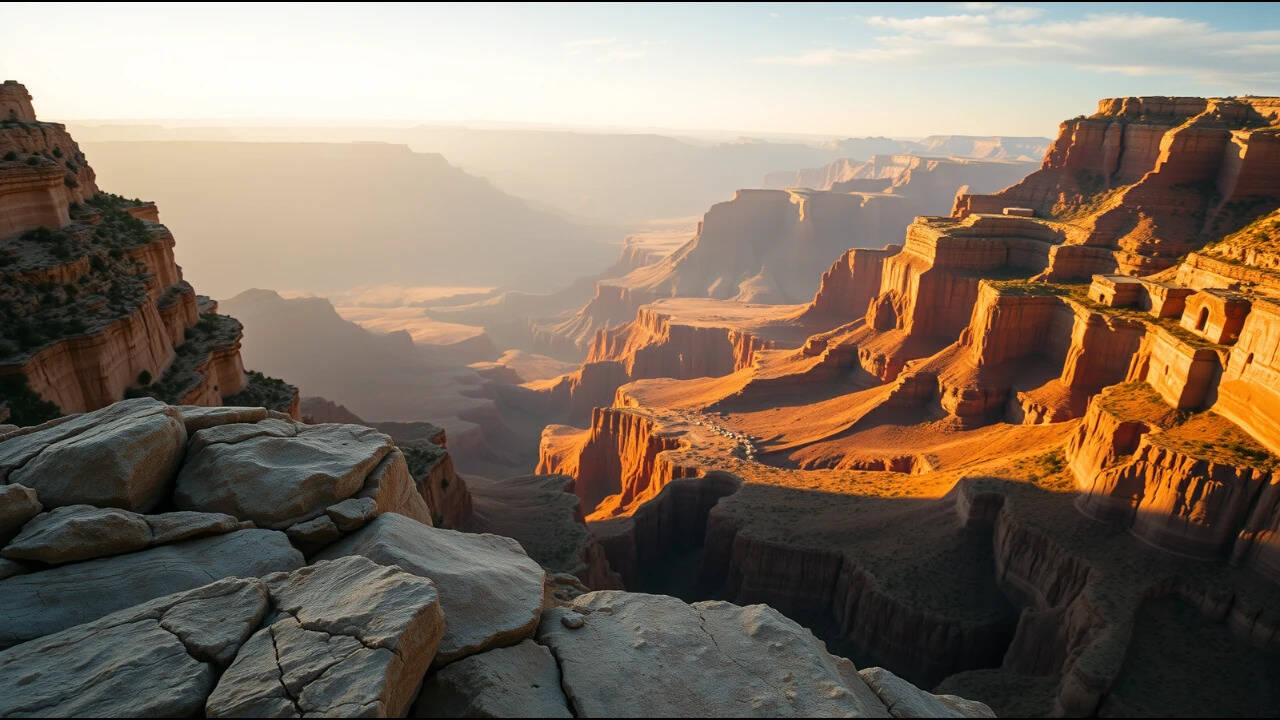
Geology has a dirty little secret. Hundreds of millions, sometimes over a billion years of rock history, just vanished. You won't find it in most places on Earth. It is a massive blank page in the middle of our planet's biography.
Geologists call this frustrating gap the Great Unconformity. For over a century, scientists have argued about what erased this colossal chunk of time. They’ve pointed fingers at ancient ice ages, runaway tectonic shifts, and ancient supercontinents breaking apart. But a newer explanation is gaining serious ground. It turns out a vanished giant cliff system might hold the key to the entire mystery.
If you care about how our planet evolved into a habitable world, you need to understand this gap. It sits right below the explosion of complex animal life in the fossil record. Miss the story of the missing rock, and you miss the setup for pretty much everything alive today.
The Mystery of the Missing Billion Years
Imagine reading a thick history book. You turn from page 50 to page 1500. Everything in between is shredded out. That is what geologists face when looking at the Great Unconformity.
First noticed by geologist James Hutton in Scotland back in the late 1700s, this feature shows up all over the world. You see ancient, intensely deformed crystalline basement rock sitting directly beneath flat, younger sedimentary layers. The transition is abrupt. Millions of years of strata should be sandwiched in that boundary. Instead, there is nothing. Just a flat, scraped-down surface.
Geologists used to think this was a single, uniform event happening globally at the exact same time. Honestly, that was lazy thinking. The Earth is far too chaotic for a single global eraser.
Different regions lost different slices of time. In some places, a billion years are gone. In other places, it is only a few hundred million. Whatever stripped those rocks away worked slowly, relentlessly, and on a continental scale.
Snowball Earth and the Great Scrape
The most popular working theory for decades involved climate extremes. We know that Earth plunged into deep, planet-wide icehouse states a few times in its youth. These periods are known as Snowball Earth events.
During these frozen epochs, glaciers thousands of feet thick advanced across entire continents. Picture an ice sheet sliding relentlessly over a granite mountain range. It acts like a planetary belt sander. The weight and movement would grind down towering peaks and flush the pulverized sediment out into the oceans.
This idea makes intuitive sense. Glaciers are incredible at erasing landscape. But recent geological modeling shows ice alone might not have done the entire job. Ice sheets tend to leave deep gouges and uneven troughs. The actual Great Unconformity is often remarkably flat over thousands of square miles. Ice needs a partner in crime to plane down a continent that cleanly.
That partner is water. Specifically, the violent rise and fall of ancient sea levels driven by tectonic rifting.
The Vanished Giant Cliff Hypothesis
This brings us to the core of the new breakthrough. How do you strip away vertical miles of rock and spread the debris flat? You need a dynamic coastline.
Researchers studying ancient fault lines and thermal pulses in the Earth's crust have proposed a dramatic mechanism. As the ancient supercontinent Rodinia began to tear apart roughly 800 million to a billion years ago, the continental margins heated up and bowed upward.
This thermal uplift created towering escarpments. Imagine giant cliffs rising thousands of feet straight out of the sea along continental edges.
These weren't normal cliffs. They were massive fault-bounded scarps exposed to aggressive weathering. Torrential rains, chemical reactions, and gravity battered these highlands. Rivers carved deep canyons into them. The resulting sediment eroded rapidly into the ocean basins.
As the continents drifted and subsided, sea levels rose over these flattened remnants. Wave action swept across the coastal plains like a giant squeegee. It planed off the remaining irregularities, creating that iconic, smooth unconformity boundary we see today.
Basically, the Earth built a series of gigantic continental cliffs, weathered them down to dust, and drowned the wreckage under shallow seas.
Why This Missing Time Matters for Life
You might wonder why anyone cares about a bunch of missing dirt. It turns out this planetary scrubbing changed the chemistry of the oceans. That change allowed complex life to finally emerge.
Before the Great Unconformity, Earth was mostly stuck in a boring biological loop. Single-celled organisms ruled the waves for billions of years. Complex animals didn't show up until the Ediacaran and Cambrian periods. Why the sudden rush?
The erosion of those giant ancient cliffs dumped an unimaginable amount of minerals into the primordial ocean. We are talking about massive fluxes of calcium, potassium, phosphorus, and iron.
These elements acted like a massive fertilizer injection into nutrient-starved seas. At the same time, the weathering process drew down atmospheric greenhouse gases, cooling the planet and oxygenating the water chemistry.
Drop a ton of chemical nutrients into a newly oxygenated ocean, and biology responds. The sudden availability of calcium let organisms build shells and skeletons for the very first time. The great erasure cleared the slate, reset the planetary chemistry, and set the stage for predators, bones, and eventually us.
What We Still Don't Know
Science moves forward by admitting what it lacks. We still don't have a complete picture of the Great Unconformity because it isn't a single event. It is a composite scar.
Different sections of the unconformity formed at different times. The version you look at in the Grand Canyon tells a different local story than the one exposed in the Canadian Shield or the mountains of Scandinavia.
Researchers are currently pulling high-precision radiometric dates from zircon crystals trapped in the boundary layers. They are mapping out thermal histories rock by rock. Every new field season in remote places like Death Valley or the Australian Outback brings fresh geochemical data that tests the giant cliff model.
The next time you hike past a dramatic rock layer, look closely at the contact point. If there is a sharp line where millions of years are simply absent, remember what it took to wipe that slate clean. It took tectonic violence, ancient ice, and towering coastal scarps to reshape our world into a place where complex life could finally take root.