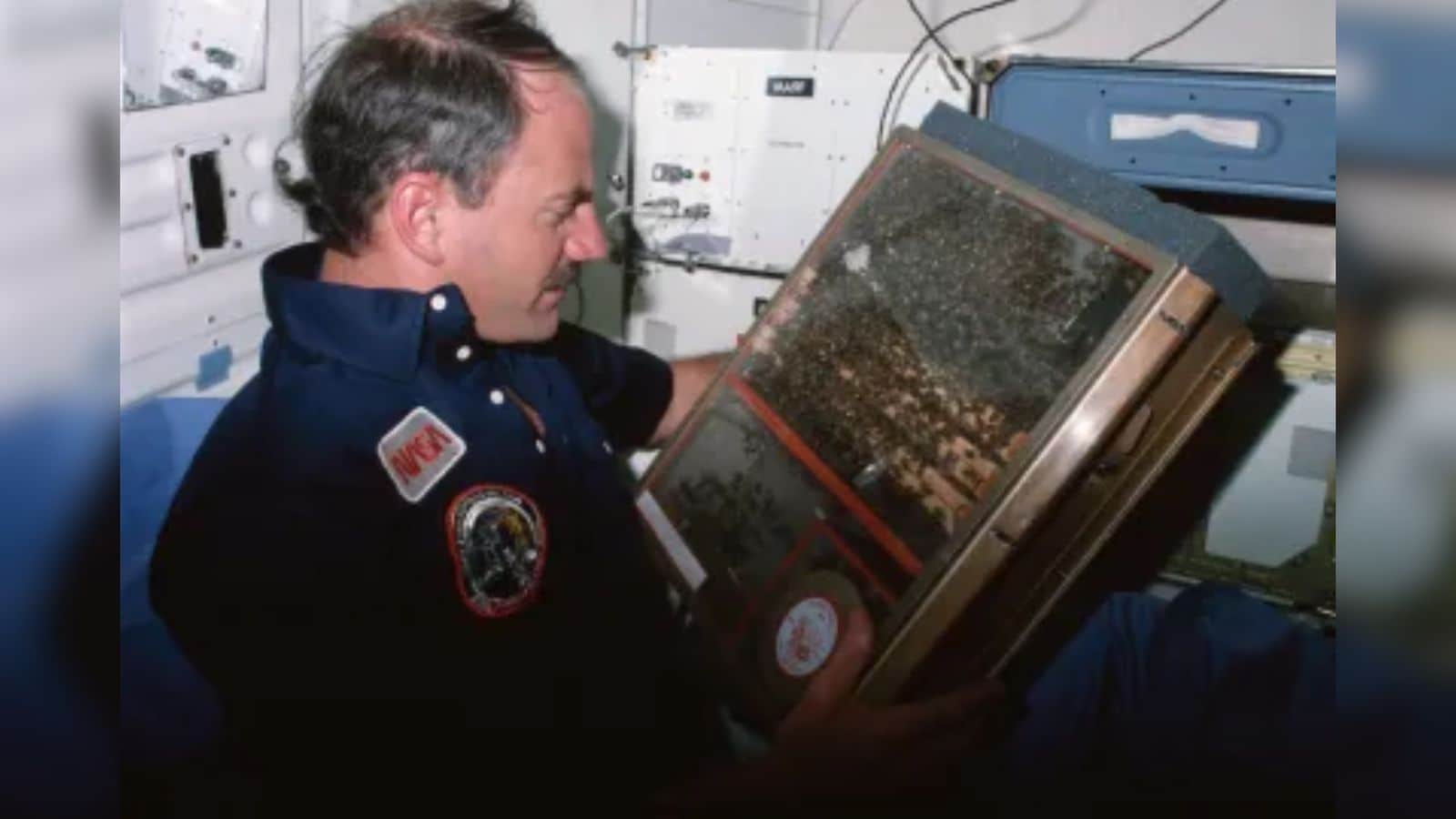
In April 1984, during the Space Shuttle Challenger mission designated STS-41-C, NASA launched an unusual payload into Earth orbit. Entomologists and aerospace engineers packed approximately 3,300 honeybees (Apis mellifera) into a specialized container known as the Bee Enclosure Module. The objective was not to produce honey in weightlessness, but to test whether a complex, gravity-dependent biological system could execute architectural coordination without a downward gravitational vector.
The resulting production of roughly 200 square centimeters of honeycomb under microgravity conditions provides a case study in biological robustness and environmental adaptation. Deconstructing this experiment exposes the baseline mechanics of insect behavior when evolutionary triggers are systematically stripped away.
The Biomechanical Cost of Microgravity
Terrestrial honeybees rely on gravity as a primary physical reference frame for navigation, structural alignment, and intra-colony communication. The gravitational vector informs the vertical orientation of hexagonal cells and underpins the mechanics of the waggle dance, where foragers communicate distance and vector relative to the sun using gravity as a proxy.
When the Challenger entered orbit, the removal of this constant vector triggered immediate locomotive failure. Without a physical floor, ceiling, or gravitational pull, the insects lost their directional stability. Initial observations revealed chaotic drift, with workers unable to execute standard flight patterns, instead tumbling and struggling to maintain purchase on enclosure surfaces.
This initial disorientation imposed an immediate metabolic tax. The energetic cost of locomotion spiked as the bees attempted to compensate for a lack of gravitational feedback using visual and tactile cues alone. The system faced an operational bottleneck: could a colony survive long enough for its members to recalibrate their internal orientation mechanisms?
The Three Pillars of Orbital Construction
Despite the initial chaos, the colony stabilized within days, initiating construction on the provided foundation within the enclosure. The success of this phase depended on three distinct biological variables.
- Tactile feedback loops replaced gravitational orientation. Worker bees relied on direct physical contact with adjacent nestmates and enclosure boundaries to determine spatial positioning and structural alignment.
- Exocrine wax production proceeded independently of gravity. Wax glands on the ventral side of the worker bees continued to secrete liquid wax flakes, which individuals manipulated with their mandibles and legs regardless of their spatial orientation.
- Cellular geometry retained its fundamental properties. The physical constraints of surface tension, material properties of beeswax, and the physiological dimensions of the bees themselves dictated that the resulting cells maintained a recognizable hexagonal structure.
The final output of approximately 200 square centimeters of comb demonstrated that structural self-organization does not require a gravitational field. While individual sections deviated from the rigid vertical plumb lines observed in terrestrial hives, the structural integrity of the individual cells remained structurally comparable to Earth-built comb.
Reproductive Limits and Biological Boundaries
While the construction phase succeeded, the reproductive metrics revealed hard physiological limits. During the mission, the queen bee successfully oviposited, laying 35 eggs within the microgravity environment. However, post-flight evaluation confirmed that none of these eggs developed successfully.
This failure highlights the systemic vulnerabilities of multi-stage biological organisms in spaceflight. While adult insects possess homeostatic mechanisms robust enough to adapt to short-term environmental shocks, embryonic development requires precise environmental controls—including temperature regulation, humidity management, and subtle mass-dependent gradients—that the 1984 hardware architecture could not adequately stabilize. The experiment proved that adult behavior and somatic labor can persist in zero gravity, but multi-generational continuity requires closed-loop environmental life support systems far more advanced than a simple shuttle payload.
Strategic Operational Takeaways
The 1984 Bee Enclosure Module experiment remains a foundational data point for closed ecological systems design. Future long-duration planetary habitation or space station agriculture relying on insect pollination cannot assume terrestrial behavioral baselines.
Habitat engineering must explicitly account for the absence of gravity by introducing alternative orientation cues, such as localized magnetic fields, structured tactile gradients, or directional lighting arrays. Organisms retain deep evolutionary resilience, but operational success in space requires artificial environmental scaffolding to bridge the gap between terrestrial instinct and orbital physics.