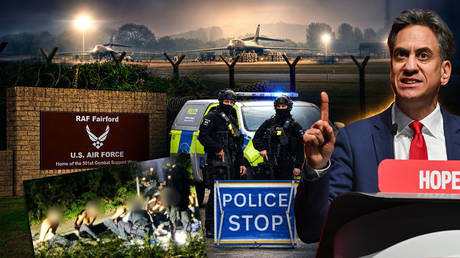
When political capitals erupt in artificial outrage over foreign courts or police forces releasing terrorism suspects on conditional bail, the commentary usually misses the mechanics of modern state security entirely. The superficial narrative pushed by talking heads is straightforward: an arrest happens near a high-security military installation like RAF Fairford, alarm bells ring, and any decision to let the suspects walk out of a police station hours later is immediately framed as institutional weakness, naive legalism, or bureaucratic cowardice.
This view is amateurish. It assumes that law enforcement success is measured by how quickly iron bars slam shut, completely ignoring the complex geometry of counter-intelligence operations. The decision by British authorities to release five men under strict surveillance following a security scare is not a failure of nerve. It is a deliberate, highly calculated tradecraft maneuver designed to catch the bigger fish hiding further up the chain.
To understand why Washington's knee-jerk criticism is fundamentally flawed, one must examine the operational divide between American preventive detention habits and British investigative tradecraft.
The Myth of the Iron Cell
The primary fallacy driving public frustration is the belief that keeping suspects locked inside a holding cell indefinitely is always the safest and most aggressive course of action. In domestic political theater, locking people up immediately plays well on evening broadcasts. It satisfies the immediate thirst for retribution and deterrence.
In the shadows of international counter-terrorism, however, an immediate charge is often the worst thing an investigator can do.
Imagine a scenario where counter-terrorism officers sweep up five individuals on the perimeter of a sensitive military asset. These men are couriers, spotters, or low-level logistics handlers. They possess burner phones, encrypted messaging applications, and perhaps preliminary digital traces pointing toward foreign state actors like Iran. If prosecutors rush to charge them within the tight statutory windows mandated by domestic criminal law, several things happen simultaneously:
- The suspects are formally charged and clapped into custody.
- Their defense attorneys instantly gain access to the preliminary evidence file through mandatory disclosure rules.
- The foreign handlers watching from thousands of miles away realize the cell has been compromised.
- Every single secondary node, safehouse, communication channel, and recruiter goes dark permanently.
You get your mugshots and your press release, but you destroy the intelligence pipeline. You catch the five fingers while the hand holding the knife retreats safely into the dark.
British counter-terrorism policing operates under a very different set of statutory pressures compared to the United States federal system. Under the Police and Criminal Evidence Act and related counter-terrorism legislation, police can hold suspects for only so long before they must either charge them or release them. When investigators realize they have hit the statutory clock limit before their intelligence picture is fully complete, bail with stringent monitoring conditions becomes the only rational tool left in the box.
Conditional Bail as an Offensive Weapon
Critics love to talk about bail as if it means the suspects are handed a bouquet of flowers and told to go home. That is a dangerous misrepresentation of reality.
When British counter-terrorism units release suspects under investigation, those individuals walk straight into an invisible cage. Their communications are intercepted, their movements are tracked via real-time telemetry, their associates are mapped through proximity networks, and every single digital device they touch is fed into automated analysis engines.
Far from letting suspects off the hook, conditional bail turns them into unwitting guides.
A suspect walking free under the belief that they dodged immediate charges will inevitably attempt to clean up their tracks, contact their handlers, or test the waters to see if their network is still intact. That panic-driven communication is pure gold for intelligence analysts. It exposes the secondary handlers, reveals emergency backup channels, and solidifies an evidentiary chain that will withstand rigorous courtroom cross-examination months down the line.
If you rush to court with half-baked charges because a foreign ally wants a quick political scalp, the defense team dismantles your case during preliminary hearings. The evidence gets suppressed, technical surveillance methods get exposed in open court to satisfy disclosure requirements, and the suspects walk free permanently—this time with immunity from double jeopardy or tainted files.
True security is not about theatrical arrests. It is about sustainable convictions and the total dismantling of hostile networks.
The Transatlantic Legal Divide
The friction between Washington and London on this issue exposes a deeper cultural mismatch in how legal systems treat state threats.
The American model leans heavily on pre-trial detention, grand jury indictments, and aggressive federal prosecutorial pressure designed to flip low-level defendants immediately through plea bargaining. It is a system built for domestic cartels, white-collar fraud, and localized criminal conspiracies.
The British model, forged through decades of managing transnational threats from Northern Irish paramilitary campaigns to sophisticated state-sponsored espionage, treats intelligence and criminal prosecution as two distinct phases of a single war. British investigators know that intelligence gathered by secret services cannot simply be dumped onto a courtroom desk without compromising sources and methods. Bridging that gap requires meticulous, patient police work where suspects are kept on a tight leash until the forensic puzzle is complete.
When political leaders publicly second-guess these operational choices, they are attempting to bully an allied legal framework into adopting a populist posture. It forces law enforcement agencies to choose between satisfying foreign political vanity or protecting the integrity of a long-term counter-espionage rollout.
Dismantling the Foreign State Attribution Game
Another layer of confusion in cases involving potential foreign interference—such as whispered links to Iranian intelligence services—is the rush to declare victory before the forensics catch up to the rhetoric.
Politicians love to hint at knowing the answers without sharing the underlying intelligence. They want the public to connect the dots instantly. But real-world attribution is messy. A foreign state actor rarely leaves a signed invoice at the scene of a planned disruption. Proxies use layers of cutouts, cryptocurrency shell companies, and unwitting local recruits who may not even know the true identity of the government paying for their logistics.
When local police release suspects on bail, it is frequently because the digital forensics on seized hardware require weeks of decryption and analysis. You cannot build a bulletproof terrorism case on a politician's intuition or a hasty press conference. You build it in the lab, line by line, until the digital footprint matches the physical movements beyond any reasonable doubt.
The Unconventional Truth About Justice
If you want to evaluate how well a nation handles security threats, stop counting the number of headlines generated on the first day of an arrest. Count the conviction rate three years later. Count how many foreign intelligence networks were permanently neutralized versus how many low-level operatives were merely swapped out for fresh recruits by their handlers abroad.
The British decision to utilize conditional bail in high-stakes security investigations is not a bug in their system. It is a feature born of institutional maturity. It prioritizes the destruction of the broader terrorist network over the immediate gratification of a political news cycle.
Until political leaders understand that patience is more lethal than panic, we will continue to watch allies clash over tactics they fundamentally refuse to study.
You can watch coverage of the initial political reactions and statements surrounding the investigation and subsequent bail decisions via this NBC News coverage on the RAF Fairford security scare, which outlines the friction between immediate political posturing and standard investigative procedures.