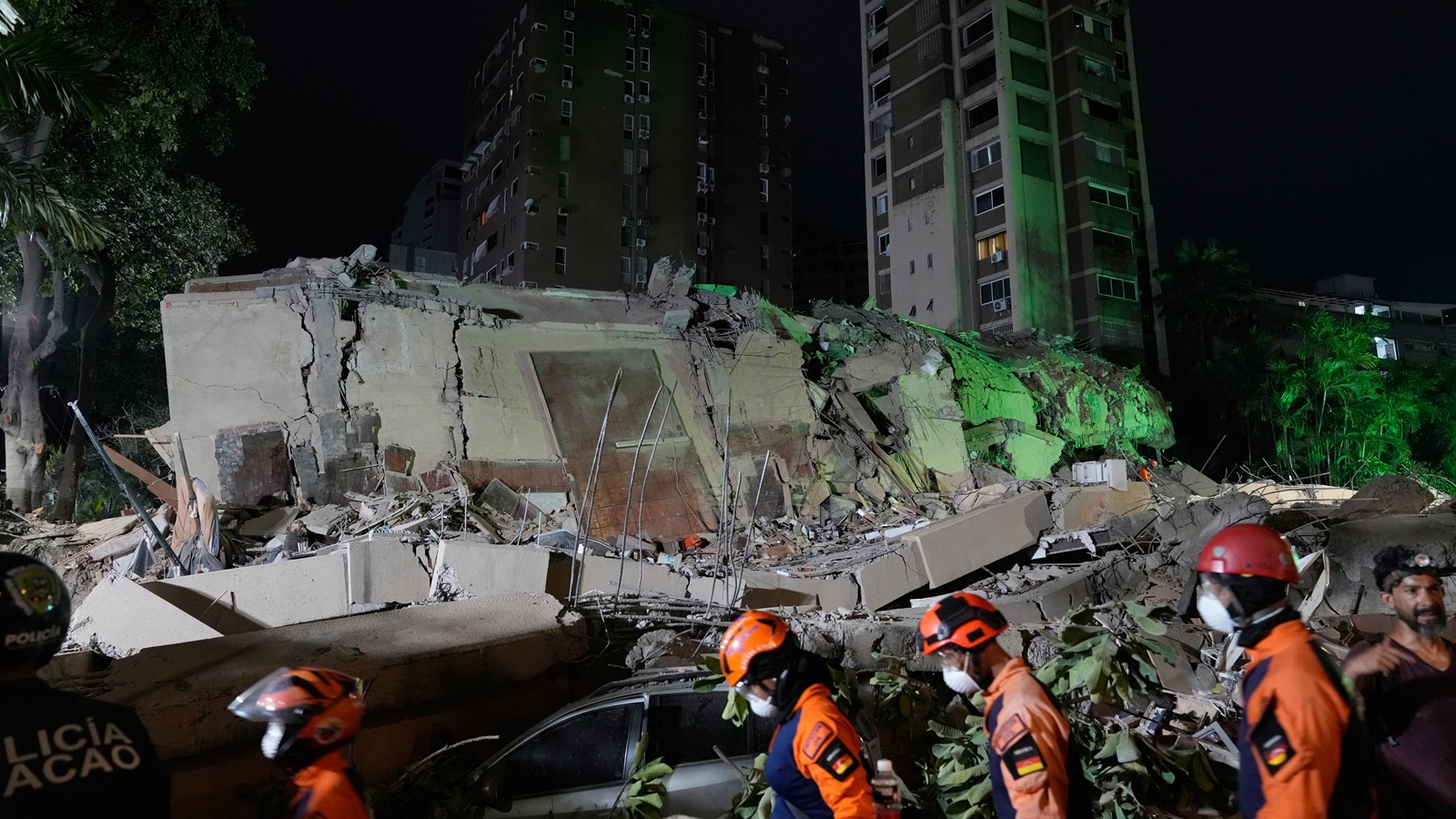
Wednesday evening changed everything for Venezuela. In the span of just forty seconds, a nation already pushed to its absolute limits by years of severe economic hardship faced a terrifying dual blow from nature. A massive 7.2 magnitude earthquake slammed the northern Caribbean coast shortly after 6 p.m., only to be followed moments later by a devastating 7.5 magnitude mainshock. The official death toll quickly climbed to at least 164 people, with another 971 injured. Emergency workers are still frantically digging through the mounds of concrete and twisted metal, meaning those numbers will almost certainly rise.
This wasn't a standard natural disaster. Seismologists call this rare event a doublet earthquake. Two massive tremors hitting almost the exact same spot back-to-back multiplied the destruction exponentially. The first quake weakened walls, shattered pillars, and sent panicked residents rushing into the streets. The second, more violent shock brought those compromised structures crashing down on top of anyone who couldn't escape in time. The coastal state of La Guaira bore the absolute brunt of the catastrophe, quickly being declared an official disaster zone by Acting President Delcy Rodríguez.
Amid the horrific stories of loss, moments of pure hope emerged on television screens across the globe. State broadcaster VTV captured the breathtaking moment when rescue workers pulled three young children alive from the thick dust of a collapsed building in La Guaira. Completely caked in grey powder but miraculously breathing, the children became an immediate symbol of survival against impossible odds. Not far away at the Coral Beach building, emergency crews managed another incredible feat, pulling a woman and her elderly father from the wreckage hours after the floors pancaked. These slice-of-life miracles offer a temporary reprieve from a grim reality that is currently unfolding across the country.
Miracles in La Guaira and the Grim Truth of the Search Efforts
The viral videos of children being lifted from the rubble show only a fraction of what is happening on the ground. For every successful rescue, there are dozens of desperate families clawing at concrete slabs with their bare hands. La Guaira sits just 30 kilometers north of Caracas, squeezed tightly between steep mountain slopes and the Caribbean Sea. It is an area packed with dense apartment blocks, many of which simply folded when the ground began to roll.
Local resident Antonio Bermudez described a horrifying scene that is playing out in neighborhoods across the state. His entire apartment building collapsed into a heap of heavy debris. He can hear a young woman named Jennifer shouting for help from what used to be the eleventh floor. She is trapped deep inside the pocket of the rubble, answering his calls. But Bermudez and his neighbors have no heavy machinery, no hydraulic jacks, and no power tools. They are completely helpless, forced to listen to her voice while waiting for professional rescue teams to arrive with the necessary gear.
A few yards away from him, a father and his surviving son worked frantically with a basic pickaxe and a single crowbar. They are trying to pry away massive concrete slabs to reach two other sons trapped underneath. The trapped boys are still alive, but their air supply is dwindling. Neighbors are begging them to stop screaming to preserve their voices and conserve what little oxygen remains in the dark gaps beneath the stone.
The chaos extended well onto the roads during the tremors. Javier Pérez was driving through La Guaira when the earth opened up. He watched a multistory residential building collapse right in front of his windshield. The violent shifting of the road almost flipped his car entirely over. People were running in every direction, screaming, as the sky filled with a thick cloud of pulverized concrete that blotted out the evening sun.
The Doublet Phenomenon That Defied Seismology Rules
What makes this specific disaster so incredibly destructive is the geological mechanics of the twin quakes. The United States Geological Survey reported that the initial 7.2 magnitude quake hit near the coastal town of Morón, roughly 170 kilometers west of Caracas. It was shallow, striking at a depth of 22 kilometers. While a 7.2 quake is powerful enough to cause severe structural failure on its own, the real catastrophe occurred a mere 39 seconds later.
A second, even larger 7.5 magnitude earthquake ruptured a fault line just 16 kilometers away from the first epicenter, this time at a terrifyingly shallow depth of only 10 kilometers. When two major earthquakes strike this close together in both time and geography, it creates a nightmare scenario for engineering structures. Paul Earle, a prominent seismologist with the USGS, explained that these overlapping seismic waves make it incredibly difficult for scientists to immediately map out the exact boundaries of the fault lines.
Buildings are designed to withstand specific types of lateral movement. The first shock fractured foundations, broke support beams, and cracked the core pillars of older concrete towers. Before those buildings could even finish swaying, the secondary 7.5 shock hit them from a slightly different angle with twice the energy. Structures that might have survived a single isolated earthquake simply dissolved into dust. The geological double-tap essentially guaranteed that older, poorly reinforced concrete buildings had zero chance of standing.
Crumbling Infrastructure in a Vulnerable Nation
You can't understand the true scale of this tragedy without looking at the pre-existing fragility of Venezuela. Long before these fault lines slipped, the country was already mired in a severe, decade-long economic crisis. Decades of hyperinflation, political gridlock, and strict international sanctions have left local infrastructure completely degraded. Hospital systems routinely face shortages of basic medicine, power grids fail under normal weather conditions, and water systems are notoriously unreliable.
The earthquakes instantly severed the weak lifelines holding the capital city together. In Caracas, authorities immediately suspended all subway services and completely shut off the natural gas networks to prevent massive urban explosions from ruptured pipelines. Large swathes of the capital lost electricity and cellular coverage within minutes of the second shock.
The country's primary international gateway, Simón Bolívar International Airport, suffered extensive structural damage. Roof segments collapsed into the main terminals, windows shattered across the check-in areas, and cracks marred the runways. Panicked travelers were filmed sprinting through dust-choked corridors trying to escape falling concrete slabs. The immediate closure of the airport completely paralyzed commercial air travel and created a massive logistical bottleneck for incoming foreign aid.
In the wealthy eastern district of Chacao and the historic neighborhood of El Paraíso, the scene resembled a war zone. People spent the night sleeping on sidewalks, in public parks, and inside parked cars. They refuse to return to their apartments out of sheer terror of the continuous aftershocks rattling the valley. Families sat huddled together on the pavement, hugging their pets, watching emergency crews carry injured victims out of apartment complexes on makeshift stretchers.
The medical system collapsed under the sudden influx of patients. In the city of Tucacas, located about 200 kilometers northwest of Caracas, the local hospital sustained heavy structural cracks during the shaking. Doctors and nurses were forced to evacuate patients onto the streets, setting up IV lines and treating compound fractures on the pavement outside the building while the ground continued to tremble beneath their feet.
Geopolitics Meets Disaster Relief
The sheer scale of the destruction forced an immediate pivot in international relations. Before the dust even settled, global leaders began offering emergency assistance to the beleaguered administration in Caracas. The economic modeling from the USGS suggests that total financial losses will easily land between ten billion and one hundred billion dollars. For a nation whose economy has shrunk by roughly 80 percent since 2013, that is a fatal sum.
Acting President Rodríguez quickly announced that the government is coordinating with the International Monetary Fund to secure an initial 200 million dollar emergency fund to rebuild destroyed medical facilities and housing. This is a massive shift given the historical friction between the Venezuelan leadership and Western financial institutions.
In Washington, the response was surprisingly swift. US Secretary of State Marco Rubio announced the immediate deployment of elite urban search and rescue teams from Fairfax County, Virginia, and Los Angeles. These specialized teams are equipped with acoustic listening devices, fiber-optic cameras, and search dogs trained to find signs of life deep inside collapsed concrete structures. The US is also providing critical high-resolution satellite and overhead imagery of the coastal zones, giving the Venezuelan emergency ministries a clear view of areas where local communications remain completely blacked out.
Other regional neighbors stepped up immediately. Colombia, Brazil, Chile, and Ecuador have mobilized medical personnel and field hospitals to help relieve the overwhelmed Venezuelan healthcare system. The United Nations also noted that nearly eight million people inside Venezuela were already in desperate need of regular humanitarian assistance before the quakes struck. This disaster risks plunging those vulnerable populations into an irreversible humanitarian spiral if aid distribution hits political roadblocks.
If you want to help the relief efforts right now, look toward established international organizations that already have boots on the ground in northern Venezuela. Local search teams don't need amateur volunteers showing up at the debris sites; they need funding for heavy lifting equipment, clean drinking water, portable generators, and medical supplies. Donating directly to verified international agencies like the Red Cross or Pan American Health Organization ensures your resources bypass political red tape and get straight to the doctors and rescue teams working in the ruins of La Guaira. The window to pull survivors from the rubble is closing fast, and every single hour counts.