Salt stings the back of my throat. It is the kind of stale, heavy air that feels like breathing through a wet wool blanket, thick with the smell of sun-baked guano and rotting kelp.
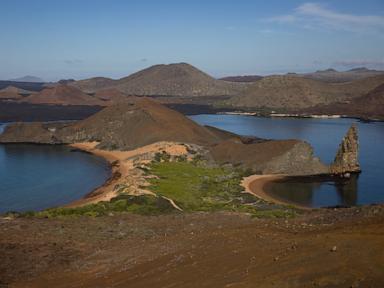
Stand on the black basalt shores of Fernandina or Santa Cruz long enough, and you stop seeing the archipelago as a postcard. You start seeing it as a pressure cooker.
Scientists are sounding alarms again. Another strong-than-normal El Niño is brewing, flexing its invisible muscles across the Pacific, and the reaction on the islands is not panic. It is a quiet, heavy dread. Everyone who has lived through the scorched, starved years knows what happens when the ocean gets too warm. The engine of life down here does not just stutter. It breaks.
To understand why a few degrees of temperature shift can unravel an ecosystem that weathered millions of years of isolation, you have to look down. Way down.
Imagine walking along a tide pool where the water is bathwater-warm. That warmth sounds pleasant to a human looking for a tropical escape. To the marine life of the Galápagos, it is a death sentence. The foundation of this entire living laboratory is built on cold water. The Humboldt and Cromwell currents pull nutrient-rich, frigid depths up from the Antarctic and the equatorial undercurrents, slamming them into the shallow volcanic shelves of the islands. This underwater collision creates an explosion of phytoplankton. The microscopic feeds the small. The small feeds the large.
When El Niño arrives with abnormal strength, it acts like a giant, invisible hand turning off the kitchen tap.
The cold currents stall. A warm, nutrient-poor pool of water floods the surface. The microscopic algae that green the rocks vanish. Without that green fuzz, the marine iguanas—creatures found nowhere else on Earth—starve.
I remember talking to a veteran researcher on the docks in Puerto Ayora years ago. He pointed to a pile of skeletal iguanas no larger than house cats. He told me something that stayed with me: During a severe El Niño, these animals don't just waste away. They shrink. Their bones actually reabsorb. They sacrifice their own skeletal structure just to stay alive, shrinking in length because nature leaves them no other choice. If the food doesn’t return in time, they don't bounce back. They simply become part of the dark rock.
History keeps receipts. The brutal El Niño events of 1982-1983 and 1997-1998 wiped out staggering percentages of marine iguanas, sometimes up to ninety percent in certain colonies. Galapagos penguins and flightless cormorants faced near-extinction thresholds as their fish stocks plunged into deeper, colder water where the birds could not safely dive.
Now, the climate patterns are shifting again, amplified by broader planetary warming. The anomalies are stacking up.
When scientists look at the ocean temperature maps today, they do not see abstract squiggles and color gradients. They see a slow-motion fire spreading across the surface of the sea.
Consider the land, too. We tend to focus on the ocean because the Galápagos is an oceanic Eden, but the highlands tell a parallel tragedy. Normally, the garúa—the misty, damp season—keeps the Scalesia forests dripping and green. But a supercharged El Niño turns the weather vicious. Instead of a gentle, life-giving mist, the islands experience torrential, biblical downpours. The soil erodes. Invasive plants, opportunistic and aggressive, choke out the native flora that took millennia to evolve in fragile isolation.
It is a double-edged sword forged in fire and flood. Too hot and dry in the water; too wet and chaotic on land.
We talk about climate change as if it is a distant projection on a news ticker. We treat it like a political debate or an abstract ledger of carbon parts per million. But standing on the equator, watching the surf wash over empty, bleached coral heads, carbon metrics feel painfully inadequate. This is about ancestry. It is about a living museum of evolution watching its roof catch fire.
The blue-footed boobies stop breeding. The waved albatrosses fail to find enough squid to feed their chicks, watching helplessly as their young starve in the scrub brush. These birds have nested on these specific lava fields for generations, guided by ancient instincts that the modern climate is rendering obsolete.
How much change can a closed system endure before it snaps?
That is the question haunting every marine biologist, park ranger, and conservationist patrolling the shores right now. We are pushing these ancient evolutionary lineages into a stress test they were never designed to pass. Evolution takes thousands, sometimes millions of years to craft a flightless cormorant or a temperature-sensitive iguana. Destruction, it turns out, only takes a couple of unusually warm ocean seasons.
The alarms are ringing. Whether we are listening closely enough to change the trajectory of the planet before the islands fall silent remains the terrifying unknown.
The tide rolls in, warm and deceptively calm, against the black stone.