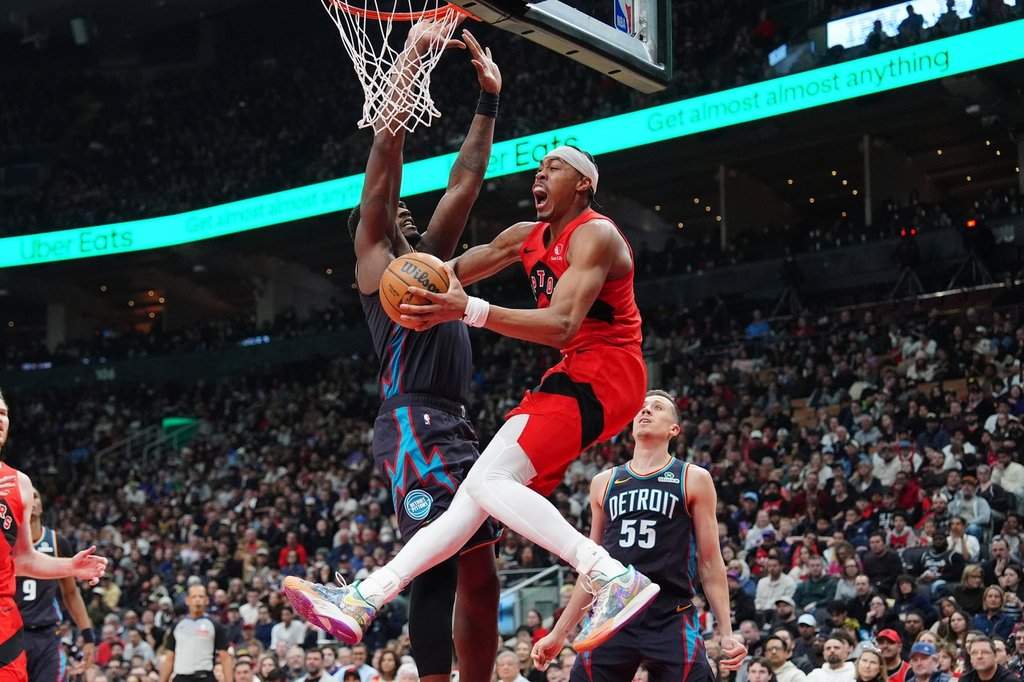
The box score tells a lie. It says the Toronto Raptors beat the Detroit Pistons 119-108. It says Brandon Ingram "powered" the win. It suggests a team finding its rhythm against a struggling opponent.
Most sports media outlets will feed you this comfortable narrative. They’ll talk about "momentum" and "shooting efficiency." They’ll highlight Ingram’s point total as if it exists in a vacuum.
They are wrong.
Winning a game in the modern NBA is often the worst thing a transitional franchise can do. This wasn't a step forward. It was a high-speed sprint into a brick wall of mediocrity. If you’re cheering for this 11-point margin, you aren't paying attention to how championships are actually built.
The Empty Stat Trap
Brandon Ingram is a phenomenal talent. Nobody with eyes can deny his midrange fluidity or his ability to create his own shot. But when a team "relies" on a singular scoring outburst to put away a bottom-tier Detroit squad, it’s not a sign of strength. It’s a symptom of a broken offensive philosophy.
The "lazy consensus" among analysts is that a win is a win. In the standings, sure. In the trajectory of a franchise, a win against a basement-dweller like Detroit is often "empty calories."
Consider the efficiency. Scoring 119 points against one of the worst defensive ratings in the league isn't an achievement; it’s the bare minimum requirement for entry. The Pistons essentially offer a revolving door at the perimeter. When Ingram or any high-usage wing exploits that, they aren't proving they can compete with the Celtics or the Nuggets. They are simply participating in a scheduled workout.
I’ve watched front offices trick themselves for decades. They see a double-digit win over a lottery team and decide they are "one piece away." They use these games to justify standing still at the trade deadline. They mistake individual brilliance for systemic success.
The Defensive Mirage
Toronto’s defense looked "solid" because Detroit’s offense is historically inept. If you allow 108 points to a team that frequently forgets how to space the floor, you haven't fixed your defensive rotations.
The Pistons’ turnovers weren't all forced by elite pressure. Many were unforced errors—errant passes into the third row and botched handoffs. When the Raptors’ coaching staff reviews this film, they shouldn't see a defensive masterclass. They should see a series of lucky breaks.
True defensive identity is measured by $DefensiveRating$ against top-10 offenses. Beating up on the Pistons is like a heavyweight boxer bragging about knocking out a middle-schooler. It’s embarrassing to even bring it up as a positive.
The Cost of the Middle Ground
The NBA is designed to punish the middle. You either want to be a legitimate contender or you want to be at the very bottom, accumulating assets. This 119-108 victory is the sound of a franchise settling for the 10th seed.
- Draft Capital Erosion: Every "feel-good" win against a bad team pushes you three spots down the draft board.
- False Evaluation: You cannot evaluate your young core when they are playing against a team that has already checked out for the season.
- Roster Stagnation: Veterans play heavy minutes to secure these meaningless wins, stealing developmental time from the players who actually matter for the year 2028.
Stop Asking if They Won
People always ask: "Can the Raptors build on this win?"
That is the wrong question. The real question is: "Why are the Raptors trying to win this specific game?"
If the goal is a ring, beating Detroit does nothing. In fact, it actively hurts the long-term mission. The Pistons are playing the long game—even if they look incompetent doing it. They are gathering data on their failures. Toronto is gathering a temporary ego boost that will evaporate the moment they face a team with a winning record.
We see this in business all the time. A company pivots to a "safe" product that generates quick cash but kills their innovation pipeline. That’s what this game was. It was a "safe" win that keeps the lights on but ensures the building will never be a skyscraper.
The Ingram Paradox
Brandon Ingram’s presence on this roster is a fascinating case study in cognitive dissonance. He is too good to let the team bottom out, but he isn't surrounded by enough talent to make them a threat. By "powering" them past Detroit, he is effectively trapping the organization in a loop.
Imagine a scenario where the Raptors traded their aging assets for three first-round picks and committed to a real rebuild. They would lose this game 120-90. Fans would be upset. The media would call it a "disaster."
But that "disaster" would be more honest than this win.
It would be a strategic retreat to higher ground. Instead, we get 119-108. We get highlights on the evening news. We get a false sense of security.
The Brutal Reality of the Standings
Look at the history of the last ten NBA champions. How many of them spent years hovering around the .500 mark, picking up "gutsy" wins against the Pistons?
Zero.
They either drafted a generational superstar (which requires losing) or they cleared the decks to sign one (which requires flexibility). This win provides neither. It’s a vanity project for a team that is afraid to look in the mirror.
The Detroit Pistons are currently a mess, but at least their mess has a purpose. They are at the bottom because that is where the talent is. Toronto is in the middle because they are too proud to admit they aren't good enough.
Stop celebrating the 119. Start worrying about the 108 points you gave up to a team that can barely dribble. Stop praising the "power" of a single star and start questioning the structural integrity of the entire project.
If you want to win a championship, you have to be willing to lose a Monday night game in Detroit. The Raptors didn't have the stomach for it. They chose the win. They chose the middle. They chose irrelevance.
Trade the "stars" while their value is peaked from beating up on bottom-feeders. Fire the scouts who think this roster is "close." Stop lying to the fans.
Go home and watch the tape of the 4th quarter. Notice how many times the Pistons had an open look and simply missed. That wasn't your defense. That was luck. And luck isn't a strategy.