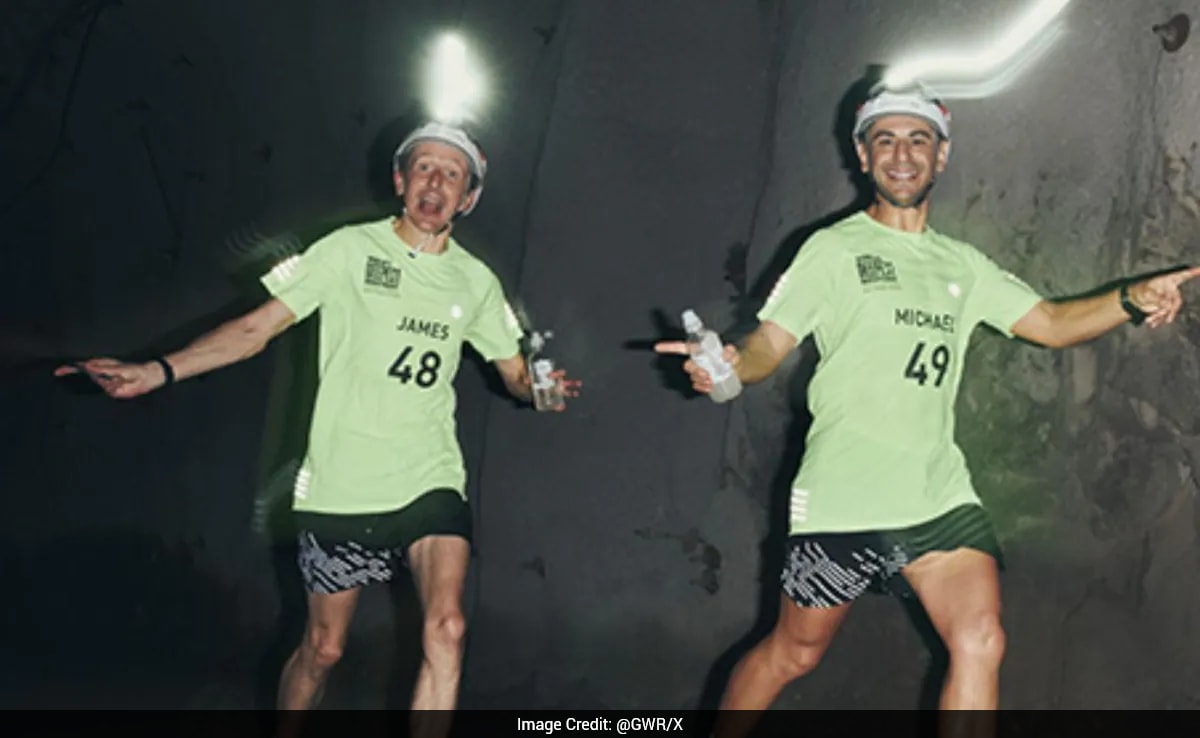
Running a marathon is a feat of endurance that pushes the human heart to its mechanical limits. Doing it 3,000 feet below the surface of the earth, inside the claustrophobic shafts of a working salt mine, is an exercise in physiological masochism. This is the reality of the Untertage Marathon in Sondershausen, Germany. While the surface world tracks split times under open skies, these runners navigate a subterranean labyrinth where the air is thick, the ground is jagged, and the psychological pressure matches the literal atmospheric weight of the crust above them.
This isn't just a race. It is a high-stakes experiment in how the human body reacts to extreme environmental stressors that no track-and-field coach can prepare for.
The Atmospheric Trap
Standard marathon conditions prioritize oxygen availability and heat dissipation. At 3,000 feet below sea level, both of these factors are compromised. The air pressure in a deep mine is significantly higher than at the surface. While this might suggest a higher concentration of oxygen, the reality is a dense, "heavy" air that makes respiratory exchange feel like breathing through a wet cloth.
The temperature is the silent killer here. Most deep mines maintain a constant heat regardless of the season on the surface. In Sondershausen, the mercury sits around 30 degrees Celsius. In a typical city marathon, that temperature would be enough to trigger medical alerts. Underground, it is compounded by a total lack of wind and a humidity level that renders sweat almost useless for cooling. When sweat cannot evaporate, the body’s primary cooling mechanism fails. The core temperature rises rapidly, leading to a state of hyperthermia that sets in long before the runner hits the halfway mark.
Ground That Fights Back
Most marathoners worry about asphalt or occasional gravel. In the world's deepest marathon, the "road" is a floor of crushed salt and potash. This surface is notoriously unstable. Every stride requires the stabilizer muscles in the ankles and knees to work overtime, fighting for purchase on a shifting, crystalline floor.
The course isn't flat. It features grueling inclines and descents with gradients that would be illegal in a sanctioned road race. Runners are essentially sprinting up and down the guts of a mountain from the inside. The impact on the joints is non-linear. Because salt is harder than dirt but more volatile than concrete, the vibration travel up the tibia is jagged and unpredictable. Stress fractures aren't just a risk; they are an expectation for the unprepared.
The Light Deprivation Factor
The human brain relies on visual cues to pace effort. We look at the horizon, the movement of trees, or the distance to the next landmark. Underground, the horizon doesn't exist. The only light comes from the bounce of a headlamp off a salt wall five feet away.
This creates a sensory deprivation effect. Without a fixed point in the distance, the brain struggles to calculate velocity. Runners often find themselves "over-clocking"—running much faster than their target pace because the flickering shadows create a false sense of speed. By the time the central nervous system realizes the error, the glycogen stores are depleted, and the runner hits the wall with a violence rarely seen in daylight races.
Logistics of a Subterranean World Record
Setting a world record in this environment requires more than just fast legs. It requires a logistical operation that mirrors a mining extraction. To even get to the starting line, participants must be lowered into the earth in industrial cages. This isn't a glass elevator. It’s a rattling, dark descent into a world where the sun doesn't exist.
The record-breaking attempts at Sondershausen aren't just about the clock. They are about managing the "mine-breath." Industrial ventilation systems work constantly to pump fresh air down, but they also kick up fine salt dust. This dust coats the throat and lungs of the athletes. Every breath is abrasive. Over 42 kilometers, this micro-abrasion can lead to significant respiratory distress, making the final 10 kilometers a battle against a literal tightening of the chest.
Why Runners Choose the Abyss
There is a specific psychology to the subterranean athlete. These are not people seeking a "personal best" for their social media feed. They are seeking a confrontation with the primal fear of being buried. The underground marathon strips away the pageantry of modern sports. There are no cheering crowds lining the 26-mile route. There is no scenery. There is only the rhythmic crunch of salt underfoot and the heavy, humid silence of the earth.
This environment favors the stoic. The runners who succeed are those who can internalize their effort and ignore the mounting signals of claustrophobia. The "why" is simple: it is the ultimate test of the internal versus the external. When the external world is reduced to a circle of light from a headlamp, all that remains is the runner’s own mental fortitude.
The Health Toll
We have to be honest about the long-term impact of these races. High-intensity aerobic effort in a high-pressure, dust-filled environment is not "healthy" in the traditional sense. It is a shock to the system. Medical teams at these events are looking for more than just dehydration. They are watching for electrolyte imbalances caused by the salt-heavy air and signs of pulmonary edema.
The recovery time for a deep-mine marathon is nearly double that of a surface race. The lack of UV light and the intense heat stress trigger a massive cortisol spike that can suppress the immune system for weeks. This is the hidden cost of the world record.
Engineering a Course Below the Crust
Maintaining a "raceable" track in an active or semi-active mine is a feat of engineering. The tunnels must be secured against rockfalls, and the air quality must be monitored every second. Carbon monoxide and methane levels are the invisible spectators of this race. A slight shift in the mine’s geology could theoretically end the event instantly.
The organizers are not just race directors; they are safety engineers. They have to ensure that the heavy machinery used for mining doesn't cross paths with a runner at the 35-kilometer mark. It is a delicate dance between industrial output and athletic pursuit.
The Salt Factor
The salt itself is a double-edged sword. While the dust is a respiratory irritant, the ground is incredibly hygienic. Bacteria struggle to survive in the high-salinity environment of the mine. However, any small cut or scrape a runner sustains during a fall is immediately "salted." The pain is instantaneous and sharp, a constant reminder that the environment is chemically hostile to soft tissue.
Runners often report a strange phenomenon after the race: their gear is stiff, caked in a layer of salt that has leached from both their sweat and the air. The equipment is usually ruined. Shoes are shredded by the crystals, and technical fabrics are stripped of their moisture-wicking properties.
The Silence of the Record
When a world record is set 3,000 feet down, there is no roar of the stadium. The sound of the finish line is muffled by the density of the air and the vastness of the surrounding rock. It is a quiet, lonely victory. The athlete crosses the line, gasps for heavy air, and realizes they are standing in a place where humans were never meant to run.
The Untertage Marathon proves that the "limits" of human endurance are often just a lack of imagination regarding the environment. We can go faster, deeper, and harder, but the earth always demands a tax. In the salt mines of Germany, that tax is paid in sweat that won't dry and breath that burns.
Next time you lace up for a morning jog through the park, consider the weight of the ceiling. For a select few, the only way to truly find their limit is to go where the light doesn't reach.
Check the mechanical tension in your own footwear before attempting a high-gradient trail run.