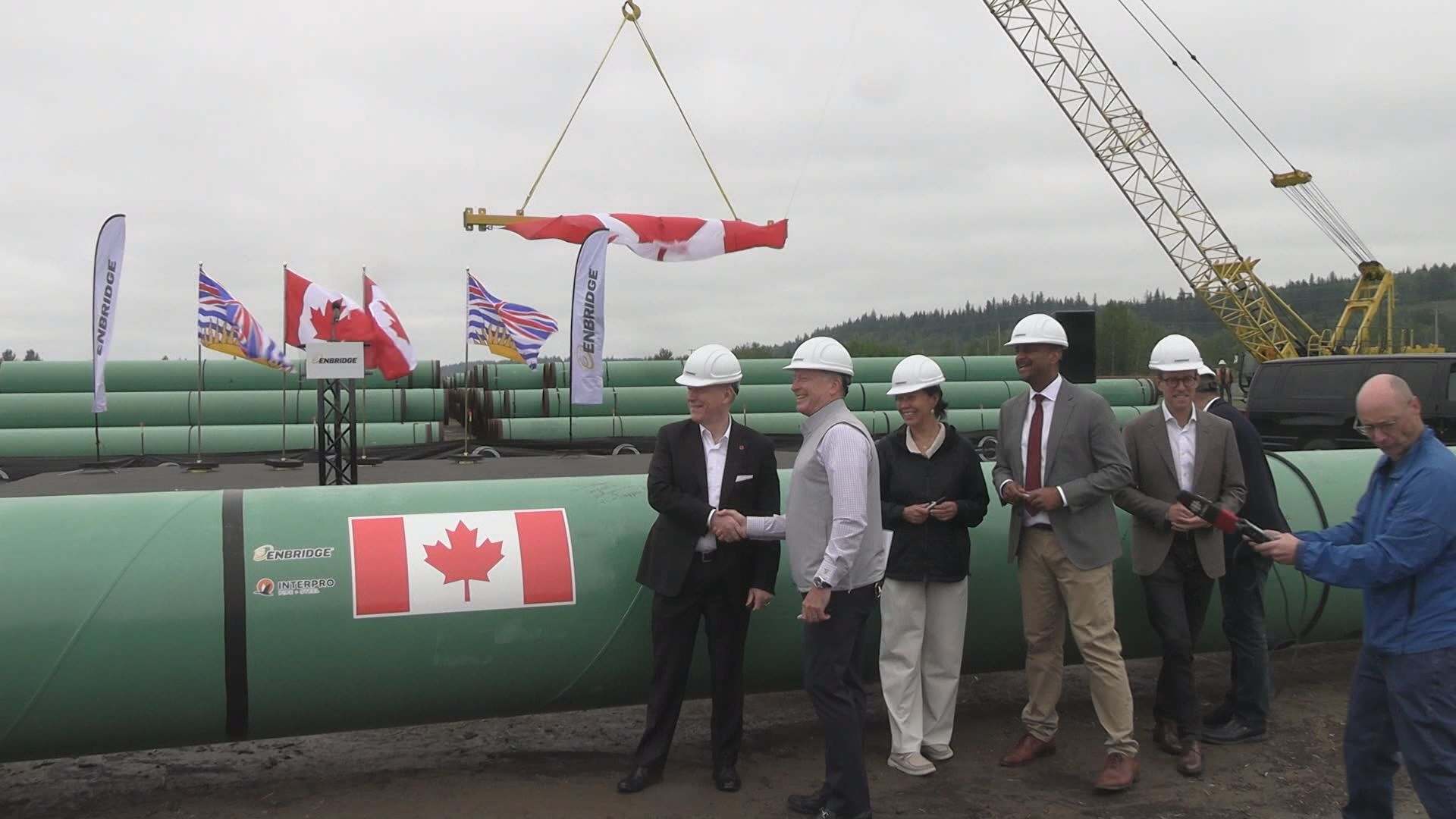
Another shovel hits the dirt near Prince George, and the predictable cheerleading squad immediately starts singing the same worn-out tune.
"Energy security!" screams industry PR.
"Environmental catastrophe!" yells the activist chorus.
Both sides are fundamentally misreading the board.
The mainstream coverage around Enbridge’s Sunrise pipeline expansion—a critical segment of their B.C. Pipeline system moving natural gas down to B.C. homes and the U.S. Pacific Northwest—focuses almost entirely on short-term capacity gains and local job counts. They treat a major fossil fuel infrastructure play as either a triumphant economic miracle or a simple carbon nightmare.
That binary line of thinking is dangerously naive.
I have spent decades watching utility boards, pipeline operators, and municipal leaders miscalculate capital expenditures during transition eras. What is actually happening in northern British Columbia is not just a routine infrastructure build out to meet winter peak demand. It is a massive, high-stakes gamble on structural lock-in—one that risks trapping regional taxpayers and utility customers with the bill for assets that could easily end up economically crippled before their payback period closes.
The Myth of Necessary Expansion
The core argument for pushing more natural gas capacity through B.C.’s central corridor hinges on one basic premise: demand will keep climbing, and pipeline bottlenecks are the ultimate enemy.
That is lazy logic.
When utility executives look at peak demand spikes during a cold snap in December or January, their knee-jerk reaction is to expand physical pipe diameter or build out additional loop capacity. It is the easiest hammer to swing. But physical infrastructure is a brute-force answer to a software and demand-side management problem.
In capital-intensive energy corridors, expanding a pipeline creates what economists call structural path dependency. Once you drop billions into civil works, right-of-way acquisitions, compressor stations, and steel, that capital demands a financial return. To get that return, the operator must guarantee long-term throughput. That means local utilities commit to long-term firm transport contracts.
Imagine a scenario where a municipality spends heavily to expand a four-lane highway to eight lanes because traffic jams peak for exactly 45 minutes every Tuesday afternoon. For the remaining 23 hours of the day, seven of those lanes sit empty. Yet, the city must collect taxes for fifty years just to pay off the asphalt.
That is precisely how linear midstream assets fail quietly.
Instead of building massive regional steel networks to survive 72 hours of freezing weather, modern energy strategy relies on localized storage, dynamic demand response, and peak shaving technologies. Expanding the pipeline corridor near Prince George solves yesterday’s demand problem using yesterday’s playbook, locking B.C. ratepayers into legacy fossil infrastructure right as competing alternatives hit cost parity.
Follow the Capital, Not the PR
Let us talk numbers and risk allocation.
When midstream giants undertake massive capital projects, they rarely absorb the real long-term transition risk. They hedge it. They secure long-term firm service agreements with local distribution companies and regional buyers.
Who pays for those agreements? You do.
If regional demand for natural gas drops over the next two decades due to heat pump adoption, stricter municipal building codes, or shifting industrial electrification trends, the physical pipe does not magically disappear. The cost to maintain that massive infrastructure gets spread across a shrinking pool of gas utility customers.
The mainstream press buys the narrative that expanding pipeline infrastructure lowers immediate energy costs for B.C. residents. In the short term, avoiding supply constraints during a deep freeze prevents price spikes. Sure. But over a 30-year amortization schedule? It guarantees a high fixed-cost baseline that ratepayers cannot escape.
I have sat in boardroom meetings where executives explicitly acknowledge this dynamic: secure the regulated asset base now, guarantee the return on equity, and let the next generation worry about stranded asset risk. It is a brilliant strategy for corporate balance sheets. It is an absolute disaster for regional economic resilience.
The Elephant in the Corridor: Electrification Parity
The argument for expanding gas transport capacity relies on the assumption that industrial and residential heating cannot be economically swapped for electricity in sub-zero climates.
That assumption is collapsing in real time.
Cold-climate heat pumps, industrial thermal storage, and clean hydrogen integration are moving down the cost curve far faster than linear pipeline construction can adapt. While a pipeline takes years to clear regulatory hurdles, secure environmental permits, and lay pipe in difficult northern B.C. terrain, modular energy technologies iterate in months.
By committing heavy capital to physical gas transport today, we are effectively shorting technological innovation.
Consider the operational reality:
- Pipeline projects face compounding regulatory delays, driving capital expenditures well beyond initial estimates.
- Maintenance costs on aging linear assets scale exponentially, not linearly.
- Decarbonization mandates will force operators to either capture emissions at high costs or buy expensive offsets.
When you factor in the true long-term cost of capital, expanding physical gas capacity near Prince George looks less like a strategic energy move and more like a defensive defensive play to lock in market share before cleaner alternatives render the capacity redundant.
What Real Leadership Would Look Like
If regional planners and industrial leaders actually wanted to build a resilient energy matrix in British Columbia, they would stop treating pipeline expansion as the default answer to every capacity constraint.
First, dismantle the assumption that peak demand must always be met with more fossil molecule transport. A fraction of the capital being poured into linear steel expansions could fund massive grid upgrades, localized battery storage, and targeted demand-response systems that eliminate peak spikes entirely.
Second, force midstream operators to bear a greater share of the long-term stranded asset risk. If an energy company is convinced that gas demand will remain robust through 2050, let them build without passing long-term regulatory cost guarantees down to regional utility ratepayers.
Third, call out the greenwashing on both sides. Activists claiming we can turn off existing pipelines tomorrow without freezing northern communities in January are lying to you. But industry reps claiming that endless capacity expansions are the only way to keep the lights on are selling a bridge to the past.
The construction starting near Prince George isn't a sign of forward-thinking industrial growth. It is a high-priced monument to risk aversion—a play designed to protect legacy revenues while shifting the ultimate financial burden of the energy transition onto the public.
Stop celebrating expanded steel in the ground. Start asking who pays for it when the gas stops flowing.