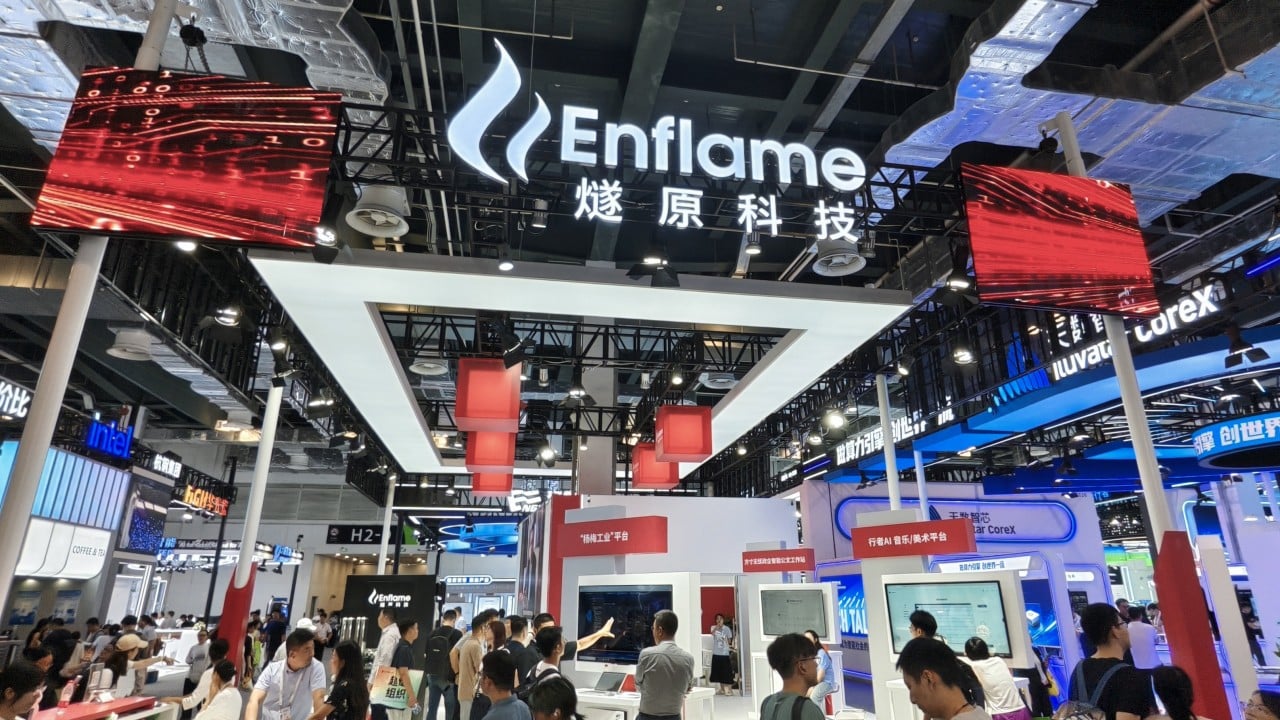
The air inside a cleanroom does not smell like money. It smells like nothing at all. It is scrubbed, filtered, stripped of every wandering speck of dust, every rogue skin cell, every stray thought of the outside world. To stand in that silence is to feel intensely small. You are standing in the presence of gods who demand absolute purity, and silicon is their altar.
Right now, that altar is located in Shanghai. And the people tending to the flames are watching a very specific number tick upward on a terminal screen: nine hundred million dollars.
That is the size of the impending initial public offering for Enflame, a company known in financial ledgers as an artificial intelligence chipmaker, but known in the trenches of the great technological cold war as something far more dangerous. They call them the little dragons. Not the legendary beasts of old imperial banners, but the scrappy, underestimated challengers born in the shadow of giants, forced to figure out how to build a brain out of sand and electricity while the iron gate is slowly being lowered around them.
To understand why this IPO matters—why bankers in Hong Kong are chewing their fingernails down to the quick and strategizing traders in New York are leaning closer to their monitors—you have to step away from the abstract vocabulary of venture capital. You have to look at what happens when a continent tries to build its own nervous system from scratch.
Imagine Chen, a hypothetical lead architect who has spent the last five years staring at circuit diagrams until the lines blur into purple veins behind his eyelids. (To be clear, Chen is a composite figure, built from the shared DNA of dozens of engineers working in the Zhangjiang Hi-Tech Park.) Chen does not care about stock tickers. He cares about nanometers. He cares about thermal dissipation. He cares about the exact microsecond delay it takes for a matrix multiplication to clear a register.
For years, Chen and engineers like him lived in a comfortable dependency. If you wanted to train a massive language model, you bought the reigning American hardware. You paid the toll, you accepted the software ecosystem, and you built your dreams on top of someone else's foundation. It was efficient. It was profitable. It was also a house built on sand, though nobody wanted to look at the shoreline until the tide came in.
Then came the export controls. The sweeping, unilateral blocks on advanced semiconductor manufacturing equipment that fell like a portcullis. Overnight, the rules of gravity changed.
The common narrative in Western media is that China’s domestic chip industry is a monolith of state-directed triumph, a well-oiled machine marching in lockstep toward silicon independence. Walk the corridors of these startups, however, and you find a very different emotional reality. It is frantic. It is exhausting. It is defined by a terrifying cocktail of immense national expectation and the daily, grinding dread that your next batch of wafers might fail quality control at the foundry.
Success here is not guaranteed by a massive influx of capital. In fact, money is the easy part. The Chinese state and private venture funds have thrown oceans of liquidity at the domestic semiconductor sector. But you cannot print physics. You cannot legislate lithography.
This is where the Enflame IPO serves as a profound psychological and financial litmus test.
Raising nine hundred million dollars in the current market climate—a climate scarred by economic slowdowns, real estate tremors, and heavy-handed regulatory tightening—is no small feat. It requires convincing institutional investors that the domestic market for artificial intelligence accelerators is robust enough to sustain high-growth valuations without relying on global supply chains. It requires proving that a company that has historically operated at a net loss can eventually turn its technological hustle into cold, hard profit.
Let us look under the hood of what Enflame actually makes. They design specialized processors meant to handle the grueling math of deep learning inference and training. When an AI model answers a user prompt, summarizes a legal document, or diagnoses an X-ray, it requires a staggering number of parallel floating-point operations. For years, Nvidia's CUDA software ecosystem has held a virtual monopoly on this kind of work, not just because their chips are fast, but because software developers write code that speaks CUDA's language natively.
Building a chip is only half the battle. Building the software stack that makes developers actually want to use the chip—without wanting to throw their keyboards out the window—is where empires rise and fall.
Consider what happens when Chen’s team ships their latest accelerator to a cloud provider in Hangzhou. The hardware works on paper. The benchmarks look dazzling in a PowerPoint presentation delivered to venture capitalists in starched suits. But then the customer plugs it into a live cluster running a proprietary LLM, and suddenly a memory bandwidth bottleneck chokes the pipeline. The loss function plateaus. The training run stalls.
At three in the morning, Chen is on a video call with a dozen panicked infrastructure engineers, trying to rewrite a compiler optimization pass because a rare instruction edge-case causes a silent data corruption. There are no textbooks for this. They are building the airplane while hurtling toward the ground at Mach 2, and everyone on earth is watching to see if the wings stay attached.
This is the hidden human cost of the tech decoupling. It breeds an environment of hyper-acceleration where burnout is a baseline state of being. Engineers sleep under their desks not out of romantic startup bravado, but because the margin between technological sovereignty and total irrelevance has shrunk to the width of a single transistor gate.
When the Enflame prospectus hits the public market, it will not just measure investor appetite for domestic AI hardware. It will measure the market’s belief in endurance.
Can a company nurtured in an ecosystem cut off from the most advanced extreme ultraviolet lithography machines still scale to compete on the global stage? Can architectural cleverness compensate for brute-force manufacturing limitations?
The early indicators suggest yes, but with asterisks the size of boulders. Domestic demand within China for localized AI solutions is immense. Financial institutions, government agencies, and domestic tech titans are under strict directives—implicit and explicit—to migrate their computational workloads away from foreign dependencies. There is a captive, massive, hungry market waiting for whatever these little dragons can produce.
Yet, captive markets can become comfortable cages if they fail to force international competitiveness. If an AI chip can only run domestic software stacks and struggles to keep pace with the bleeding edge of global algorithmic research, it risks becoming a walled garden of second-tier capability.
The investors buying into this nine hundred million dollar valuation know this. They are not blind optimists. They are calculating risk in a theater of economic warfare. They are betting that even if the hardware is one generation behind the global standard, the sheer velocity of iteration, combined with massive state backing and bottomless local demand, will bridge the gap before time runs out.
We have seen this movie before in other sectors—telecommunications, high-speed rail, electric vehicles. In each case, an initial period of chaotic, subsidized experimentation yielded domestic champions that eventually spilled over their home borders to challenge established international incumbents. The playbook is well-worn. But silicon is different. Silicon is unforgiving of shortcuts. You cannot fake a sub-seven-nanometer yield rate with good marketing or aggressive pricing.
So the IPO proceeds. The bankers sharpen their pencils. The analysts write their long-winded notes about addressable markets and margin expansions.
Back in the cleanroom, the lights hum a steady, low frequency. A robotic arm lifts a thin disc of polished crystal, moving it with preternatural gentleness from one vacuum chamber to the next. Somewhere down the hall, Chen takes a sip of lukewarm green tea, looks at a terminal graph that refuses to smooth out, and reaches for his keyboard. The future of an entire technological ecosystem hangs in the balance of the next compilation.