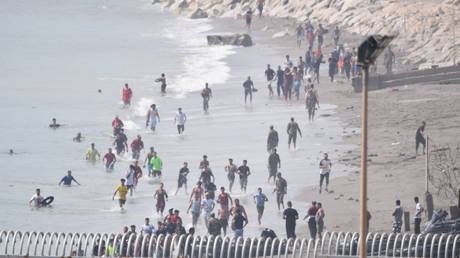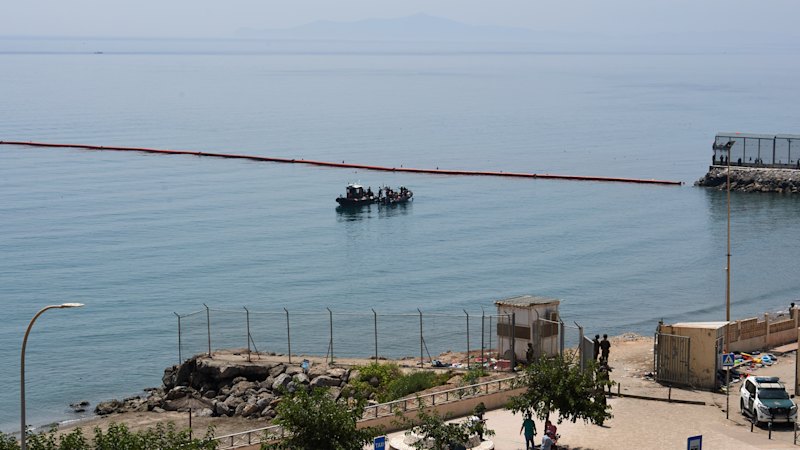
Another concrete slab, another roll of razor wire, another headline weeping over a mounting death toll. Spain is doubling down on its architectural anxiety in Ceuta, constructing yet another barrier to keep out the desperate. The mainstream narrative writes itself: a humanitarian crisis met with an immovable wall, pitting human suffering against sovereign defense.
It is a completely bankrupt framing.
The lazy consensus dominating media coverage assumes that physical barriers fail because they are insufficiently high or poorly maintained. Politicians wring their hands, activists demand open borders, and the press tallies the dead as if tragedy were an unpredictable act of weather rather than a predictable engineering outcome. Everyone is arguing about the height of the fence while completely ignoring the economics of desperation.
I have spent years analyzing cross-border logistics, migratory black markets, and state-sponsored friction. I have watched governments burn billions of euros on perimeter security while simultaneously subsidizing the very illicit networks they claim to fight.
Ceuta is not a security problem. It is an economic vacuum choked by bureaucratic incompetence, and more concrete will only make the cartels richer.
The Economics of the Wall
Let us look at how black markets actually operate. When a state introduces a hard barrier to a high-demand, low-supply economic gradient, it does not stop the flow. It professionalizes it.
Before the fence was reinforced, migration through the North African enclaves was chaotic, fragmented, and relatively cheap. Enter the state with millions in European Union border-enhancement funding. Suddenly, crossing casually is impossible. The risk skyrockets.
What happens to prices in economics when risk skyrockets? The margins go up.
By building an impenetrable wall, Spain and the European Union have essentially handed a localized monopoly to transnational human-smuggling syndicates. You no longer pay a local guide a few hundred euros to slip past an understaffed post. You pay a cartel thousands of euros for sophisticated tunneling, forged documentation, or high-speed maritime evasion. The wall acts as a market filter. It weeds out the amateurs, concentrates capital in the hands of organized crime, and ensures that only those with deep pockets or extreme debt survive the transit.
To understand why this fails, look at basic supply-side dynamics. As long as the wage differential between sub-Saharan Africa and the European Union remains astronomical—often a factor of ten or twenty to one—no amount of steel will alter human behavior. People do not risk drowning in the Mediterranean because they underestimate the height of a fence. They risk it because the alternative at home is a guaranteed dead end.
The Fatal Flaw in the Humanitarian Debate
The humanitarian camp loves to frame this as a moral failing of European coldness. They argue that if Brussels just showed more compassion, the crossings would normalize.
This is equally detached from reality. Open borders without structural economic integration in origin countries is an administrative fantasy that would collapse municipal infrastructure in weeks. But conversely, fortress policies predicated on deterrence through misery are morally reprehensible and functionally useless.
Both sides share a fundamental delusion: that the border is a static line where policy begins and ends.
Borders are not lines on a map; they are filters for global capital and labor. Right now, Europe desperately needs low-skilled labor to prop up aging demographics, agricultural harvest cycles, and service sectors. Simultaneously, it criminalizes the exact transit mechanisms that supply that labor.
Imagine a scenario where multinational corporations were barred from moving goods across borders, restricted only to shipping empty containers back and forth. Trade would halt instantly. Yet, this is precisely how Europe treats human labor. It creates hyper-demand through a gray-market economy that relies on undocumented workers for cheap construction, agriculture, and domestic care, while funding a military-industrial complex to hunt those exact same workers down at the fence line.
The hypocrisy is staggering. The wall does not stop the labor pool from entering; it forces them into exploitation. Undocumented migrants without legal recourse accept sub-minimum wages, zero safety standards, and absolute vulnerability to abuse because the border regime criminalized their existence. The wall is not protecting European jobs. It is subsidizing an underground slave economy.
Dismantling the Popular Myths
Let us address the common refrains that echo through talk shows every time a body washes up near Tarifa.
First: "If we don't secure the perimeter, our cities will be overrun."
This assumes migration is an infinite wave. It is not. Migration is elastic, responsive to economic shifts, job availability, and enforcement patterns. When enforcement is smart, it manages flow. When enforcement is brutal and blind, it creates bottlenecks and black markets. Ceuta is a bottleneck of the state's own making.
Second: "More surveillance technology and naval patrols will deter departures."
Data from the past two decades of Frontex operations proves the exact opposite. Increased naval patrols in one zone simply displace routes to more dangerous, longer maritime paths. You do not stop water from flowing by cupping your hands tighter; you redirect it into more volatile channels. The rise in deaths is a direct mathematical correlation to the militarization of traditional crossing points.
Third: "Aid to origin countries will stop people from leaving."
Foreign aid is a multi-decade play that often gets siphoned off by corrupt local elites before it ever hits a localized labor market. Waiting for structural reform in the Sahel while people starve today is not a policy; it is an excuse for inaction.
What Actually Works
If we stopped treating migration as a criminal invasion and started treating it like the complex logistics problem it is, the solution set changes entirely.
We need to decouple security from processing.
- Move the Border Outward: Create heavily staffed, legally robust consular processing hubs in origin and transit nations. If a person can apply for a work visa, an asylum hearing, or a seasonal labor contract while sitting in a safe city rather than clinging to a fence in Morocco, the incentive to pay smugglers vanishes overnight.
- Legalize Seasonal Labor Flows: Europe has predictable agricultural and industrial labor deficits. Match those deficits directly with regulated, temporary work visas. Let workers come, work, pay taxes, and return home legally. When a worker knows they can legally cross next year, they do not risk their life trying to scale a razor-wire barrier today.
- Target the Financial Networks, Not the Walls: Dismantling cartels requires following the money, not welding more steel beams. Freeze the informal hawala networks and cryptocurrency channels used by smugglers. Make the illicit transport business economically non-viable by undercutting it with legitimate, cheap, state-vetted transport options.
Spain's new barrier in Ceuta will be completed on schedule. Politicians will cut ribbons, cameras will flash, and pundits will declare that the border is finally secure.
It will be obsolete before the paint dries.
The next time a desperate group breaches the perimeter, or another tragedy makes the evening news, remember that the wall didn't fail because it wasn't high enough. It failed because it was built to solve a political photo-op, not a human reality.
Stop funding the monuments. Fix the pipeline.