Every mainstream analysis of the Ceuta border surge relies on the same intellectual laziness.
The standard narrative plays out like a predictable script. Commentators hyperventilate over humanitarian distress, point fingers at bilateral diplomatic spats, and treat human movement across an international enclave as if it were a meteor strike. They frame the sudden influx of thousands of people into a tiny Spanish city on the North African coast as an accidental explosion. A spontaneous combustion of desperation.
They are wrong. Dead wrong.
If you treat a pressure-release valve as a plumbing disaster, you will spend all your time mopping the floor while ignoring the engineer who just turned the handle.
I have spent years watching geopolitical actors use migration corridors as high-frequency trading desks. I have seen governments blow millions on border fences while completely missing the structural mechanics of leverage. The Ceuta surge was not a chaotic accident. It was a calculated, highly calibrated demonstration of statecraft.
To understand why everyone missed it, we have to look past the bleeding-heart editorials and the saber-rattling headlines, and examine how modern borders actually function as bargaining chips.
The Lazy Consensus of Border Dynamics
The prevailing wisdom regarding the May 2021 events in Ceuta argues that Morocco experienced a moment of domestic distraction, lost control of its perimeter, or simply buckled under standard migration pressures. Pata-de-gallo analysis. Surface-level noise.
This lazy consensus assumes that borders are static walls meant to keep people out, and that when breaches occur, they represent a failure of state capacity.
That framework is obsolete.
In the modern theater of international relations, a border is not a wall. It is a dial.
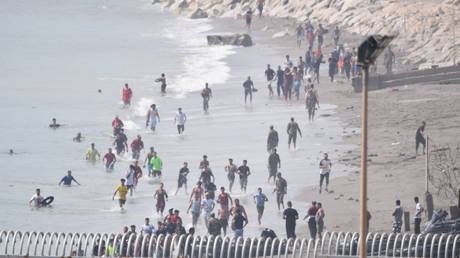
When Rabat needed to signal intense displeasure to Madrid over the hospitality shown to Brahim Ghali, the leader of the Polisario Front, they did not issue a sternly worded diplomatic cable. They reached for the dial. They turned it from low to maximum. For roughly thirty-six hours, border enforcement mechanisms across Tetouan and Fnideq went dark. The result was a predictable rush toward the double perimeter fence separating Morocco from the Spanish exclave.
Calling this a spontaneous humanitarian crisis strips away the agency of the actors involved. It treats human beings as weather patterns rather than tactical instruments in a broader game of chess.
The Core Misconception: Believing that border surges are failures of enforcement rather than deliberate choices of non-enforcement.
When you look at Ceuta through the lens of state-managed pressure, the entire timeline snaps into focus. The surge began instantly, coordinated via social media channels that suddenly operated without interference from local authorities, and it stopped just as abruptly when the diplomatic message had been successfully delivered and acknowledged.
The Mechanics of State Leverage
Let us define terms clearly. Asymmetric leverage occurs when a smaller or developing state possesses a vital security or economic choke point desired by a larger regional power.
Spain and the European Union need Morocco to act as the gendarme of the Mediterranean. They need Rabat to intercept boats, man detention facilities, and suppress local economic aspirations that lean toward irregular transit. Billions of euros flow southward under various cooperation agreements to ensure this cooperation.
However, dependency cuts both ways.
When Madrid chose to admit a geopolitical rival of Rabat into a Spanish hospital under a falsified identity, they violated an unwritten protocol of the neighborhood. They forgot that the partner policing your border is also the gatekeeper.
Imagine a scenario where a high-security prison warden deliberately insults the head of the inmate union, and then acts surprised when the internal courtyard gates are left unlocked for an hour.
That is what happened in Ceuta.
Madrid screamed about international law and sovereignty. Brussels expressed deep solidarity and dispatched empty rhetoric about EU unity. But behind closed doors, every strategic planner in Western Europe understood the reality of the transaction. Morocco had demonstrated that the price of European security is absolute diplomatic alignment—and zero tolerance for unilateral provocations.
The human cost of this demonstration was real, tragic, and entirely secondary to the perpetrators on both sides. Thousands of young men, teenagers, and families were funneled into a political messaging campaign. That is the grim truth that neither the bleeding hearts nor the hardline nationalists want to admit: migration management is often just a proxy war fought with bodies.
Dismantling the People Also Paws (And PAA) Queries
If you plug Ceuta border events into any search engine, you run into a wall of identical questions designed to reinforce the standard narrative. Let us dismantle them one by one.
Why did Morocco open the borders in Ceuta?
The standard answer claims local security forces were overwhelmed or distracted by COVID-19 enforcement.
The Brutal Truth: They did not open the borders because they were overwhelmed; they opened them because they stopped guarding them. It was a deliberate, state-directed relaxation of control intended to punish Spain for hosting Brahim Ghali.
Is migration used as a political weapon?
Mainstream articles tiptoe around this with academic jargon like instrumentalization.
The Brutal Truth: Stop sanitizing the term. It is coercion. It is state-sponsored demographic pressure used to extract political concessions, funding, and diplomatic deference. When a government deliberately turns a blind eye to mass movement to force a foreign ministry to blink, that is weaponization in its purest form.
Can border walls solve diplomatic disputes?
Politicians love selling the illusion of concrete.
The Brutal Truth: A wall is only as effective as the political will of the entity operating the gate. Ceuta proved that you can have razor wire, biometric scanners, and Guardia Civil patrols, but if the country on the other side decides to stop holding the line at the source, your fortress becomes an open-door reception center. Concrete cannot substitute for geopolitical alignment.
The Downside of the Realist Lens
Every analytical framework has a blind spot, and looking at human migration purely as a calculus of state leverage carries a massive moral hazard.
I will admit the glaring downside to this contrarian approach: it risks dehumanizing the very people caught in the machinery.
When we reduce thousands of desperate youths swimming around the Benzú breakwater into mere "signaling mechanisms," we risk falling into the exact trap that the state actors set. We treat human lives as collateral damage in a high-stakes poker game between Madrid and Rabat.
Furthermore, this perspective can breed a paralyzing cynicism. If borders are merely dials turned by cynical bureaucrats and intelligence officers, then local humanitarian efforts, legal frameworks, and human rights advocacy can feel like shouting into a hurricane.
Yet, refusing to acknowledge how the system actually works guarantees repeat performances. If you continue to treat every border surge as an unpredictable natural disaster, you will never build the structural deterrence required to stop governments from using human beings as pawns.
Actionable Strategy for Border Security in the Real World
If policymakers actually want to stop repeating the Ceuta playbook, they must abandon naive idealism and adopt an unsparing operational reality.
- Decouple Aid from Acquiescence: Stop tying financial assistance to short-term border containment. When migration is treated as the sole currency of a bilateral relationship, the weaker state holds a permanent gun to the donor's head. Diversify security partnerships so that no single capital holds a monopoly on regional stability.
- Codify Immediate Consequences: If a state explicitly weaponizes migrant flows to extract diplomatic concessions, the response must carry an immediate, painful economic and political cost that outweighs any gain achieved by the stunt. Ambiguity invites repetition.
- Call the Bluff Instantly: In high-stakes deterrence, hesitation is fatal. When the perimeter pressure spiked in Ceuta, Spain's initial reaction was a deer-in-the-headlights paralysis rooted in fear of looking heavy-handed. A mature state prepares for proxy pressure by establishing pre-engineered rapid response protocols that neutralize the political utility of the surge before it achieves its media objective.
The next time a border flares up overnight, stop looking at the fence. Look at the foreign ministry that just made a phone call they shouldn't have.