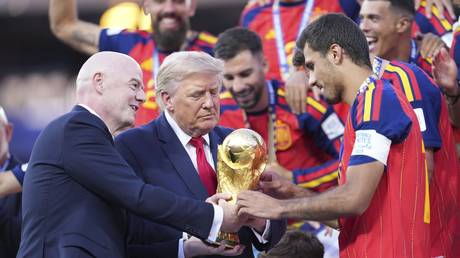
The mainstream media is choking on its own narrative again. For the past month, every major outlet has obsessed over the same tired script. They track every political statement, analyze every executive tweet, and treat minor transport delays outside stadiums as if they were geopolitical crises.
When Donald Trump declared this tournament an unqualified triumph ahead of the final, the press immediately weaponized the claim. They dusted off their pre-written checklists of controversies. They pointed to ticket pricing outrages, trans-continental travel fatigue, and localized security skirmishes. They wanted a referendum on an administration. They wanted a moral victory.
They missed the entire point of modern sports capitalism.
The lazy consensus states that a mega-event’s success is measured by public relations harmony and flawless logistical execution. It assumes that if fans are complaining on social media about a two-hour line for a train in New Jersey or high beer prices in Dallas, the tournament is somehow teetering on the edge of failure.
This is a fundamental misunderstanding of how massive sporting infrastructure operates. Legacy media judges the event through a twentieth-century lens of civic pride and soft power.
The reality is colder, sharper, and far more commercial. The 2026 World Cup is a staggering success, but not for the superficial reasons being shouted from political podiums, and certainly not by the metrics used by its detractors.
The Logistics Mirage
Every sports writer with a laptop loves to play supply chain expert. They see thousands of fans waiting in the summer heat and declare the host cities unprepared.
I have spent two decades analyzing stadium operations and municipal financing for major tournaments. I watched cities scramble during South Africa in 2010 and Brazil in 2014. Those tournaments faced genuine structural threats—unfinished stadiums, massive public strikes, and systemic security failures.
By comparison, the friction points of this tournament are minor operational noise. Moving millions of people across three massive countries—the United States, Canada, and Mexico—was never going to look like a synchronized ballet. It was always going to be an exercise in brute force asset management.
Critics point to the staggering distances between venues as a failure of planning. They argue that making a team play a group stage match in Vancouver and a knockout match in Miami is logistical malpractice.
It is actually an intentional, profit-maximizing design.
The expanded 48-team format was never about spreading the beautiful game to developing nations. That is the corporate fiction FIFA sells to secure votes. The expansion was designed to maximize domestic television markets and stadium seat monetization across the highest-spending consumer base on earth.
When you look at the stadium revenues, the argument that travel distances hurt the tournament falls apart completely. Every single venue has broken its historical gate-receipt records. Luxury suites, which cost more than a modest suburban home for a single match, sold out eighteen months in advance. Corporate hospitality packages were swallowed up by private equity firms and multinational tech companies before the general public even had a chance to log into a ticketing queue.
The fans complaining about $300 nosebleed seats are missing the structural reality. The modern World Cup is no longer an accessible populist festival. It is a premium corporate retreat disguised as a sporting tournament. By that metric—the only metric that dictates the long-term survival of sports governing bodies—the event has rewritten the rulebook.
The Myth of Political Distraction
The press insists on filtering every match through the lens of national politics. They tell us that domestic polarization is overshadowing the sport, that corporate sponsors are nervous, and that the global perception of the host nation is at risk.
This is pure projection.
Sponsors do not care about political noise unless it actively depresses consumption. Look at the balance sheets of the official partners. Adidas, Coca-Cola, and Visa did not pull back. They doubled down. They recognized that the hyper-fragmented media environment makes a live, unskippable sporting event the only place left to capture mass human attention.
Imagine a scenario where a corporate sponsor pulls its funding over a political tweet from a head of state. It simply does not happen at this scale. The financial momentum is too massive. The contracts are locked in years in advance, protected by ironclad indemnity clauses. The brand executives might give vague, neutral statements to PR firms, but behind closed doors, they are celebrating the highest viewership numbers in sports history.
The political controversies are not a bug; they are a feature of the modern attention economy. The constant outrage machine keeps the tournament at the top of every news cycle, feeding the algorithms and driving digital engagement to unprecedented levels. The division does not dilute the value of the event; it amplifies its reach.
Dismantling the People Also Ask Nonsense
If you look at what the public is searching for, you see how deeply the flawed media narrative has taken root. The questions driving search traffic reveal a public that has been conditioned to look at the wrong variables.
- Did the expanded format ruin the quality of the tournament?
This question assumes that sporting purity is the primary goal of FIFA. It is not. The addition of sixteen teams did not dilute the product; it created sixteen new domestic media markets hungry for advertising inventory. The group stage matches that purists labeled "unwatchable" drew tens of millions of viewers in countries that historically ignored the tournament. Sporting quality is subjective; broadcast rights revenue is absolute. - Are the high ticket prices hurting the legacy of the sport?
This is an emotional question wrapped in economic ignorance. High prices do not hurt the legacy; they validate the premium nature of the asset. If tickets were priced to be affordable for the average fan, a secondary black market would simply capture the arbitrage value anyway. By pricing the tickets at true market demand, the organizers ensured the capital stayed within the ecosystem rather than leaking to third-party scalpers. - Will the host cities ever recover the billions spent on infrastructure?
This is the most flawed premise of all. Unlike previous hosts like Qatar or Brazil, the United States did not need to build white-elephant stadiums in the middle of nowhere. The venues used are already highly profitable NFL and MLS stadiums. The infrastructure spend was largely diverted to airport upgrades and transit lines that were already approved but languishing in bureaucratic limbo. The tournament was a catalyst to accelerate municipal spending that was already necessary.
The True Cost of the New Blueprint
To fully understand this tournament, we must acknowledge the real shift that occurred. This was the moment that international football fully adopted the American sports monetization model.
For decades, European and international sports bodies looked down on the hyper-commercialized, break-heavy format of American sports. They clung to the tradition of clean jerseys, minimal commercial interruptions, and a focus on local club identity.
That era is officially dead.
This tournament proved that the American model of sports as premium content, rather than civic tradition, is the dominant economic force of the century. The integration of sports betting, the aggressive monetization of every square inch of the stadium, and the transformation of matches into multi-day entertainment festivals are now the global standard.
The downside to this approach is obvious, and it is the one legitimate critique the contrarian perspective must concede. It alienates the traditional working-class fanbase that built the sport. The fans who live and breathe the game for four years are being priced out, replaced by corporate clients who use matches as a backdrop for closing deals.
But don't confuse fan alienation with organizational failure.
The stadium seats are full. The television ratings are shattering records. The money flowing into the sport has reached a velocity that ensures the next cycle will be even larger, more commercial, and more exclusive.
The media can continue to write its hand-wringing columns about political statements and logistical hiccups. They can debate the validity of a politician's victory lap until the next cycle begins. While they argue over the optics, the financial and structural reality of the sport has already changed permanently under their feet. The tournament didn't just succeed; it industrialized the sport at a scale never before witnessed.
Stop looking at the tweets. Look at the ledger. That is where the real final was won.