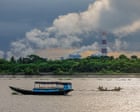
Dusk falls differently over the port of Odesa. It is heavy, bruised with the low rumble of distant thunder that everyone knows is not weather. For months, the horizon has belonged to steel and smoke rather than the golden silhouettes of loading cranes.
Stand on the concrete edge of Pier 4, and the air smells of old damp grain, bunker fuel, and salt. It is a working smell, the foundational scent of billions of mornings. Somewhere across this dark water, a freighter sits silent, its engines cold, caught in an invisible chokehold that stretches from the choppy swells of Eastern Europe all the way to a breakfast table in Cairo, Nairobi, and beyond.
We talk about geopolitics as if it were a board game played by men in suits thousands of miles away. We push numbers around spreadsheets. We track export quotas and maritime corridors like weather patterns. But geopolitics has a weight, and right now, that weight is resting squarely on the throats of ordinary people who have never set foot near a coastline.
Consider Tariq, a fictional bakery owner in Alexandria whose reality mirrors thousands of real ones right now. Every morning at four, before the minarets begin their call to prayer, Tariq fires up his massive brick ovens. The flour he pours into his wooden troughs isn't just an ingredient; it is a social contract. A loaf of bread is the one constant in a world of erratic currency, broken promises, and soaring inflation. When flour prices stay stable, society stays quiet. When they spike, the foundations begin to fracture.
For the past year, Tariq has watched the price of his primary commodity climb into the stratosphere, not because his local farmers forgot how to grow wheat, but because the Black Sea—historically one of the most prolific breadbaskets on Earth—has turned into a firing range.
To understand why a missile strike hundreds of miles away means an empty shelf in North Africa, you have to look past the abstract maps on the evening news. The Black Sea basin is responsible for supplying nearly a third of the world's wheat and barley. Ukraine and Russia together feed the planet's most vulnerable populations. When commercial shipping lanes are mined, blockaded, or targeted by aerial attacks, the global supply chain does not merely experience a delay; it suffers a cardiac arrest.
Insurance rates for cargo vessels entering these contested waters skyrocketed by astronomical margins almost overnight. Shipowners look at the risk, look at the potential payout, and simply say no. Crew members, courageous as they are, refuse to sail into a maritime graveyard. And so, millions of metric tons of golden grain sit rotting in silos, trapped behind a wall of steel and fear, while ships rust at anchor and breadlines lengthen across developing nations.
This is the hidden cost of conflict. It is not just measured in craters and ruined masonry. It is measured in empty calories, in desperate family budgets strained to the absolute breaking point, and in the quiet panic of a mother wondering how she will afford the next loaf.
History teaches us a harsh lesson we refuse to learn. Wars are fought with bullets and bombs, but they are sustained and suffered through hunger. From the ancient sieges of Mesopotamia to the modern grain corridors of Europe, controlling the food supply has always been the most potent weapon in an aggressor's arsenal. It requires no direct confrontation with an army; you simply starve the opponent's economy and let collateral damage do the rest.
When we watch the footage of attacks on Black Sea ports, our brains naturally distance ourselves from the horror. We tell ourselves it is a regional dispute. We view it through the flat screen of a smartphone, swipe to the next headline, and forget.
(Note: The following scenario is a logical extrapolation of verified trade data and maritime risk assessments.)
Picture a single grain elevator in central Ukraine, packed to capacity with the recent harvest. That grain was meant for export via Odesa. Without those exports, Ukrainian farmers face financial ruin, unable to pay their debts or plant the next season's seeds. Simultaneously, a milling plant in East Africa, dependent on those exact shipments, shuts down its assembly lines because alternative suppliers in North America or Australia cannot meet the sudden surge in demand without doubling prices. The ripple effect is instantaneous, brutal, and entirely borderless.
We are living through a profound illusion of insulation. In the developed world, we walk down supermarket aisles overflowing with imported goods, assuming the machinery of global trade is invincible. It is not. It is fragile, cobbled together by trust, open shipping lanes, and fragile treaties that can be shredded by a single missile launch.
The crisis in the Black Sea is a warning shot across the bow of modern civilization. It exposes just how dependent we remain on narrow, vulnerable geography for our daily survival. When the arteries of the sea are blocked, the entire global body politic begins to suffocate.
Solving this requires more than temporary diplomatic workarounds or military escort proposals fraught with escalation risks. It demands a complete reckoning with how easily global food security can be weaponized by bad actors. Until the international community guarantees safe, unhindered passage for the merchant fleets that feed humanity, the shadow over the water will only grow longer.
The sun dips below the horizon in Odesa, plunging the silent port into absolute darkness. Somewhere out there, beyond the invisible line where the water meets the sky, a freighter waits for a dawn that may take a very long time to arrive.