When the Spanish Civil War collapsed into Franco’s dictatorship in 1939, the national kitchen did not simply change—it fractured into an elaborate, desperate geometry of deception. The kitchen table became a theater of illusion where home cooks waged chemical warfare against starvation, attempting to replicate the foundational icons of Spanish cuisine using water, flour, baking soda, and whatever discarded vegetation could be salvaged from the gutter.
History often remembers military campaigns, but the real attrition happened over empty plates. Between 1939 and 1942, upwards of 200,000 Spaniards perished from malnutrition and outright starvation. The defeat of the Second Republic brought international isolation, internal blockades, and a draconian rationing system that lasted in various forms until 1952. In major urban centers like Madrid, Barcelona, and Valencia, the postwar period proved even more lethal and hungry than the active conflict itself.
The Anatomy of a Phantom Omelet
Consider the tortilla de patatas, the immutable crown jewel of Spanish gastronomy. Normally, this requires eggs, potatoes, and olive oil. During the darkest years of the Años de Hambre, these components vanished behind closed market doors and exorbitant black-market prices.
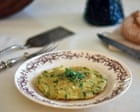
To trick both the eye and the stomach, resourceful culinary writers like Ignacio Doménech and ordinary housewives engineered terrifyingly creative substitutes. They built eggless, potato-free omelets using thin strips of orange peel or soaked stale bread to mimic the dense texture of potatoes. For the eggs, a precise chemical intervention took over: a batter whipped from water, flour, a pinch of bicarbonate of soda, and a microscopic drop of oil. When heated, the baking soda created carbon dioxide bubbles that puffed the batter up, simulating the coagulated protein of a true egg yolk.
This was not cooking. This was organic engineering driven by desperation.
The substitutions extended far beyond the breakfast table. Street vendors and home cooks fried deep-cut onion rings to masquerade as fried squid, relying on batter and heavy salting to trick the senses. Soup stock was routinely made with "rented" bones—a single butcher’s bone borrowed for a few copper coins, dipped into boiling water to impart a ghost of flavor, and then dutifully returned to the butcher for the next customer.
The Economics of Deprivation and the Black Market
The official narrative pushed by the regime claimed self-sufficiency, but the reality on the ground was governed by the estraperlo—the black market. Ration books provided meager allowances of bread, oil, and flour, but the portions were mathematically insufficient to sustain human life.
Families quickly exhausted their savings. Household items, heirlooms, and clothing were traded in rural provinces directly for sacks of wheat, dried beans, or illicit lard. The disparity between the countryside and the cities was stark. While rural villagers could occasionally forage for wild herbs, steal olives from commercial groves, or slaughter a hidden rabbit, urban populations faced concrete walls and heavily policed distribution centers.
Livestock feed made its involuntary debut on human plates. Fodder crops like beetroot and coarse turnips, normally reserved for cattle and pigs, were boiled down into stews. Protein scarcity became so acute that domestic pets fell into peril. In apartment blocks across Madrid, residents pasted frantic handwritten notes in shared stairwells begging neighbors to spare family cats. These animals were predators of urban rats, yet desperate citizens eyed them as a source of meat.
The Psychological Armor of Inventive Cuisine
Food historians frequently sanitize these eras, framing them through the cozy lens of rustic resourcefulness. That perspective insults the dead. The people inventing "wartime hake" (which was simply salted cod soaked beyond recognition) or drinking a burnt-chicory substitute for coffee were not participating in a charming historical workshop. They were fighting a psychological battle against despair.
Maintaining the ritual of cooking—sitting down around a table, passing a plate of ersatz food, and pretending it possessed substance—preserved a shred of human dignity under an authoritarian regime that sought to atomize civil society. Cookbooks published during and immediately after the conflict were survival manuals disguised as domestic guides. They taught citizens how to stretch a single onion across five meals, how to toast barley until it smelled like coffee, and how to turn orange rinds into delicacies through sheer force of culinary will.
When we look at contemporary Spanish cuisine, with its modernist deconstructions and high-end revivals of historical dishes, the shadow of this era lingers. The minimalist ethos of modern gastronomy shares a direct lineage with the zero-waste survival tactics of the 1940s. Back then, waste meant death. Every scrap of vegetable peel, every drop of rancid oil, and every crumb of stale bread was accounted for in an unforgiving ledger of survival.
The imagination required to cook without ingredients saved a generation, but the cost was etched into the collective memory of a nation that learned too well how little it takes for civilization to starve.