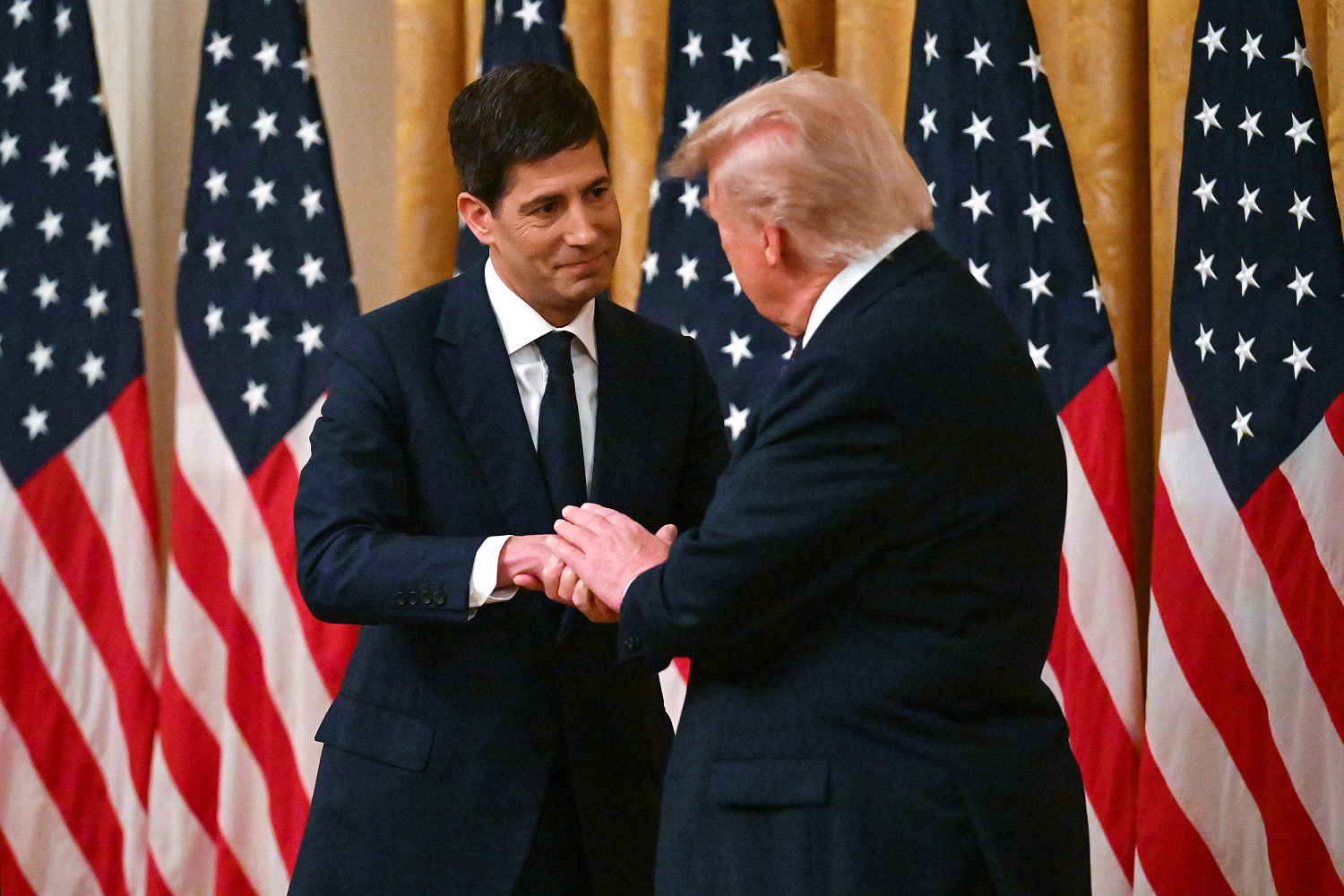
Kevin Warsh took the oath of office as Chairman of the Federal Reserve Board of Governors on Friday in the East Room of the White House, standing alongside a President who openly expects him to engineer an historic economic boom. While President Trump publicly insisted that his handpicked central banker should remain totally independent, telling him to "do your own thing," the political reality is far more transactional. Trump wants deep interest rate cuts to lower corporate and consumer borrowing costs, yet the macroeconomic environment has made those very cuts nearly impossible to deliver without triggering a structural emergency.
By staging the swearing-in ceremony at the White House—a highly unusual departure from standard central bank protocol not seen since Alan Greenspan in 1987—the administration signaled a desire for tighter alignment between executive ambition and monetary policy. Outgoing Chair Jerome Powell spent his final years enduring public insults from the Oval Office, resisting rapid rate cuts due to persistent inflationary pressures. Now, Warsh inherits a fractured institution, an aggressive President, and a global economy that refuses to cooperate with Washington's political timeline.
The baseline assumption on Wall Street was that a Warsh-led Fed would quickly slash rates to appease the White House. That assumption is wrong. The underlying economic fundamentals, severely aggravated by an escalating war with Iran and supply chain shocks, have effectively trapped the new Chairman before he can even hold his first Federal Open Market Committee meeting.
The Illusion of the Dovish Mandate
For the past year, the executive branch operated on a simple premise. The White House argued that the Federal Reserve was unnecessarily stifling American growth through high interest rates. In this view, swapping Powell for Warsh would remove the final roadblock to cheap credit.
But the economic data tells a radically different story.
Inflation is creeping upward again, driven by structural forces that no central bank can print or cut its way out of. The conflict with Iran has rattled energy markets, sending crude oil prices higher and instantly translating into steeper costs at American gas pumps. When energy costs spike, they bleed into everything from agricultural production to transcontinental shipping.
If Warsh aggressively cuts interest rates in this environment, he risks supercharging consumer demand at the exact moment the supply side of the economy is constrained by geopolitical friction. The result would not be a sustainable economic boom, but an inflationary spiral that could decimate the purchasing power of the middle class.
The Balance Sheet Dilemma
Beyond interest rates, Warsh faces an institutional mess on the Fed’s own ledger. The central bank's balance sheet remains bloated, hovering well above $6 trillion. During his previous tenure as a Fed governor from 2006 to 2011, and in his subsequent years at the Hoover Institution, Warsh was an outspoken critic of quantitative easing and massive asset-buying programs. He has repeatedly warned that an oversized balance sheet distorts financial markets and turns the central bank into an unintentional political tool.
| Economic Variable | Current Status (May 2026) | Political Objective | Market Reality |
|---|---|---|---|
| Federal Funds Rate | Elevated to combat sticky inflation | Rapid reductions to stimulate growth | Trapped by rising commodity and energy prices |
| Fed Balance Sheet | Exceeds $6 trillion | Secondary priority for the executive branch | Warsh desires contraction; selling assets tightens credit |
| Geopolitical Risk | Active war involving Iran | Ignored in domestic political rhetoric | Driving up global shipping and energy costs |
Warsh has committed to trimming this asset portfolio. Shrinking a $6 trillion balance sheet requires the Fed to either let bonds mature without replacing them or sell them outright into the open market. Both actions drain liquidity from the banking system, which naturally pushes long-term borrowing costs higher.
This creates a glaring policy contradiction. Warsh cannot easily fulfill the President's demand for cheaper money while simultaneously executing his own long-held doctrine of draining excess liquidity from the financial system.
The Untested Artificial Intelligence Argument
During his confirmation hearings before the Senate Banking Committee, Warsh attempted to bridge this ideological gap by introducing a novel economic theory. He argued that the American economy is on the cusp of an artificial intelligence productivity boom.
According to this thesis, widespread corporate adoption of machine learning and advanced automation will drastically increase output while lowering production costs. In a hyper-productive economy, supply expands fast enough to meet demand, allowing the central bank to lower interest rates without triggering inflation. It is an elegant theory that justifies both Trump's growth agenda and Warsh's desire for structural reform.
The problem is that this productivity miracle remains largely invisible in official macroeconomic data.
While tech firms are investing billions into infrastructure, the broader economy has not yet experienced the massive, nationwide efficiency gains required to offset the immediate inflationary pressures of a foreign war and high energy costs. Relying on future tech-driven productivity to justify immediate interest rate cuts is a dangerous gamble. If the productivity boom takes five years to materialize but the rate cuts happen next month, the economy will face an immediate inflation crisis.
"Kevin Warsh starts his tenure with his credibility in tatters," noted Senator Elizabeth Warren on Friday, reflecting the deep skepticism among congressional Democrats who view the new Chairman's shifting views on interest rates as political opportunism rather than sound economic stewardship.
While critics label him a political operative, his defenders point to his extensive Wall Street background. As a former Morgan Stanley mergers and acquisitions executive, Warsh approaches monetary policy through the lens of financial markets rather than pure academic theory. He understands how corporate boardrooms react to credit conditions, which could make him more pragmatic than his detractors fear.
The Historical Precedent of Executive Encroachment
The tension between the White House and the Federal Reserve is not new, but the directness of the current pressure is unprecedented in the modern era. When the executive branch attempts to dictate monetary policy, the long-term consequences are rarely positive.
In the early 1970s, President Richard Nixon successfully pressured Fed Chairman Arthur Burns to keep interest rates artificially low ahead of the 1972 presidential election. Burns complied, prioritizing short-term political economic expansion over long-term stability. The result was the "Great Inflation" of the 1970s, a disastrous decade of stagflation that required painful, double-digit interest rates under Paul Volcker to finally cure.
[Oval Office Political Pressure]
               │
               ▼
[Artificially Low Interest Rates]
               │
               ▼
[Short-Term Boom / Accelerated Demand]
               │
               ▼
[Severe Supply Shocks / Energy Crisis]
               │
               ▼
[Uncontrolled Structural Inflation]
Warsh is acutely aware of this history. He knows that if he cuts rates too quickly to satisfy political promises, his legacy will resemble that of Arthur Burns rather than Paul Volcker. Yet, if he maintains a restrictive stance to fight the inflation stoked by global conflict, he will face the same fierce executive condemnation that ultimately forced Jerome Powell out of the institution.
The Real Mechanism of Fed Independence
The true test of Warsh's chairmanship will occur behind closed doors during the upcoming FOMC meetings. The Federal Reserve does not operate as a dictatorship; monetary policy decisions are voted on by a committee of regional Fed presidents and governors who hold staggered terms and cannot be easily removed by the President.
Many of these committee members are deeply conservative regarding inflation risks. They look at the current geopolitical environment, the supply disruptions in the Middle East, and the sticky service-sector inflation data, and they see no justification for easing credit.
Even if Warsh wanted to push through aggressive rate cuts to align with executive desires, he would face significant internal resistance from career central bankers. A Chairman who cannot build consensus within his own committee quickly loses authority over the markets. If Wall Street senses that the FOMC is fractured, bond yields will fluctuate wildly, undermining the very stability the central bank is designed to protect.
The financial world is watching to see how the new Chairman balances his clear obligations to the law with the intense political gravity of the administration that appointed him. The celebratory atmosphere of the White House East Room will quickly fade when the next round of consumer price index data lands on the Chairman's desk. The numbers do not care about political alignments, and right now, the numbers are telling Kevin Warsh to keep his hands off the interest rate levers.


(mh=Dw6W9uWaLcHnfEql)0.jpg)
