In April 1984, the Space Shuttle Challenger roared off the launchpad on mission STS-41-C, carrying a high-priority payload that included the repair of the Solar Maximum satellite and a much smaller, buzzing passenger manifest. Roughly 3,300 honeybees were tucked away inside a custom-built aluminum container known as the Bee Enclosure Module. Their objective was deceptively simple. Build a honeycomb in absolute microgravity.
For decades, popular accounts have treated this student-conceived project as a quirky space-age footnote, a bizarre diversion from serious orbital mechanics. That perspective misses the deeper mechanical and biological reality. Honeybees do not merely inhabit a hive; they engineer it using the physical constants of Earth, relying on gravity to orient their wax structures and communicate vector pathways through their iconic waggle dances. Stripping away downward pull did not just confuse the insects. It forced researchers to confront a fundamental question about terrestrial life. How much of our biological programming depends entirely on the constant drag of planetary mass?
The 1984 flight was actually NASA's second attempt at answering this question. Two years prior, a smaller contingent of fourteen bees had been sent into orbit and suffered a complete failure. Those earlier insects faced a poorly designed enclosure, starved because they could not navigate to diluted liquid feed on smooth plastic surfaces, and ultimately perished without building anything. That failure taught aerospace engineers a harsh lesson. Living organisms cannot be dropped into an orbital vacuum without accounting for the sensory deprivation of weightlessness.
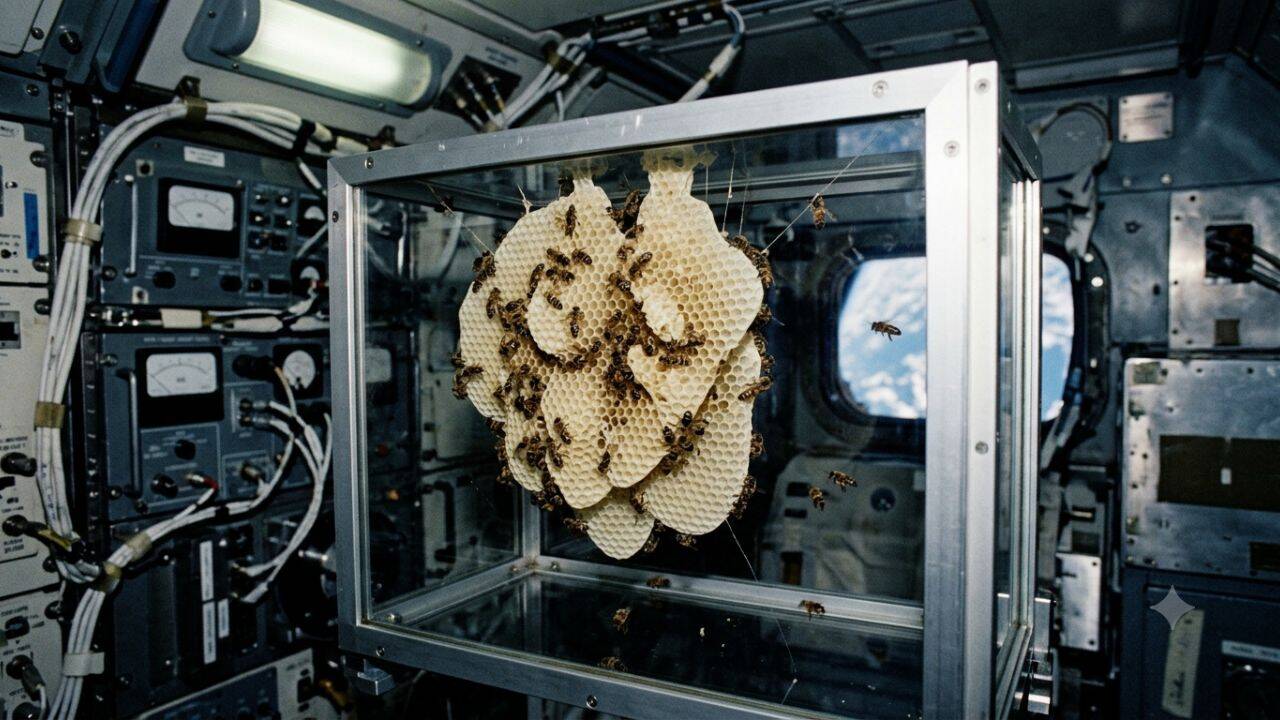
When mission planners prepared the STS-41-C package, designed by Tennessee Technological Institute student Dan Poskevich and engineered by Honeywell, they factored in those hard-won lessons. The new habitat measured roughly eighteen by nineteen inches, lined with textured mesh screens that allowed the bees to grip their surroundings rather than drifting chaotically. Inside this specialized box, the 3,300 workers faced a profound physical disorientation.
On Earth, worker bees build comb by sensing gravity to align their hexagonal cells downward. Without that vector, the initial hours of the 1984 flight were chaotic. Eyewitness video and post-flight reports noted that the insects initially struggled to coordinate their flight patterns, kicking their legs against empty air and failing to achieve standard aerodynamic stability. Yet, adaptation happened swiftly. Within days, the colony adjusted its locomotion, learning to navigate the enclosure through a mix of flight and surface gripping.
Then came the construction phase. The bees began secreting wax from their abdominal glands, handling the tiny flakes with their mandibles, and attempting to fashion their signature geometric chambers. Without a universal "up" or "down," the comb did not grow in the neat, parallel sheets seen in a standard backyard hive. Instead, the insects constructed roughly 31 square inches of honeycomb oriented at varying, irregular angles.
Crucially, the cellular architecture itself remained intact. The individual cells maintained their hexagonal integrity. The bees did not forget how to build a polygon, even when they lost their directional compass. Furthermore, the colony maintained its internal social order. Worker bees continued to groom one another, managed the disposal of deceased peers, and kept the operational rhythm of the hive moving forward despite the alien environment. The reigning queen even managed to deposit 35 eggs during the mission, proving that reproductive biology could at least initiate in free fall.
Skeptics at the time dismissed the output as a biological novelty with no practical application. After all, 31 square inches of crooked comb produced zero usable honey during a week-long shuttle flight. But aerospace life-support engineers viewed the data through a different lens. As modern space agencies plan permanent lunar outposts and long-duration transit to Mars, the challenge of biological closed-loop life support grows increasingly urgent. Feeding crews far from Earth will eventually require localized agriculture, which in turn demands reliable pollination vectors.
The 1984 Challenger experiment proved that complex cooperative instincts do not instantly shatter when gravity is removed. Insects possess hardwired behavioral scripts that run independently of planetary physics, provided their immediate sensory and structural needs are met. Future agricultural architectures in deep space will not need to artificially recreate Earth's gravity to secure basic biological productivity from animal partners. They will simply need to engineer better interfaces.
The aluminum container that housed those orbital workers now sits quietly in the collection of the Smithsonian National Air and Space Museum. It stands as a reminder that humanity's push into the cosmos has always relied on the smallest, most stubborn passengers we could bring along for the ride.
.jpg?width=1200&auto=webp&trim=0%2C27%2C0%2C173)