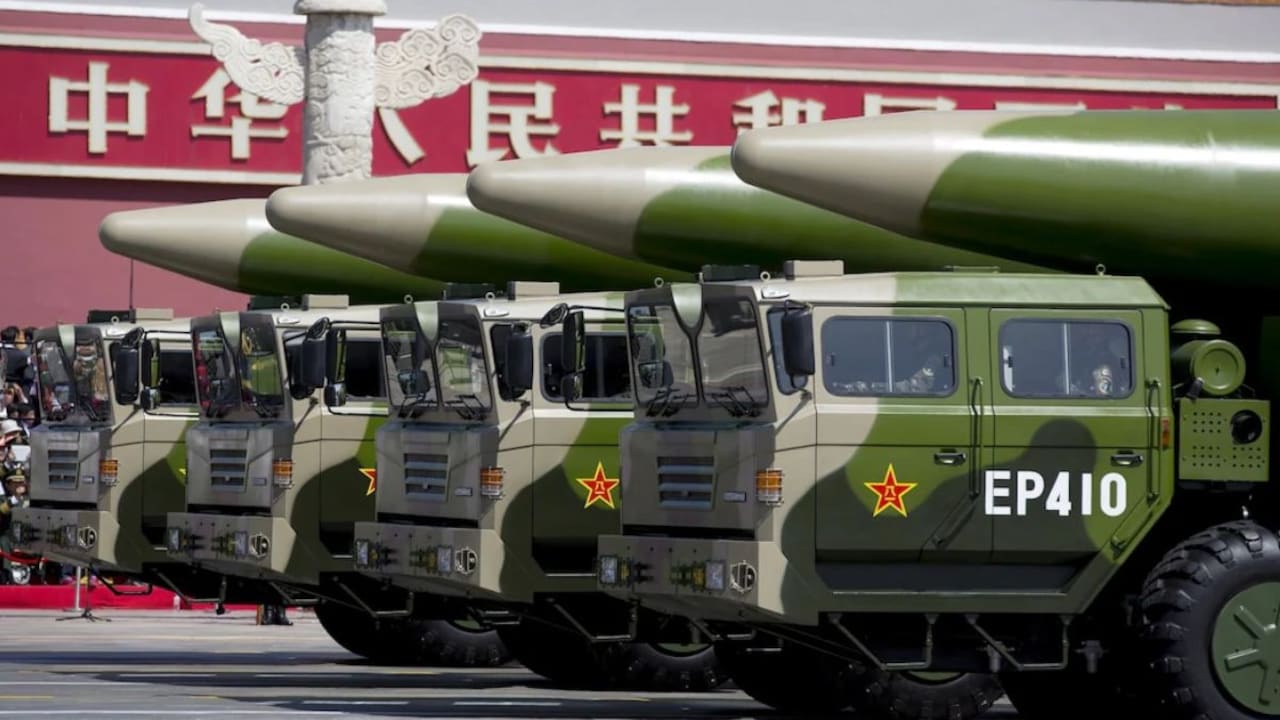
The operational utility of traditional airborne force multipliers—specifically airborne early warning and control platforms, aerial refuelers, and electronic intelligence nodes—relies on spatial insulation. Historically, these high-value airborne assets operated thousands of meters in the air and hundreds of miles behind frontline tactical fighters, secure in the assumption that distance functioned as an absolute defensive barrier. The emergence of long-range hypersonic glide architectures mated with specialized kinetic delivery mechanisms fundamentally invalidates this spatial buffer. By compressing transit times across multi-thousand-kilometer operational theaters, this capability forces a structural re-evaluation of anti-access and area-denial strategies without relying on sensationalized threat inflation.
The Mechanics of Kinetic Compression
Standard tactical interception relies on high-subsonic or low-supersonic air-to-air missiles whose kinematic energy degrades rapidly over extended ranges due to atmospheric drag and fuel depletion. Hypersonic glide vehicles bypass this traditional energy management curve through exo-atmospheric boost-glide trajectories. A booster lifts the payload to near-space altitudes, after which the vehicle re-enters the upper atmosphere and utilizes aerodynamic lift coupled with extreme velocity—typically exceeding Mach 5—to sustain an unpredictable flight path.
This profile alters the traditional time-distance equation governing aerial engagement. When applied to high-value airborne assets, the weapon system eliminates the warning time traditionally afforded by conventional radar tracking of standard cruise or ballistic missiles.
- Boost Phase: High-thrust rocket motors project the payload outside dense atmospheric layers, establishing an initial high-energy state.
- Glide Phase: The vehicle skips or glides horizontally along the upper stratosphere, minimizing thermal decay while maintaining high maneuverability.
- Terminal Engagement: Passive or active multi-spectrum seekers acquire large, unstealthy radar cross-sections characteristic of support aircraft, executing a terminal dive that circumvents defensive countermeasures.
The operational consequence is a direct reduction of reaction windows from tens of minutes to mere seconds. Because platforms like AWACS and aerial tankers lack the kinematic agility or electronic countermeasures suites of dedicated frontline fighter aircraft, they represent soft targets when exposed to sustained hypersonic vectors.
Strategic Implications for Theater Architecture
The deployment of long-range hypersonic strike capabilities against airborne support nodes forces a doctrinal contraction of expeditionary air power. Modern air combat operations in contested environments depend heavily on an uninterrupted logistics and data-fusion chain. Aerial refuelers extend the combat radius of tactical fighters, while airborne command posts aggregate sensor data across distributed networks.
When these nodes are pushed further backward to evade incoming engagement envelopes, second-order operational bottlenecks emerge:
- Sortie Generation Decay: Increased transit distances between rear-area staging bases and forward engagement zones reduce the effective on-station time of tactical strike aircraft.
- Communications Latency: Pushing command and control nodes further from the tactical edge degrades data-link throughput and increases vulnerability to localized electronic jamming.
- Asset Concentration: Reduced operational airspace forces high-value assets into compressed holding patterns, elevating their vulnerability to saturation attacks.
This dynamic creates a severe asymmetry in defense economics. Defending a high-value support aircraft against a high-velocity, maneuverable threat requires multi-layered kinetic and directed-energy interceptors that are orders of magnitude more expensive than the marginal cost of the offensive launcher.
Systemic Vulnerabilities and Limitations
Despite the strategic pressure exerted by hypersonic anti-access systems, technical and physical constraints bound their operational effectiveness. Hypersonic flight regimes generate extreme thermal friction, ionizing the surrounding air and creating a plasma sheath that can severely degrade internal radio-frequency communication and radar tracking unless specialized apertures or transmission windows are utilized.
Furthermore, targeting high-value airborne assets at extreme ranges requires real-time, high-fidelity cueing data. Because these support aircraft maintain emission control discipline or operate far from frontline radars, the offensive system relies heavily on a distributed, resilient sensor grid—including space-based infrared surveillance and over-the-horizon radar networks—to maintain custody of the target track prior to weapon release. Any disruption to this reconnaissance-strike complex degrades the weapon's terminal accuracy, transforming a precision engagement into a speculative area-saturation attempt.
Strategic Execution and Operational Adaptation
Mitigating the vulnerabilities exposed by hypersonic anti-access architectures requires shifting away from centralized, large-signature support platforms toward distributed, redundant network models. Military planners must prioritize the development of uncrewed refueling platforms with reduced radar signatures, decentralized command-and-control payloads distributed across commercial or hardened modular airframes, and autonomous sensor nodes capable of operating closer to contested zones without requiring continuous, high-bandwidth umbilical links to rear-echelon headquarters. The objective is not to find a kinetic silver bullet against hypersonic glide vehicles, but to eliminate the high-value, single-point-of-failure assets that make such weapon systems strategically decisive.

.jpg?width=1200&auto=webp&trim=0%2C27%2C0%2C173)