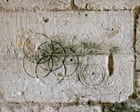
The oak beam inside the 14th-century tithe barn at Bradford-on-Avon is cold, dense, and slightly damp to the touch. If you run your fingers along the grain, past the deep grooves left by adzes six hundred years ago, you will eventually hit a smooth, shallow indentation. It is a perfect six-petaled flower, neatly incised into the wood with a iron compass.
For the last decade, tour guides and heritage agencies have given this little flower a terrifying, thrilling name: a witch's mark.
We are told a specific story about these symbols. It is a narrative of trembling peasants, flickering tallow candles, and a suffocating fear of the dark. In that version of history, the overlapping lines are a spiritual snare, an apotropaic maze carved into thresholds and mantelpieces to trap passing demons before they could sour the milk or murder the livestock. When heritage organizations launched nationwide public hunts for these marks, thousands of people stared at the walls of old houses and felt a sudden, chilling connection to a paranoid past. We wanted to see the fear. We wanted to believe that the old world was haunted, and that our ancestors left their terror written in stone.
But the real human story left on those walls is entirely different. It is arguably much more moving, though it has nothing to do with the occult.
Consider a boy named Thomas, standing in that exact barn during the dead of winter in 1380. The harvest is long over, the grain is stacked, and the vast, cavernous building is quiet save for the whistling wind. Thomas is fourteen years old. His hands are raw from the cold, and his knuckles are stained with gray stone dust. He is not staring into the shadows looking for devils. He is looking at a slab of scrap limestone, trying to understand how a straight line can become a curve.
Beside him stands a master mason. The master does not hand Thomas a book, because books are rare treasures locked away in monasteries. Instead, he hands the boy an iron compass and a straightedge.
"Do it again," the master says.
Thomas presses the sharp point of the tool into the stone, pivoting the iron leg to sweep a perfect circle. Without changing the width of the compass, he drops the point onto the circle’s edge and swings another arc. Then another. Six times around.
When he lifts the tool, the stone bears a flawless hexafoil. A daisy wheel.
To a modern romantic, it looks like magic. To Professor Jennifer Alexander, a leading architectural historian at University of Warwick, it looks like a Tuesday afternoon geometry class.
The recent revelation that these celebrated "witch marks" are actually the remnants of medieval trade schools has sent a quiet shockwave through the world of British heritage. For years, organizations like English Heritage and Historic England have pointed to places like Gainsborough Old Hall, boasting of a "staggering array" of ritual protection symbols discovered on the walls. They told us the simple circles were demon traps, and that the overlapping V carvings were secret invocations to the Virgin Mary—Virgo Virginum—etched by frantic souls looking for divine shields.
It was a brilliant marketing campaign. It was also, as it turns out, entirely hollow.
When you strip away the modern folklore, the evidence for mystical meanings evaporates. The daisy wheels littering England's historic timber and stone are not weapons against the supernatural; they are practical geometry. They are the universal exercises used to train young apprentices how to master intractable surfaces.
Think back to your own childhood. Do you remember the quiet, satisfying click of your first plastic school compass? Do you remember the idle hours spent filling the margins of your notebook with interlocking circles, watching a flower bloom out of pure mathematics?
The boys who built the cathedrals of Europe did the exact same thing. They just did it on stone.
The variance in the quality of these marks tells the story beautifully. Some daisy wheels are breathtakingly precise, cut with a steady hand that knew exactly how much pressure to exert on a rotating blade. Others are clumsy, slipping out of alignment, their petals warped where an awkward adolescent hand lost its grip on the iron tool. A defensive talisman against a hellish entity would surely require precision; a teenager trying to figure out how a compass works does not.
The same pragmatism unravels the mystery of the overlapping W and M carvings, so often romanticized as Marian symbols. In the messy reality of a medieval construction site, these were mason ciphers. They were assembly guides, the 14th-century equivalent of a flat-pack furniture instruction manual. When a team of carpenters was preparing a massive timber roof framing system on the ground, they scratched matching characters into the joints so that the laborers hoisting the heavy oak into the sky would know exactly which piece locked into another.
Admitting this feels a bit like finding out the monster under the bed is just a pile of laundry. There is a distinct, melancholic letdown when the supernatural is replaced by the mundane. We are living through an era of profound uncertainty, and there is a strange comfort in imagining that our ancestors possessed secret, magical symbols to ward off the things that scared them. We want the world to be enchanted, even if that enchantment is born of terror.
But treating these buildings like ancient horror movies does a profound disservice to the human beings who actually lived in them.
When we look at a daisy wheel and see a witch mark, we are projecting our own dark fantasies onto the past. We turn our ancestors into a caricature of ignorance, a collective of terrified peasants cowering in the dark.
When we look at that same wheel and see a lesson plan, the centuries melt away. We are suddenly standing next to an ordinary person who was trying to learn a skill, earn a living, and build something beautiful that would outlast his own brief life. The barn at Bradford-on-Avon wasn't a fortress against the dark arts. It was a classroom. It was a space where the old passed their hard-won knowledge down to the young, using the universal language of triangles, arcs, and lines.
The marks are not signs of fear. They are the physical graffiti of human ambition, scratched into the architecture of survival.