Picture a scholar sitting by candlelight in a timber-framed pavilion during the Ming dynasty. Outside, rain taps a steady rhythm against tiled roofs. Inside, the air smells of warm wine, damp earth, and aged paper. The scholar reaches for a three-footed blue-and-white porcelain cup. He fills it.
Instantly, something impossible happens at the bottom of the vessel.
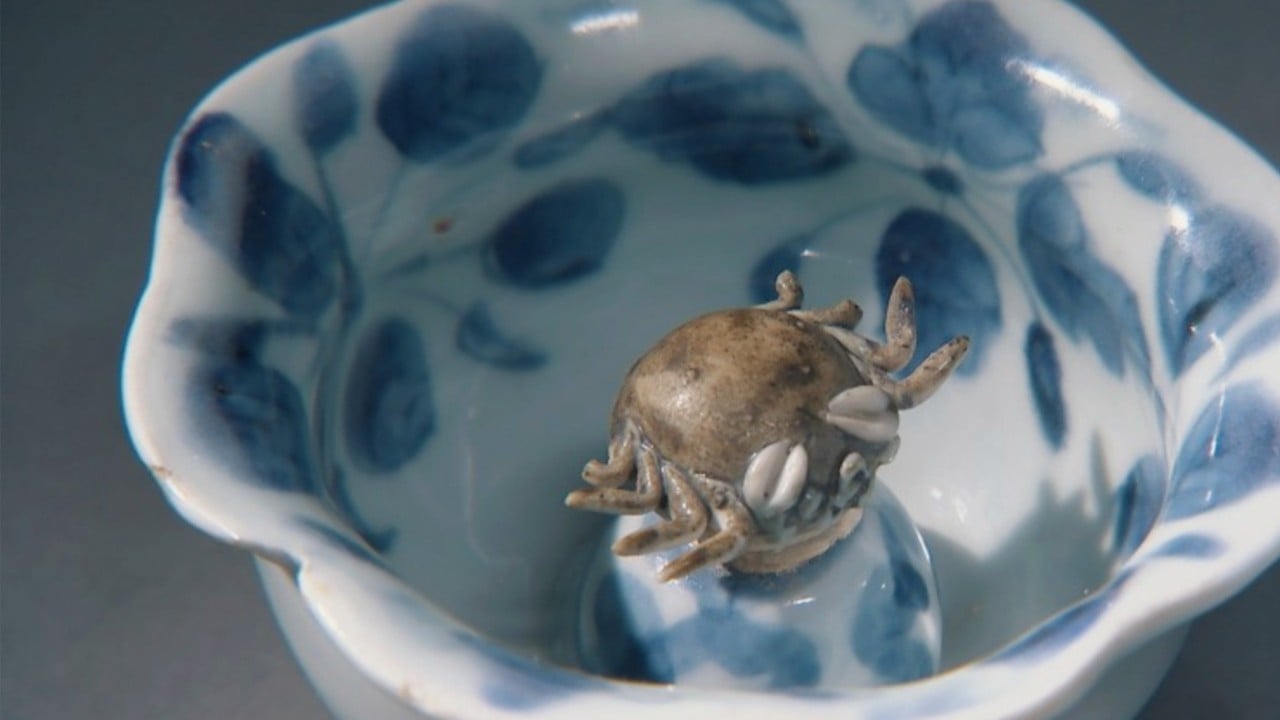
A tiny, grey-green ceramic crab detaches from the floor, kicking up its legs and beginning to swim. It whirls and dances in the rising liquid, frantically trying to escape the rising tide of wine. It is not magic. It is engineering born of profound wit.
Between 2018 and 2022, archaeologists working in the muddy ruins of the ancient Zhouqiao Bridge in Kaifeng, China, pulled this exact object from the historical record. Buried beneath layers of Yellow River silt and centuries of forgotten wars, the floating crab cup survived. When researchers poured water into it for the first time in hundreds of years, the mechanical illusion still worked. The ceramic creature came back to life.
The mechanics are brilliantly deceptive. When the cup stands empty, a minute porcelain crab rests motionless on a bell-shaped dome at the base. Pour wine or water into the vessel, and the liquid rushes through hidden perforations at the foot of the dome. Buoyancy takes over. An upward force catches the hollow-bodied crab, lifting it toward the surface. To keep the creature from floating completely away into the drinker's mouth, a tethered internal pin acts as a mechanical leash, capped with a head wider than the dome's opening.
The result is an optical illusion that bridges a six-hundred-year chasm.
We often think of history as a series of heavy, solemn milestones: battles, treaties, dynastic collapses. We forget that people thousands of years ago loved a good trick. They wanted to laugh at the dinner table. They wanted their wine cups to surprise them.
Yet this floating crab was not an isolated stroke of genius. It was the evolutionary descendant of a much older tradition. Four centuries earlier, during the Tang dynasty, poets like Du Fu drank from vessels featuring the "dancing immortal cup". In those older versions, a miniature figure of an immortal would float and spin when the cup filled, honoring legendary figures like Li Bai, one of the famed Eight Immortal Drinkers.
Over hundreds of years, Chinese artisans shifted their inspirations. The immortal figures gave way to fauna, transforming a spiritual motif into an interactive joke. By the Song dynasty, similar designs were making their way across elite circles, eventually inspiring Berlin's Museum of Asian Art to house its own surviving fragments of this whimsical engineering.
Recreating this artifact today is an exercise in extreme humility. Modern Henan ceramicist Guo Yong spent three grueling years trying to replicate the floating crab cup. Every single crab claw had to be sculpted entirely by hand. The firing process demands four separate trips through a kiln. The margin for error is so punishing that the successful yield rate sits at less than one percent. Most attempts warp, crack, or fail to achieve the precise weight distribution required for the buoyancy trick to function.
Consider what this object means in modern hands. A collector named Miao recently acquired one of Guo's rare successful replicas. Every morning, Miao uses the porcelain vessel to drink his tea. He watches the tiny grey-green crustacean lift off its pedestal, struggling against an invisible tether as the liquid settles.
He calls it healing.
In a culture steeped in linguistic puns, the cup is a symphony of good wishes. The word for floating sounds like blessing. The word for crab sounds like gratitude. Its claws echo the phonetic word for money. Even the term for a river crab shares sound with harmony. It is a physical manifestation of optimism molded from mud, water, and fire.
We build screens that glow with a million pixels to keep us entertained, searching endlessly for digital novelty. Down in the silt of Kaifeng, an anonymous artisan proved that true wonder requires no electricity. It only takes a cup, a hidden pin, and a ceramic creature desperate to escape the wine.