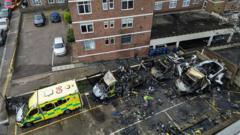
The release of a 24-year-old suspect on bail following a targeted arson attack against a Jewish volunteer ambulance service in Hackney marks more than just a procedural update in a criminal case. It signals a breakdown in the unspoken contract of urban safety. When a vehicle belonging to Hatzola—a renowned emergency medical provider—is torched outside its own headquarters, the act transcends simple property damage. It is an assault on a vital organ of the community. While the Metropolitan Police continue their investigation into the fire that gutted the vehicle on Lordship Road, the legal limbo of a "bail release" leaves a neighborhood on edge and raises uncomfortable questions about the rising tide of antisemitic violence in London.
The incident occurred in the early hours of the morning, a time when the streets of Stamford Hill are usually quiet. Witnesses reported a sudden bloom of heat and light as the specialized ambulance, equipped with life-saving technology funded by private donations, became a charred skeleton within minutes. The speed of the attack suggests intent. This was not a random act of teenage mischief or a fire started by a faulty battery. This was a message sent to a group that provides emergency care to everyone, regardless of faith, though its roots are firmly planted in the Charedi Jewish community.
The Fragility of Voluntary Emergency Infrastructure
Hatzola occupies a unique space in the London emergency response ecosystem. It is a volunteer-led organization that often reaches patients faster than the overstretched London Ambulance Service (LAS) due to its hyper-local presence. By attacking an ambulance, the perpetrator did not just hit a religious symbol; they removed a life-saving asset from the grid.
The replacement cost of a modern ambulance, outfitted with defibrillators, oxygen systems, and trauma kits, regularly exceeds £100,000. For a charity, that is not a rounding error. It is a massive blow to operational capacity. When the police announce a suspect has been released on bail, the community feels the sting of that vacancy twice over—once in the loss of the vehicle and again in the lack of immediate judicial finality.
We have to look at the mechanics of why these attacks are becoming more brazen. Security experts point to a shift in how hate crimes are executed. It is no longer just about graffiti or verbal abuse in the street. We are seeing a move toward high-impact, high-visibility destruction designed to instill a sense of permanent vulnerability. The choice of an ambulance is calculated. It is a symbol of help and mercy. Burning it is a way of saying that even the healers are not safe here.
The Bail Dilemma and Public Perception
In the British legal system, bail is a presumption, not a privilege. Unless the police can prove a significant risk of flight, interference with witnesses, or an immediate danger to the public, a suspect will likely walk out of the station pending further inquiries. To a veteran investigator, this is standard procedure. To a resident of Hackney who just saw an ambulance melted into the pavement, it feels like a failure of the state to take the threat seriously.
The gap between legal reality and public anxiety is widening. The Metropolitan Police have classified the incident as a hate crime, a designation that carries heavier sentencing weight but does not necessarily change the immediate conditions of bail. This creates a vacuum of trust. When a suspect is returned to the streets while the forensic evidence is still being processed in a lab, the message to the community is one of "wait and see." But for those living in the shadow of Lordship Road, waiting is a luxury they feel they can no longer afford.
A Pattern of Escalation in North London
This arson attack does not exist in a vacuum. It is part of a documented spike in antisemitic incidents across the capital that has seen a sharp incline over the last eighteen months. Data from groups like the Community Security Trust (CST) show that physical assaults and targeted property damage have moved from the periphery of social concern to the center of daily life for London's Jewish population.
The geography of these attacks is telling. Stamford Hill is home to one of the largest Orthodox Jewish communities in Europe. It is a dense, vibrant, and highly visible enclave. That visibility is its strength, but it also makes it a concentrated target for those looking to vent geopolitical frustrations or deep-seated prejudices on local neighbors. The arson on Hatzola is a terrifying escalation because it targets a service that is universally recognized as "good." There is no political nuance to an ambulance. There is no controversial policy held by a paramedic. There is only the provision of care.
The Failure of Deterrence
If the legal system cannot provide immediate consequences for high-profile hate crimes, the burden of security shifts to the private sector. We are now seeing a massive influx of private security spending in North London. Synagogues, schools, and even community centers are being turned into mini-fortresses.
- Increased use of thermal imaging cameras to detect intruders before they reach vehicles.
- The installation of reinforced bollards to prevent ramming attacks.
- The hiring of private patrols to supplement the thinning ranks of the Metropolitan Police.
This shift represents a privatization of safety that should be a public right. When a community has to pay twice—once through taxes and again for private guards—to ensure their ambulances aren't burned in the night, the social contract is frayed beyond recognition.
The Investigative Hurdles of Arson
Arson is a notoriously difficult crime to prosecute. The fire itself often destroys the very evidence needed to secure a conviction. DNA is vaporized. Fingerprints are scorched off surfaces. Accelerants leave traces, but connecting those traces to a specific individual requires a chain of custody and forensic precision that takes months to solidify.
This technical reality is why suspects are often released on bail. The police may have enough for an initial arrest based on CCTV or a witness statement, but "beyond a reasonable doubt" requires more. In the case of the Hackney attack, investigators are likely scouring hundreds of hours of grainy footage from private doorbells and council cameras, trying to map the suspect's movements before and after the strike.
The struggle is that while the police follow the slow grind of forensic science, the psychological impact of the crime moves at the speed of social media. Photos of the charred Hatzola unit were viral within an hour of the flames being extinguished. By the time the suspect was released on bail, the community had already lived through a thousand cycles of fear and speculation.
Beyond the Charred Metal
The Hatzola arson is a symptom of a much larger malaise in urban policing. It highlights a recurring theme in modern London: the struggle to protect specific minority groups from becoming the localized lightning rods for global tensions. When we stop seeing an ambulance as a neutral vessel of mercy and start seeing it as a target for fire, we have lost a fundamental piece of our civic identity.
The recovery of the Hatzola service will likely be funded by the same community that was targeted. They will buy a new ambulance. They will install more cameras. They will continue to respond to heart attacks and car accidents with the same speed as before. But the scorch marks on the pavement of Lordship Road will remain a reminder that for some, the mere act of providing help is enough to warrant a torch.
The true measure of the investigation will not be the arrest, but the eventual outcome in a courtroom. Until then, the release of a suspect on bail serves as a cold reminder that justice in the aftermath of hate is rarely swift, and never simple. The charred remains of a life-saving vehicle are a loud, silent testament to the work that remains to be done in securing the streets for everyone.
The focus must now shift toward a more aggressive, preventative posture that doesn't just react to the smoke but identifies the fire before it starts.