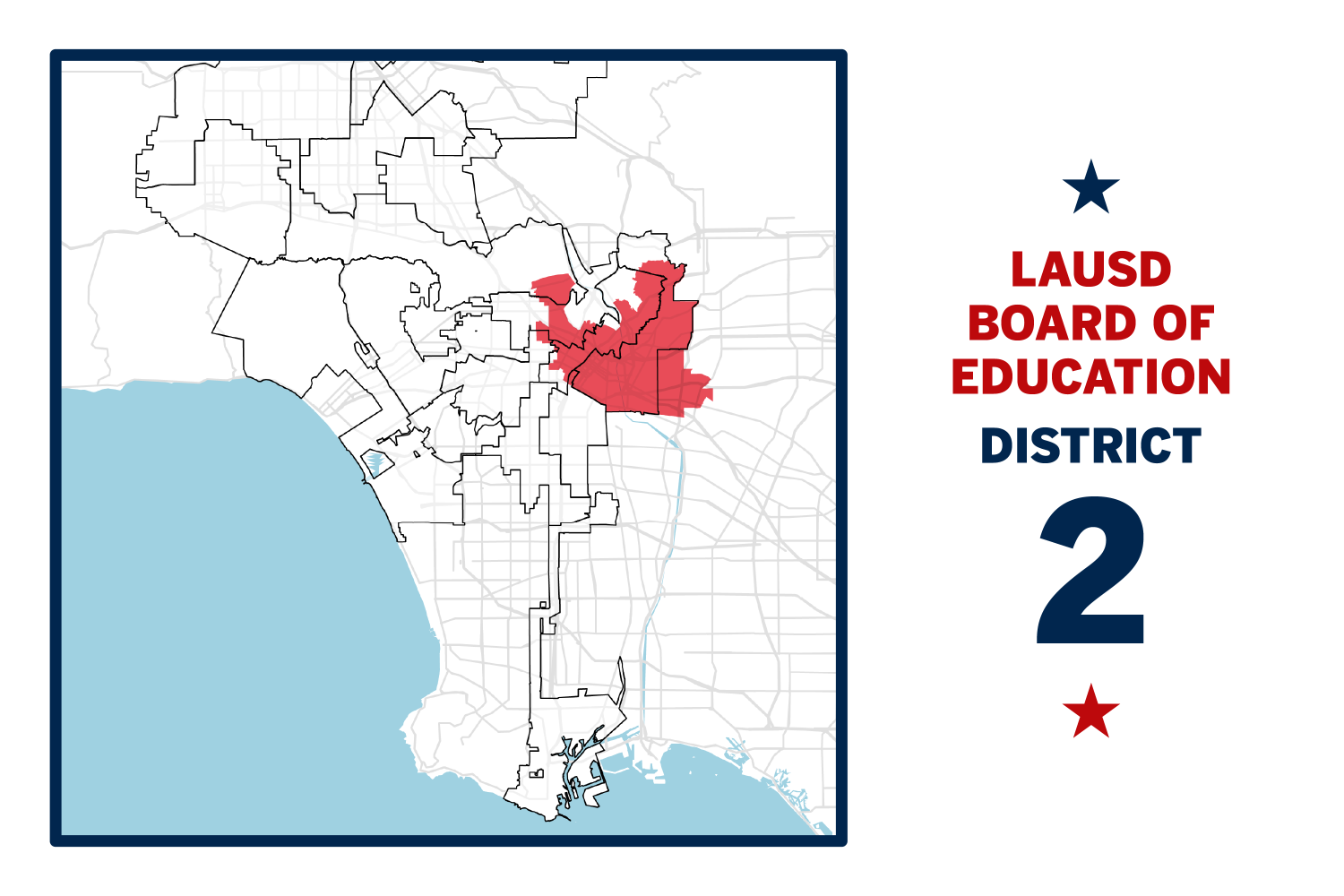
The peeling paint on a classroom door in East Los Angeles isn't just a maintenance oversight. It is a boundary marker. On one side sits the promise of the American dream, neatly packaged in textbooks and standardized tests. On the other lies the reality of a system buckling under the weight of its own bureaucracy, serving a population of students who often feel like afterthoughts in a political chess match.
This is District 2 of the Los Angeles Unified School District. It is a sprawling, vibrant, and exhausted geography that stretches from the historic streets of East L.A. through the dense corridors of Downtown and into the hills of Los Feliz. When the sun sets over the 101 freeway, it illuminates thousands of windows where parents are sitting at kitchen tables, staring at report cards or IEP forms, wondering if the person sitting on the Board of Education actually knows their child’s name.
They don't. Not individually. But the person who wins this seat will decide if those children get a nurse on Tuesdays, if their arts program survives another budget cycle, and whether their school remains a traditional public institution or pivots toward the charter model.
The choice isn't between two names on a ballot. It is a choice between two distinct philosophies of survival.
The Incumbent and the Researcher
Rocío Rivas walks with the measured pace of someone who has spent years dissecting data in the quiet corners of an office, only to realize the data is screaming. As the incumbent, she carries the heavy mantle of the status quo while simultaneously trying to dismantle it. Her background isn't in glad-handing; it’s in research. She earned a doctorate in international agriculture and extension education, but her true laboratory has been the classroom.
Rivas represents the defensive line for traditional public schooling. To her supporters, she is the guardian of the gate, preventing the privatization of a public good. She looks at a school and sees a community hub that requires more than just better test scores—it needs a "community school" model where healthcare, housing support, and mental health services are woven into the fabric of the campus.
But the reality of her tenure is complicated. Under her watch, and the watch of those before her, the district has struggled with declining enrollment and a massive, looming budget deficit. Critics argue that her loyalty to the United Teachers Los Angeles (UTLA) union creates a conflict of interest that prioritizes adult employment over student outcomes.
Consider a hypothetical student named Mateo. Mateo attends a middle school in Boyle Heights. He’s bright, but he’s three grade levels behind in reading. For Rivas, the solution for Mateo is systemic. It involves stabilizing his school’s funding, ensuring his teachers aren't burnt out, and providing a safety net that catches his family before they are evicted. It’s a long-game strategy. It’s slow. It’s expensive. And for a parent watching Mateo struggle now, it can feel like watching grass grow while the house is on fire.
The Challenger and the Counselor
On the other side of the ring stands Raquel Zamora. If Rivas is the researcher, Zamora is the practitioner. A longtime school counselor and teacher, Zamora’s perspective was forged in the hallways, not the ivory tower. She has spent her career looking into the eyes of students who are falling through the cracks, the ones who don't fit into a neat data set.
Zamora’s pitch is built on the urgency of the "now." She speaks the language of a mother and an educator who has seen the system fail from the inside. Her platform leans into accountability and choice. While she hasn't positioned herself as a scorched-earth advocate for charter schools, she is viewed more favorably by those who believe the traditional system needs a jolt of competition to improve.
Her supporters see her as a pragmatist. They are the parents who are tired of hearing about "systemic shifts" when their child’s bathroom hasn't had soap for three weeks. Zamora emphasizes fiscal responsibility and a "students-first" approach that sounds common-sense but is radical in a district where political alliances often dictate the flow of money.
The tension between these two women mirrors the tension in the city itself. One side fears that any move toward "choice" is a Trojan horse designed to drain public funds into private pockets. The other side fears that doubling down on the current system is simply throwing good money after bad, while another generation of Black and Latino students is left behind.
The Invisible Stakes of the Budget
We often talk about school board races in terms of ideology, but the real story is written in the ledger. LAUSD is facing a fiscal cliff. The pandemic-era federal relief funds—the billions of dollars that kept the lights on and the masks bought—are drying up.
The next Board member for District 2 won't just be debating curriculum; they will be the ones deciding which programs to amputate.
Imagine a room where twenty people are sitting around a table, and there is only enough food for twelve. Do you take a little from everyone, leaving everyone hungry? Or do you pick eight people to leave the table entirely? That is the metaphor for the upcoming budget cycles.
Rivas leans toward protecting the workforce, believing that the people are the system. Zamora suggests a leaner, more focused approach, though the specifics of where those cuts would fall remain a source of intense debate.
The district’s enrollment is dropping. Families are moving out of Los Angeles, driven away by the cost of living, or they are opting for private and charter alternatives. Every student who leaves takes roughly $20,000 in state funding with them. It’s a death spiral. To stop it, the winner of this race has to make the "product"—the education of a child—so compelling that parents stop looking at the exits.
The Ghost of the Charter War
You cannot discuss an L.A. school board race without acknowledging the elephant in the room: the charter school debate. It is the rift that divides neighborhoods and dinner tables.
L.A. has more charter school students than any other district in the nation. For some, charters are lifelines—autonomous schools that can innovate, fire bad teachers more easily, and provide specialized environments. For others, they are parasites that "cherry-pick" the easiest students to teach while leaving the most expensive, high-needs students to the traditional schools.
Rivas has been a vocal critic of charter expansion. She sees it as an existential threat to the concept of public education. She wants stricter oversight and more hurdles for charter schools to clear.
Zamora takes a softer tone. She acknowledges the role charters play in the ecosystem. This makes her the darling of the "reform" movement, attracting donors who want to see the district broken up or at least forced to compete.
But the "charter war" is often a distraction from the fundamental truth that both types of schools are currently failing to move the needle for the city's most vulnerable kids. Whether a school has a "Charter" sign on the door or an "LAUSD" seal, if the kids can't pass the 10th-grade math assessment, the distinction is academic.
The Emotional Core of the Ballot
At 7:00 AM on a Tuesday, the real "District 2" is found at a bus stop on Cesar Chavez Avenue. It’s a grandmother holding the hand of a first-grader. The child’s backpack is almost as big as he is. The grandmother isn't thinking about Rocío Rivas’s doctorate or Raquel Zamora’s counseling credentials.
She is thinking about whether the school is safe. She is thinking about whether the teacher will notice if the boy is squinting at the chalkboard because he needs glasses. She is thinking about whether he will be prepared for a world that is becoming increasingly unforgiving to those without a degree.
The board member is the person who decides if that grandmother’s concerns are heard.
The board has the power to hire and fire the Superintendent. They have the power to approve billion-dollar contracts. They have the power to change the start times of schools, affecting the work schedules of hundreds of thousands of parents. It is the most powerful "low-profile" job in the city.
The Weight of the Choice
Rivas offers a vision of a fortified public square. She believes that if we just invest enough, care enough, and protect the institutions we have, they will eventually flourish. It is a vote for the collective. It is a vote for the belief that the system is worth saving.
Zamora offers a vision of a more agile, perhaps more fractured, future. She represents the voice of the dissatisfied, the ones who believe that the institution has had its chance and failed. It is a vote for the individual. It is a vote for the belief that the child is more important than the system.
The "human element" here is the profound sense of exhaustion. Voters in District 2 are tired of being a battlefield. They are tired of the mailers that call Rivas a union puppet or Zamora a corporate shill. They are tired of the "invisible stakes" becoming very visible in the form of closed playgrounds and cancelled music classes.
When you walk into the voting booth, or sit down with your mail-in ballot, you aren't just picking a politician. You are placing a bet on a philosophy of childhood.
One candidate believes the answer is found in the stability of the group. The other believes it is found in the empowerment of the person.
In the end, the winner will inherit a crown of thorns. They will walk into a boardroom in Downtown L.A. and face a room full of angry parents, a looming debt, and the heavy, silent expectations of nearly half a million children.
The paint will continue to peel in Boyle Heights. The traffic will still crawl through Los Feliz. But for one woman, the responsibility for those classrooms will become hers alone to carry.
The kids in the back row are waiting. They don't care about the politics. They just want to know if someone is finally going to turn on the lights.