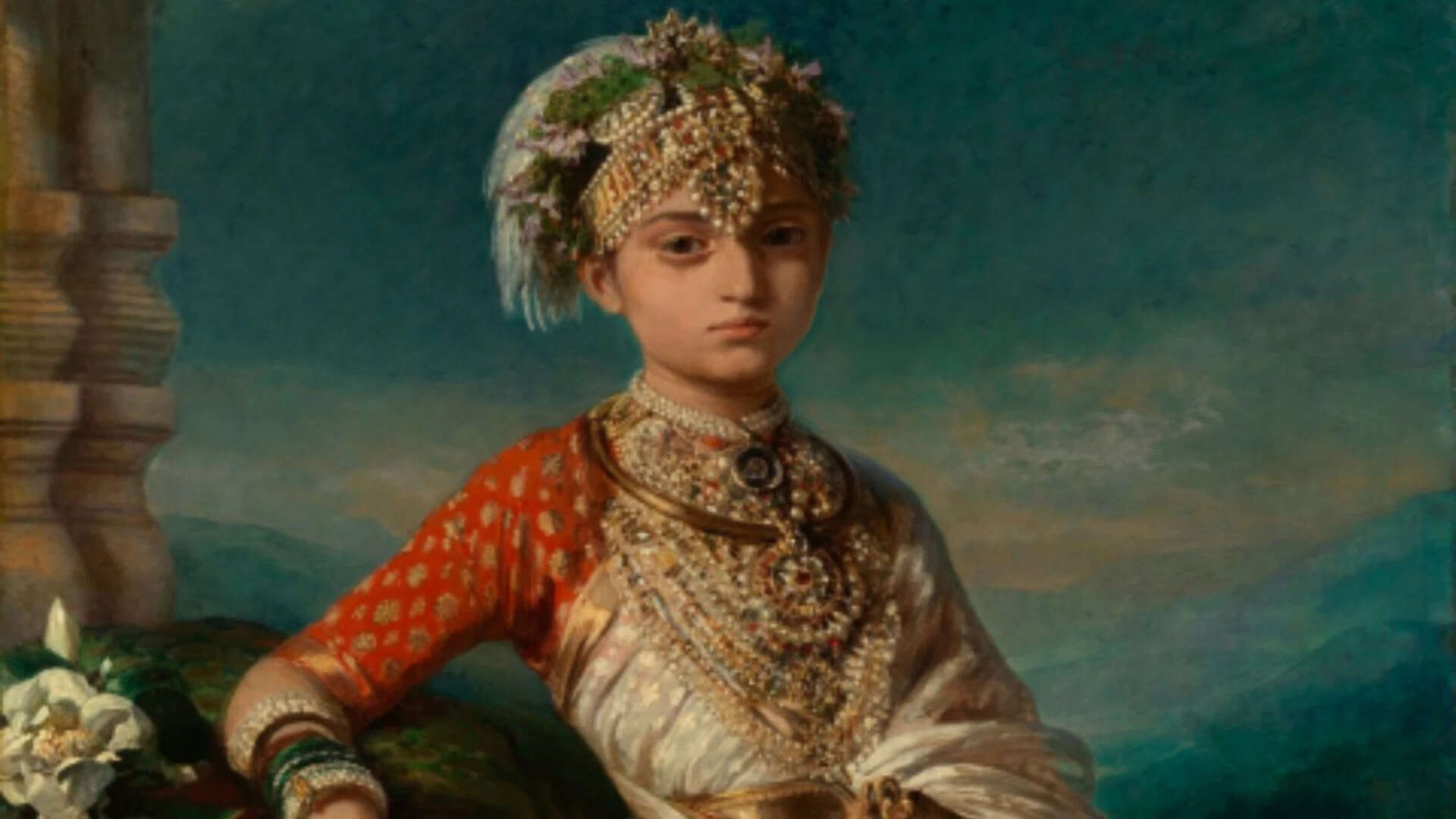
Rain hit the stone of Buckingham Palace with a rhythmic, heavy thud. It was 1852. Inside, the rooms smelled of damp wool, beeswax, and the sharp, medicinal tang of peppermint tea. A eleven-year-old girl stood by a towering window, her dark eyes reflecting the grey London sky. She wore heavy silk, stifling and structured, tailored to a European fashion that pinched her waist and restricted her breathing.
Her name was Victoria Gowramma. Just months earlier, she had been a princess of Kodagu, a lush, mountainous kingdom in southwestern India known to the British as Coorg. Now, she was a living symbol of an empire’s reach, a child adrift in a sea of white faces, crinolines, and rigid court etiquette. Don't miss our earlier article on this related article.
History books often treat colonial figures as footnotes or political chess pieces. They list dates of annexation, treaties signed, and titles stripped. But look closer at the archives, beyond the dry ink of official correspondence, and a deeply human tragedy emerges. It is the story of a child caught between two worlds, stripped of her identity in exchange for a glittering, lonely life under the protection of the world’s most powerful monarch.
From the Mountains of Coorg to the Fog of London
To understand how a princess from the Western Ghats ended up in the private apartments of Queen Victoria, one must look at her father, Chikka Virarajendra. He was the last ruler of Coorg, a man deposed by the British East India Company in 1834. Stripped of his throne, exiled to Benares, and desperate to regain his lost wealth and status, Virarajendra conceived a radical plan. He would travel to England, appeal directly to the authorities, and use his young daughter as the ultimate diplomatic leverage. To read more about the history here, BBC offers an excellent breakdown.
He understood the British mindset with terrifying clarity. He knew that the Victorian court was deeply preoccupied with Christian missionary zeal. If he offered his daughter to be raised as a proper Christian lady under the Queen's own guidance, doors would open.
The gamble worked, but the cost was paid entirely by the child.
When the ship docked in England, Gowramma was thrust into a dizzying new reality. The warmth of India was replaced by the biting cold of an English spring. The language of her childhood was suddenly useless. Imagine the sheer terror of an eleven-year-old, mourning the recent death of her mother, being paraded before a foreign court as a curiosity.
Queen Victoria, captivated by the girl’s poise and striking looks, took an immediate interest. She did not just patronize the young princess; she became her godmother.
The Baptism at Buckingham Palace
The transformation began in earnest on a summer day in July. In the private chapel of Buckingham Palace, surrounded by the highest echelons of British nobility, the young Indian princess was baptized into the Church of England.
The Queen gave the girl her own name: Victoria.
With that single ceremony, Gowramma became the first Indian royal to convert to Christianity. The British press celebrated it as a triumph of civilization over eastern barbarism. Headlines painted a picture of a savage soul saved by the grace of the empire.
But behind the celebratory print lay a profound erasure. The name Gowramma, rooted in her ancestral culture, was pushed to the background. She was now Victoria Gouramma, an experimental subject in cultural assimilation. The Queen appointed Lady Login, the wife of a prominent colonial official, to oversee the girl’s education. The goal was simple: eradicate every trace of her Indian upbringing and mold her into the perfect English aristocrat.
She was taught to play the piano, to speak fluent French and English, to carry herself with the stiff, measured grace required in the drawing rooms of high society. She was given a substantial allowance from the East India Company, but every penny was monitored. She was rich, protected, and utterly isolated.
The High Cost of Royal Favor
Living as a favorite of the Queen sounds like a fairy tale. The reality was a psychological prison. Victoria Gowramma was neither fully British nor allowed to be Indian. To the English courtiers, she was an exotic novelty, a "pet" project of the monarch. To her exiled father, who continually badgered her to use her influence with the Queen to get his money back, she was a political tool.
The isolation grew deeper as she entered her teenage years. The Queen, ever the matchmaker, decided that Victoria should marry another exiled Indian royal, Maharaja Duleep Singh, the last sovereign of the Sikh Empire, who had also been brought to England and converted to Christianity.
It seemed like a perfect dynastic match in the eyes of the British court. Two displaced fragments of an empire, joined together under the Christian faith.
But humans are not chess pieces. Duleep Singh refused. He viewed Victoria not as a equal, but as someone who had lost her heritage even more completely than he had. He allegedly remarked that she was too thoroughly Europeanized for his taste. The rejection was a public and private humiliation for Victoria, cementing her status as an outsider who fit nowhere.
A Quiet, Desperate Search for Belonging
As the years pressed on, Victoria’s health began to fail. The damp English climate took a toll on a constitution built for the sun of the Western Ghats. She suffered from chronic respiratory issues, a physical manifestation of the suffocating life she led.
Desperate for affection and an escape from the suffocating surveillance of Lady Login and the court, she fell in love with a man who offered a semblance of freedom. In 1860, she married Colonel John Campbell, an officer in the British army who was significantly older than her.
The marriage was not the salvation she hoped for. Campbell was a gambler, drawn more to Victoria’s government allowance and her proximity to royal favor than to the woman herself. They had a daughter, Edith, but the marriage was plagued by financial strain and emotional distance.
Victoria's life became a quiet race against her own failing body. The bright, sharp girl who had enchanted Buckingham Palace was fading into the background of a nondescript English life.
The Final Cord
In 1864, at the age of twenty-three, Victoria Gowramma died of tuberculosis in her London home.
Her death was a brief blip in the social calendars of the day. Queen Victoria expressed genuine grief, ordering a bust of her goddaughter to be kept at Windsor Castle, a marble testament to a life lived in shadow.
Victoria Gowramma was buried in Conwy, Wales, far from the red earth of Coorg, far from the bustling streets of London, and worlds away from the palace where she had once been the center of imperial attention.
Her story leaves behind a haunting realization about the nature of power. The British Empire did not just conquer lands; it conquered identities. They took a princess from the mountains of India, dressed her in lace, washed away her name, and expected her to be grateful for the privilege of her own erasure.
When you look at the formal portraits of Victoria Gowramma today, you see a young woman looking directly at the camera, her expression inscrutable. She wears the finest Victorian gowns, her hair styled in perfect European ringlets. But beneath the velvet and the pearls, if you look closely at her eyes, you can still see the reflection of a lost kingdom, and a child who spent her entire life trying to find her way home through the London fog.