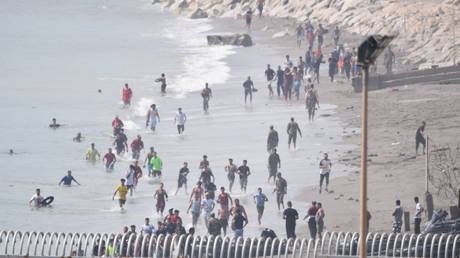
Borders aren't just lines on a map. They're flashpoints. When thousands of people arrive at a fence, politicians panic, locals scream, and reporters rush to grab the most dramatic footage they can find.
That is exactly what keeps happening in Ceuta.
If you've been watching the news, you've seen the clips. Crowds gathering, fences scaled, police deployed, and residents shouting about an invasion. But the shouting matches miss the operational reality on the ground.
Ceuta and Melilla, Spain's two tiny enclaves perched on the northern coast of Africa, function as Europe's only land borders on that continent. They're basically European islands surrounded by Morocco. That geographic accident makes them a magnet for anyone desperate to cross into the European Union.
Spain's recent aggressive pushbacks and rapid deportations tell a very specific story about how border nations handle sudden surges. Let's look at what's actually happening behind the political theater.
The Pressure Cooker That Is Ceuta
You can't understand the current tension without looking at the geography. Ceuta spans just about seven square miles. Over eighty thousand people live packed into that tiny space.
When a few thousand migrants swim around breakwaters or scale the border barriers in a single afternoon, the local infrastructure cracks instantly. Schools fill up. Temporary reception centers overflow. Local residents feel overwhelmed, and honestly, you can see why.
Politicians call it an invasion. Locals call it a crisis. Officials in Madrid call it a security challenge.
Every single label carries a political agenda. The word "invasion" implies a military force with hostile intent. But walk through the temporary shelters or talk to aid workers, and you find teenagers fleeing hopeless economic prospects, families escaping violence, and individuals who simply believe a better life waits just across a strip of razor wire.
The human reality bears zero resemblance to a military campaign. Yet the policy response often treats it like one.
How Spain Pushes Back Fast
When numbers spike, Spain relies on rapid-fire expulsions. Under bilateral agreements with Morocco, Spanish authorities often return migrants across the border within hours of their arrival.
Human rights organizations hate this practice. They argue that fast-track returns violate international asylum laws, which guarantee every individual the right to state their case and request protection. Courts have wrestled with this legal grey area for years.
Spain argues that these immediate returns prevent thousands of people from getting stuck in limbo inside overcrowded holding centers that lack basic capacity. They maintain that stopping arrivals at the fence protects public order.
The courts offer a messy compromise. They permit quick returns under strict conditions, but those conditions get broken constantly.
When a crowd of five hundred people charges a six-meter fence, nobody stops to hand out legal aid pamphlets. Law enforcement acts on muscle memory and direct orders from the top. Speed wins over due process every single time.
The Diplomatic Lever Behind Every Border Surge
Borders never operate in a vacuum. Whenever you see a massive surge of arrivals in Ceuta, look at Madrid's diplomatic relations with Rabat.
Migration serves as a geopolitical pressure valve. Morocco knows its geographic position gives it enormous leverage over Spain and the broader European Union. When diplomatic disputes flare up over trade, fishing rights, or foreign policy stances—such as the status of Western Sahara—the border controls on the Moroccan side suddenly loosen up.
Border guards look away. Small boats launch more frequently. Groups form near the fences with unusual ease.
Then, once concessions get made or diplomatic handshakes happen, the flow slows back down. It's an open secret in European foreign policy circles.
You cannot separate migration management from international politics. Spain's interior ministry spends millions funding Moroccan border security, yet those resources get dialed up or down depending on political moods in Rabat.
Relying entirely on a neighbor to police your border creates a fragile security apparatus. One diplomatic disagreement leaves your fences completely exposed.
What Real Reform Looks Like
Most news coverage stops at the fence line. It focuses on the clash between police and migrants, broadcasts the angry soundbites from local politicians, and moves on to the next crisis.
That approach changes nothing.
Real solutions require acknowledging uncomfortable truths that neither the left nor the right wants to admit. Soft borders without processing capacity collapse under the weight of human movement. Hard walls and illegal pushbacks destroy human rights norms and feed corruption.
If European nations want stability in Ceuta, they have to build legal, predictable pathways for labor and asylum that bypass the razor wire entirely. As long as the only way to apply for asylum is to climb a fence or risk drowning in a rubber dinghy, people will keep climbing and drowning.
Processing centers should exist in countries of origin or transit, not at the end of a dangerous dash across a border barrier. Until leaders tackle the root economic drivers and diplomatic gamesmanship, Ceuta will stay trapped in an endless loop of crisis, outrage, and hurried deportations.
Stop treating border surges as sudden acts of nature. Treat them as predictable outcomes of broken systems, and start fixing the architecture instead of just patching the holes in the fence.