The resumption of large-scale kinetic exchanges between United States forces and the Islamic Revolutionary Guard Corps around the Strait of Hormuz signals the structural failure of temporary deterrence architectures in maritime chokepoints. When political announcements frame military operations merely as reactive punishments for minelaying or missile salvos, they obscure the underlying economic and logistical contest: a zero-sum struggle for maritime throughput capacity. Deconstructing the mechanics of this escalation requires examining how asymmetric actors weaponize geography, how naval blockades alter regional cost functions, and why traditional deterrence models consistently break down under persistent maritime friction.
The Cost Function Of Maritime Interdiction
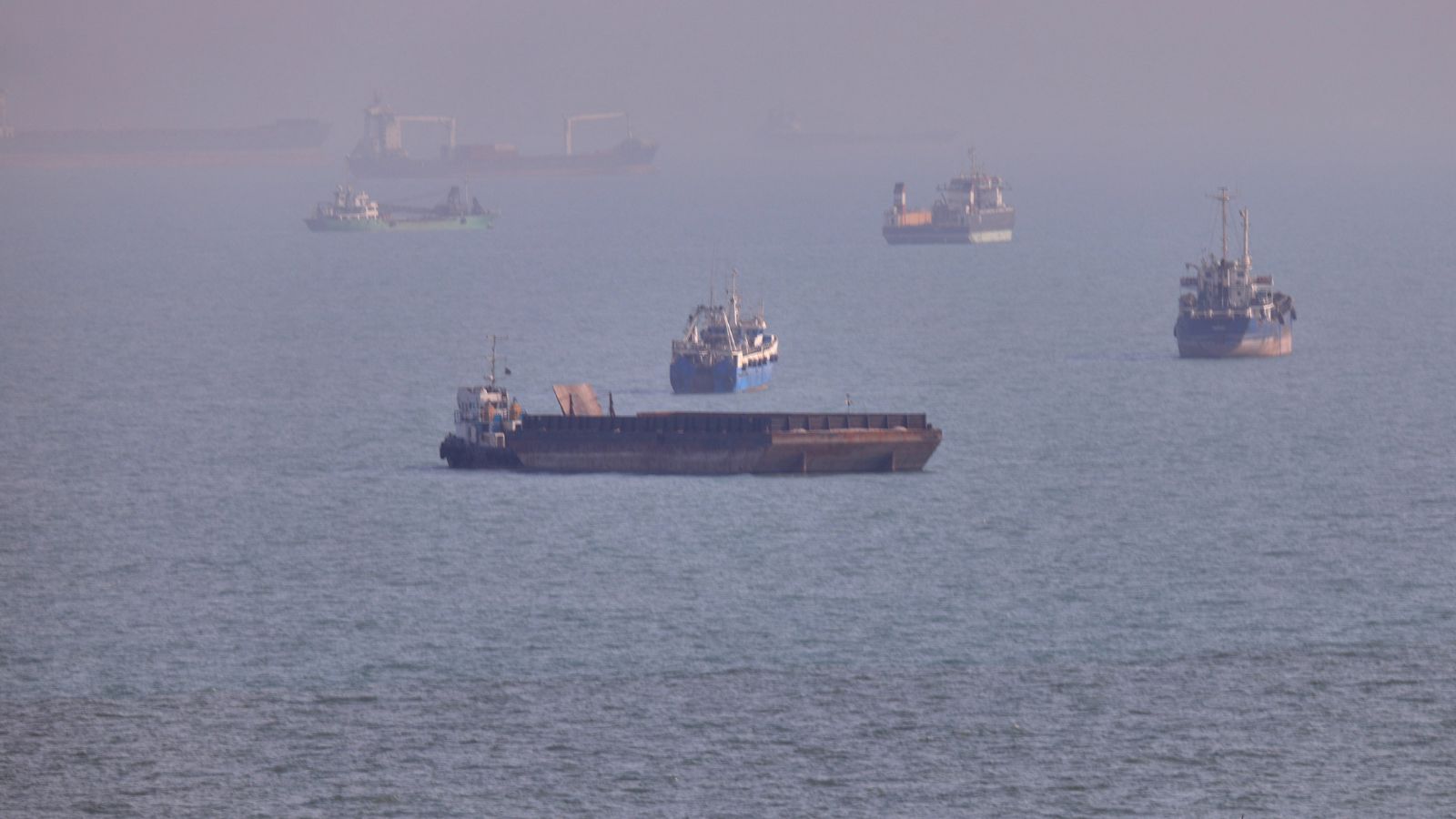
Operating commercial shipping lanes through a thirty-three-kilometer-wide corridor bordered by hostile territory introduces severe friction into global energy markets. Before kinetic hostilities commenced, daily throughput routinely exceeded one hundred vessels. Current operational data indicates a structural compression of traffic, with transit volumes operating at a fraction of baseline capacity despite naval escort initiatives. This drop is not merely a psychological reaction to risk; it represents a fundamental recalculation of maritime insurance premiums, asset exposure, and voyage delays.
The economic pressure equation relies on two opposing vectors:
- The Interdiction Vector: Iran leverages low-cost asymmetric assets—specifically mobile coastal defense batteries, small fast-attack craft, drone swarms, and clandestine minelaying platforms—to impose asymmetric costs on high-value commercial tonnage and naval escorts. Deploying a sea mine or launching an anti-ship missile requires minimal capital expenditure relative to the economic shock delivered to global oil supply chains.
- The Counter-Interdiction Vector: United States Central Command relies on high-expenditure force protection, precision strike capabilities, and active mine-clearing operations to maintain baseline navigability. This creates an inherently asymmetrical burn rate, where expensive interceptors and munitions are expended to neutralize low-cost threats, forcing military planners to adopt systemic attrition strategies rather than pure defense.
When the friction threshold crosses a tipping point, maritime operators simply refuse passage, achieving Tehran's strategic objective of partial chokepoint closure without requiring total naval supremacy.
The Logic Of Attrition And Mowing The Grass
Recent military directives, characterized by waves of widespread strikes targeting roughly one hundred Islamic Revolutionary Guard Corps assets, reflect a strategic shift from passive blockade enforcement to active degradation. Operational announcements pointing to retaliatory triggers—such as failed minelaying operations or intercepted ballistic salvos targeting regional bases—mask a continuous operational doctrine often described in military planning as systematically reducing adversary capabilities.
This doctrine operates on specific systemic realities:
- Reconstitution Timelines: Asymmetric infrastructure like radar sites, mobile missile launchers, and drone assembly nodes can be hidden, repaired, or replaced faster than major naval surface combatants can be rotated through the theater.
- The Escalation Ladder: Each kinetic intervention compresses the diplomatic window, triggering localized retaliatory feedback loops across neighboring sovereign airspaces, including secondary missile and drone vectors routed toward regional allies.
- Deterrence Decay: Short tactical pauses, such as the month-long lull preceding the recent flare-up, are systematically interpreted by decentralized military commands as operational hesitation, inviting renewed probing attacks on commercial shipping.
The transition to direct retaliatory actions against flagged assets, such as strikes targeting specific naval platforms and logistics nodes, represents an escalation designed to alter the risk calculus for state-backed maritime harassment. Yet, hitting fixed or semi-mobile infrastructure addresses only the symptoms of a distributed network capable of launching asymmetric operations from complex littoral terrain.
Structural Bottlenecks In Regional Defense Integration
Efforts to secure the corridor face acute coordination challenges among regional actors and coalition partners. While naval task forces provide point-defense coverage, the geographical proximity of critical energy infrastructure across the Gulf states leaves them exposed to retaliatory vector saturation. When integrated air defenses successfully intercept incoming ballistic or drone threats, they prevent catastrophic physical damage but deplete regional interceptor stockpiles at an unsustainable rate.
This dynamic exposes the vulnerability of relying exclusively on kinetic dominance to solve a structural logistics problem. Naval escorts and preemptive strikes can clear immediate hazards, but they cannot compel commercial risk-tolerance to return to pre-conflict baselines. Insurers will continue to price in tail risk as long as littoral launch platforms retain the capability to contest the waterway.
Execute a sustained, multi-layered denial campaign targeting the mobility nodes of asymmetric maritime units, coupling active littoral suppression with direct economic enforcement against third-party entities facilitating bypass trade, thereby forcing a systematic collapse of the adversary's sustained operational funding.