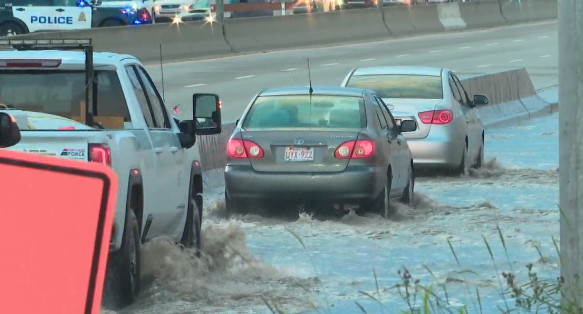
It happened again. Just days after a massive weekend storm battered Edmonton and left a massive 35-foot sinkhole in Lauderdale, another sudden, heavy downpour overwhelmed our streets. By early Wednesday morning, several underpasses along Yellowhead Trail were completely submerged.
If you tried to commute on the north side, you already know the nightmare. Commuters faced massive delays, and police had to block off-ramps and divert traffic between 97 Street and 184 Street. This isn't just a minor inconvenience; it's a recurring structural failure that points to a much bigger challenge for the city's drainage network. Also making headlines in this space: Why the Israeli Army Cannot Afford the Ultra-Orthodox Draft Freeze.
The Morning the Yellowhead Stood Still
Around 3 a.m. on Wednesday, the Edmonton Police Service issued an emergency advisory warning drivers to stay away from the Yellowhead underpasses. An overnight thunderstorm dumped intense rainfall over a highly concentrated area. Because our ground was already saturated from consecutive weekend storms, the rainwater had nowhere to go but down into the lowest geographical points.
The worst-hit section stretched from 121 Street to 156 Street. At the 127 Street and 127 Avenue underpass, drivers abandoned their vehicles in deep, pooling water as manhole covers literally popped open from the intense pressure of the overloaded stormwater systems below. Additional information on this are covered by The Washington Post.
Emergency crews, police, and EPCOR worked throughout the morning to divert traffic and pump out the flooded lanes. While parts of the freeway have slowly reopened, the event forced a hard conversation about why our critical arterial road keeps drowning.
Why Underpasses Are Edmonton's Weakest Links
It's easy to blame "unprecedented" weather, but the reality of urban planning is more complex. Underpasses are designed to channel traffic below railway lines and cross-streets, which inherently makes them deep bowls.
When a storm hits, gravity does its job. Water flows toward these low points. To prevent flooding, underpasses rely on massive mechanical pump stations and deep storm sewer trunks to carry the water away.
EPCOR points out that when we get short, incredibly intense bursts of rain on top of already wet ground, the local sewer system simply runs out of room. Even if the pumps are running at 100% capacity, the volume of runoff entering the system temporarily exceeds what the pipes can physically hold.
[Rainfall]
   ↓
[Saturated Soil (No Absorption)]
   ↓
[Runoff Flows to Low-Point Underpasses]
   ↓
[Pumps & Storm Sewers Overwhelmed]
   ↓
[Water Backs Up & Pops Manhole Covers]
This is the second time in a single week that parts of the Yellowhead had to close due to high water. The repeated failures highlight a mismatch between our changing weather patterns and aging infrastructure.
The Ongoing Fix and Why It's Taking So Long
The city isn't completely ignoring this issue. In fact, a massive freeway conversion project is actively underway on the Yellowhead between St. Albert Trail and 97 Street.
As part of this multi-million dollar upgrade, crews are constructing a massive 2-kilometre-long storm sewer tunnel along the south side of the freeway. The goal of this giant drainage trunk is specifically to prevent underpass flooding during major storms.
The problem? Tunnelling and drainage upgrades take years to complete. While the city has installed over 9,000 metres of new storm and sanitary infrastructure so far, the overall project is still only partially complete. Until the entire system is fully tied in and operational, commuters will remain at the mercy of sudden summer downpours.
What Drivers Must Do During Severe Rain
The next storm is a matter of "when," not "if." Driving through a flooded underpass is a massive risk that too many drivers still take. It only takes about 30 centimetres of moving water to float most cars, and deeper water will easily stall your engine, leaving you trapped.
If you find yourself on the road during a heavy downpour, keep these practical steps in mind:
- Never drive into standing water: If you can't see the road markings or the bottom of the curb, turn around.
- Watch for popped manhole covers: The water pressure underneath can displace heavy cast-iron covers, leaving tire-destroying open holes hidden beneath the muddy water.
- Avoid underpasses entirely: During severe weather warnings, alter your route to use overpasses or alternative arterial roads that don't dip below grade.
- Report open manholes and flooding: If you spot an active hazard or a missing utility cover, call 311 or EPCOR immediately to help crews secure the area.
The city's infrastructure will eventually catch up, but for now, staying safe means staying alert and refusing to test the depth of the nearest flooded underpass.