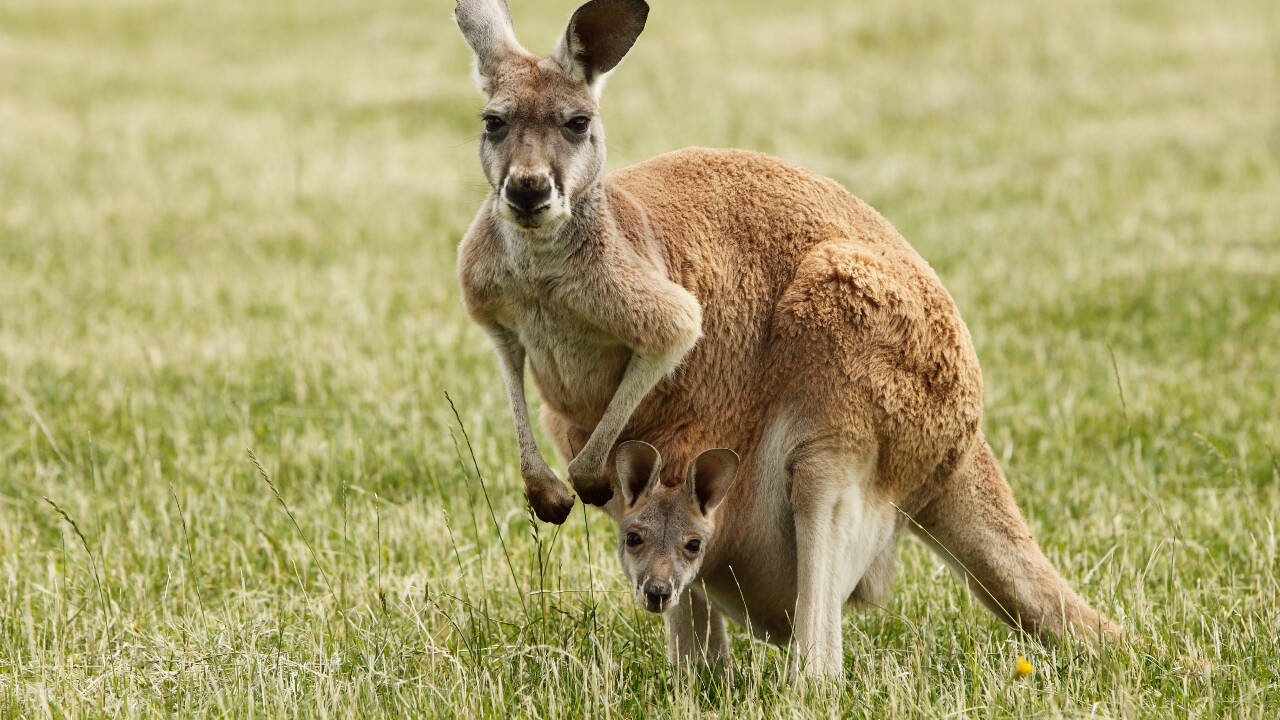
A newborn kangaroo is roughly the size of a single jellybean. It weighs less than a gram, lacks hair, cannot see, and looks shockingly like an unformed pink embryo. Yet, this tiny creature must immediately pull off one of the most grueling physical feats in the animal kingdom. Without any help from its mother, it has to climb through a thick jungle of fur, find the entrance to the pouch, and lock onto a teat before it runs out of energy.
If it fails, it dies.
For decades, biologists wondered how an animal born so astonishingly underdeveloped could manage this vertical trek. The secret lies in a bizarre evolutionary trade-off. While the rest of the baby kangaroo is barely formed, its front arms and claws are remarkably strong, muscular, and advanced.
The Extreme Asymmetry of Marsupial Birth
When you look at an adult kangaroo, its hind legs define its entire existence. Those massive feet allow it to bound across the Australian outback at incredible speeds. But at birth, those legendary legs are nothing more than useless, tiny buds.
The front legs tell a completely different story. Biologists at institutions like the University of Melbourne have studied this uneven growth pattern for years. They found that marsupials completely flip the standard rules of mammalian development. Instead of growing all limbs at a uniform pace, a kangaroo fetus pumps almost all its early developmental energy straight into its forelimbs.
By the day of birth, usually after a mere 33 days of gestation, the joey possesses robust shoulders and sharp claws. Its sole purpose in life at that exact moment is to crawl.
This hyper-targeted development is a brilliant survival mechanism. Placentals, like humans, deer, or dogs, keep their young inside the womb until they are much more structurally complete. Kangaroos do not have that luxury. The marsupial strategy relies on a short pregnancy followed by an extended external rearing period inside the pouch. Because the womb phase is so brief, the young must emerge while they are still functionally embryos. The only way this strategy works is if the embryo can physically migrate to its second home on its own.
How the Journey Actually Happens
The mechanics of the climb are brutal. Once the joey emerges from the birth canal, it relies entirely on instinct and its oversized front limbs.
The mother kangaroo does not pick the baby up. She does not nudge it along or use her paws to guide it. Doing so would risk crushing the fragile creature. Instead, she sits back and licks a path through her abdominal fur. Scientists once believed this wet trail provided a literal map for the joey, but recent observations suggest it might simply clean the area or provide a slight moisture cue.
The joey uses a swimming motion to move upward. It digs its tiny claws into the fur, pulls its body forward, and repeats the process.
- The climb takes anywhere from three to ten minutes.
- The distance is roughly six inches, a massive journey for a creature that is less than an inch long.
- Gravity works against the tiny joey the entire time.
If the joey drops off the fur, the mother will abandon it. She cannot pick it up with her large paws without killing it. The stakes are absolute.
The Genetic Blueprint Behind the Early Arms
This uneven limb growth is not accidental. It is driven by specific genetic switches that turn on much earlier in marsupials than in other mammals.
Evolutionary biologists tracking gene expression in marsupial embryos noticed that genes responsible for shoulder and arm formation, such as the Hox genes, activate well ahead of schedule. The cells that form the front paws divide at an accelerated rate, while the cells meant for the hind legs remain dormant.
This reveals a fascinating truth about evolutionary flexibility. Nature can tweak the timing of developmental events to solve specific ecological problems. For the kangaroo, the immediate problem is locomotion across a furry terrain. The hind legs can wait because they serve no purpose inside the pouch.
Once the joey reaches the safety of the pouch, its developmental priorities shift dramatically. It attaches itself to one of the four teats inside. The tip of the teat swells inside the joey's mouth, effectively anchoring it in place so it cannot be shaken loose when the mother hops. Only then do the hind legs, eyes, and internal organs begin the slow process of catching up.
Why the Marsupial Strategy is Not Inferior
People often look at marsupial birth and think it seems primitive compared to placental mammals. That is a mistake.
The marsupial strategy is incredibly resilient, especially in unpredictable environments like the Australian continent. Raising a large fetus inside a womb requires a massive, steady investment of resources. If a severe drought hits, a pregnant placental mammal might starve because she cannot easily stop the pregnancy without risking her own life.
A kangaroo handles environmental stress much better. If resources dry up, she can simply stop lactating, causing the tiny joey to leave the pouch, or she can freeze the development of a backup embryo through a process called embryonic diapause.
The energy required to produce a one-gram newborn is incredibly low. The real resource investment happens during lactation inside the pouch. This means the mother can safely cut her losses during a crisis without having wasted months of internal gestational energy. It is a highly adaptive, flexible system that has kept kangaroos thriving for millions of years.
Tracking the Future of Marsupial Science
Wildlife researchers and conservationists continue to study these early developmental phases to better protect native species. Understanding the precise nutritional needs of a joey during its early pouch life helps sanctuaries care for orphaned joeys rescued from roadside accidents.
If you want to support this kind of vital wildlife research, consider looking into local Australian conservation groups or global marsupial protection funds. They fund the field studies that help track how wild populations handle shifting climates and changing habitats. Every bit of data helps preserve this strange, beautiful evolutionary wonder.