Cold.
It is the first thing you notice when you live without heat in the northern provinces of the Korean Peninsula, a heavy, wet ache that settles into the marrow of your bones by November and refuses to leave until the spring thaw in April. You learn to measure the winter not in degrees, because thermometers are rare, but in the thickness of the ice forming on the inside of your bedroom window and the number of layers of scavenged cardboard you can wedge under your sleeping mat.
Now, picture a different kind of cold. Picture the crisp, exhilarating chill of high-altitude mountain air at the Masikryong Ski Resort, where snow cannons hum through the night to groom powdery slopes for a privileged few.
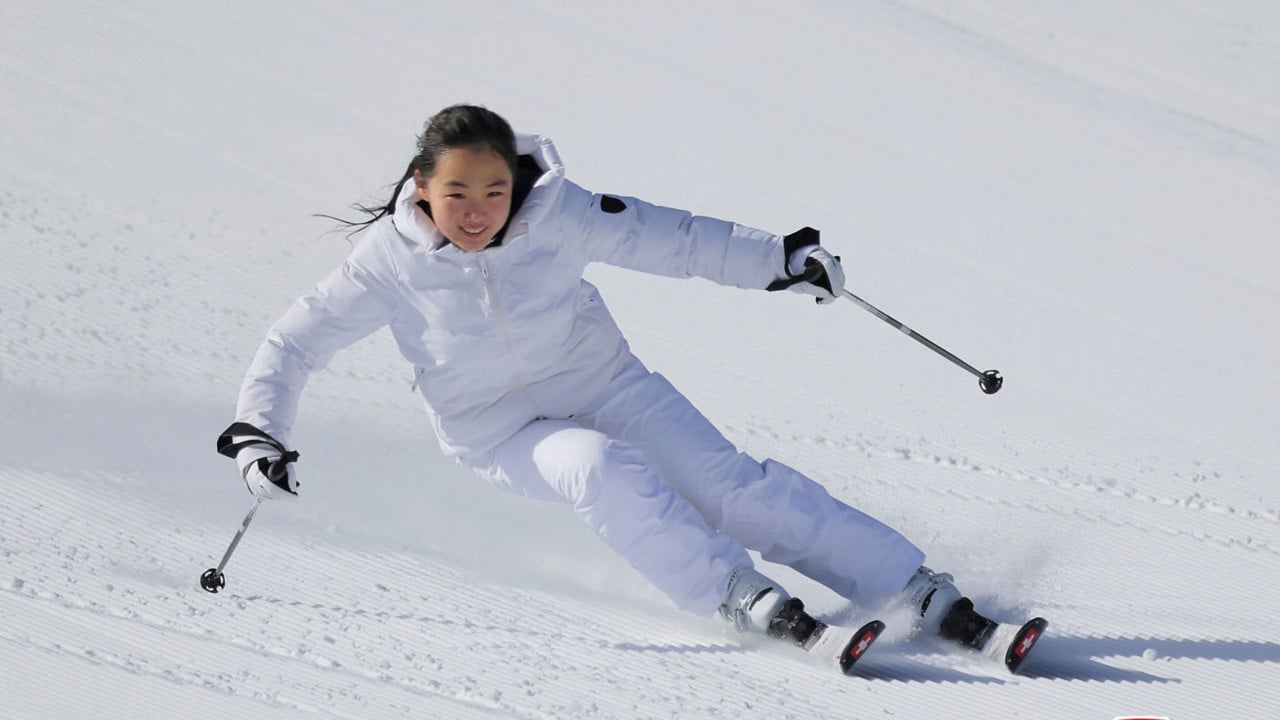
In photographs released by Pyongyang’s state media—images carefully curated for global consumption and domestic reverence—Kim Ju Ae, the young daughter of North Korean leader Kim Jong Un, stands against this immaculate white backdrop. She is smiling. She is warm. And wrapped around her shoulders is a sleek, padded white ski jacket crafted by a luxury European fashion house, a piece of technical outerwear carrying a retail price tag that exceeds what an average North Korean factory worker earns in an entire year.
On paper, this is a simple, predictable headline about autocratic hypocrisy. We have seen versions of it for decades. A dictator indulges in foreign luxuries while his people ration grain. You read the numbers, shake your head at the audacity, and scroll on to the next piece of news.
But if we stop at the price tag, we miss the actual story. That white jacket is not merely an accessory or a tone-deaf fashion choice by a teenage girl. It is a calculated political weapon, a symptom of a sophisticated smuggling network that mocks international sanctions, and a window into the quiet, suffocating reality of a nation where a single zipper costs more than a human life’s labor.
The Anatomy of a Luxury Leak
To understand how a European designer ski suit ends up on the slopes of Kangwon Province, you have to understand how walls work when enough money is thrown at them.
Since 2006, the United Nations Security Council has tightened a financial and trade noose around Pyongyang in response to its nuclear weapons and ballistic missile programs. Luxury goods—high-end watches, yachts, designer clothing, expensive spirits—were among the very first items explicitly banned from entering the country. The logic was straightforward: if you cannot easily stop a regime from starving its own citizens, you can at least strip the ruling elite of the comforts that keep them loyal to the supreme leader.
In theory, the blockade is airtight. In practice, it resembles a sieve.
Think of the global luxury supply chain not as a guarded fortress, but as a bustling, anonymous river. A jacket designed in Milan or Paris is manufactured in a contracted facility, shipped to a distributor in Central Europe, sold to a boutique in Macau or Dubai, and purchased in cash by a shell company registered in Hong Kong. By the time that garment is packed into a diplomatic pouch or hidden inside a shipping container labeled as industrial agricultural parts bound for Dalian, China, its digital footprint has vanished.
Having spent years tracking illicit trade routes and interviewing defectors who once managed state trading companies, I have seen the receipts—literal and metaphorical—of how this machine operates. It is not run by shadowy cartoon villains. It is run by middle-aged bureaucrats in polyester suits who spend their days on encrypted messaging apps, calculating currency exchange rates and paying off dockworkers. They belong to Office 39, the secretive party bureau tasked with maintaining the Kim family’s personal slush fund through everything from cyber-heists and counterfeit currency to coal smuggling and overseas labor.
When an analyst zooms in on a grainy photograph from Korean Central News Agency and identifies the distinct stitching of a European alpine brand—brands like Dior, Moncler, or Bogner that routinely retail between $1,500 and $3,000 for winter outerwear—they are not just spotting a logo. They are looking at the successful completion of a multi-continent logistical operation.
Two Worlds, One Winter
Let us ground those numbers in human reality. To do that, consider a hypothetical composite character—let’s call her Min-seo—based on the verified testimonies of hundreds of defectors from North Hamgyong Province.
Min-seo is thirty-four years old. She works at a state-run textile factory, though the machines only run three days a week because the municipal power grid fails every afternoon. Her official state salary is roughly 3,000 to 5,000 North Korean won a month. In the unofficial jangmadang—the black-market bazaars that actually keep the country alive—that official wage is worth less than a single kilogram of rice.
Like almost everyone else in her town, Min-seo survives through the gray economy. After her shift ends, she walks four miles to gather firewood from stripped hillsides, then spends her evenings sewing cheap gloves from scrap fabric to sell at the dawn market. On a remarkably good month, combining her husband’s informal labor and her own side hustle, their household might scrape together the equivalent of $80 to $100 in Chinese yuan. Over the course of twelve grueling months, if nobody falls ill with tuberculosis, if no corrupt police officer demands a bribe at a checkpoint, and if the harvest does not fail, they might earn $1,000.
Now look back at the photograph from Masikryong.
The jacket worn by Kim Ju Ae retails in European boutiques for roughly $1,900. Add the matching ski trousers, the goggles, and the thermal base layers, and the outfit easily crosses the $3,000 mark.
That is not just a disparity in wealth. In Western democracies, we are accustomed to staggering inequality; a billionaire in Manhattan wears a watch worth more than a teacher's annual salary, and we argue about tax policy. In North Korea, the disparity is enforced by the state’s monopoly on existence itself. Min-seo is legally forbidden from leaving her province without a travel permit. She cannot buy a plane ticket. She cannot access the internet to even know what the brand on that jacket is called.
When Min-seo’s family faces winter, they are burning dried corn stalks and foraging for pine bark to boil into soup. Meanwhile, three hundred miles south, snow machines consume enough electricity in a single night to power Min-seo’s entire apartment block for a month, all so the First Daughter can glide down an artificial slope in European technical down.
The Theater of the Snow
Why show it? This is the question that often confuses outside observers. If the regime is acutely aware of international sanctions, and if its domestic propaganda preaches Juche—radical self-reliance and the rejection of corrupt Western capitalism—why would Kim Jong Un allow photographers to capture his daughter wearing a symbol of European excess?
To answer that, you have to stop thinking like a Western public relations strategist and start thinking like a royal courtier in Pyongyang.
In North Korea, the Kim family does not govern as elected politicians who must pretend to be "just like regular folks." They do not roll up their sleeves at diners or wear budget wristwatches to seem relatable. They rule as a sacred bloodline—the Mount Paektu bloodline—whose authority is absolute, quasi-divine, and hereditary.
In that political ecosystem, visible luxury is not a scandal. It is proof of mandate.
Consider what happens when a high-ranking military general or a provincial party secretary opens the Rodong Sinmun, the state newspaper, and sees Kim Ju Ae bundled in pristine foreign winter gear. That official knows what that jacket costs. They know it is banned by the United Nations. And seeing it on the leader’s child sends an unmistakable, terrifyingly clear message: The sanctions cannot touch us. The world’s rules do not apply to this family. We are untouchable.
It is a projection of invincibility aimed directly at the elite class whose loyalty keeps the regime intact. If the supreme leader can effortlessly import forbidden European couture in the middle of a global blockade, then surely he can provide the imported cognac, the Mercedes-Benz sedans, and the foreign medical care that the inner circle expects in return for their obedience.
And what about the ordinary citizens who catch a glimpse of these broadcasts on state television? The state media never mentions the brand name or the price. To a viewer in a rural village where Western fashion magazines do not exist, the white jacket simply looks impossibly clean, thick, and warm—an object from another dimension. It reinforces the mythology that the leader’s family lives on a higher plane of existence, a celestial tier separate from the mortal struggles of the masses.
Growing Up as a Symbol
There is another layer to this story, one that is easy to overlook when we focus solely on geopolitical cynicism: the girl inside the coat.
Since her sudden public debut at a ballistic missile launch in November 2022, Kim Ju Ae—believed to be around twelve or thirteen years old—has been transformed before the world’s eyes. In those early photos, she wore a puffy white winter coat and red shoes, holding her father’s hand like any anxious child standing beside a massive, terrifying machine.
Over the past four years, the styling has shifted dramatically. The childish pastels have been replaced by tailored leather trench coats, fur-trimmed collars, designer sunglasses, and now, high-end European ski wear. State media refers to her with honorifics once reserved exclusively for the supreme leader himself—the "respected" and "beloved" child, the "Morning Star of Korea."
Whether she is actively being groomed to become the fourth-generation ruler of a nuclear-armed dynasty, or whether she is serving as a living symbol of the regime’s permanence to secure the future for a younger, unseen brother, her childhood has been entirely nationalized.
Every step she takes on the snow is choreographed. Every smile is timed for the shutter click. She cannot choose what she wears, where she skis, or who stands beside her. She is draped in thousands of dollars of European fabric not out of parental indulgence, but because she has become the primary canvas upon which her father paints the future of his dynasty. In a strange, gilded way, she is as much a prisoner of the state’s mythology as the miners digging coal in the dark mountains below—though hers is a prison lined with goose down and heated floors.
The Blind Spot in Our Outrage
It is comforting, when we read stories about Kim Ju Ae’s wardrobe, to feel a surge of moral superiority. We point at the hypocrisy, we mock the absurdity of a socialist dictatorship obsessing over bourgeois European labels, and we congratulate ourselves on spotting the contradiction.
Yet our outrage often obscures our own complicity in the quiet machinery that makes it possible.
Every luxury garment that reaches Pyongyang passes through legitimate global financial systems before it disappears into the shadows. It relies on European brands that prioritize quarterly sales volumes over end-user verification, on lax corporate registries in financial hubs that allow shell companies to multiply without scrutiny, and on freight forwarders who do not ask why a shipment of "textile samples" is being routed through three intermediate ports before crossing the Yalu River.
Sanctions are only as strong as the boredom of the compliance officers enforcing them. When international attention shifts to newer conflicts, enforcement quietly relaxes. The shipping lanes reopen. The middlemen adjust their paperwork. And a few months later, a new coat appears on a mountain in North Korea.
I remember speaking once with a former North Korean trade official who had defected to Seoul after decades of procuring goods for the regime in Southeast Asia. I asked him what he thought when he saw Western news reports expressing shock at the luxury items spotted in Pyongyang.
He gave a dry, tired laugh. "You think the sanctions are a wall," he told me. "To us, they were just a tollbooth. Everything was still for sale. You just had to pay a slightly higher fee to the right broker."
The Cold That Remains
Spring eventually comes to the Korean Peninsula, though it arrives unevenly.
At Masikryong, when the temperatures rise and the snow cannons are switched off, the white slopes melt back into brown, rocky terrain. The luxury ski suits are cleaned, folded, and stored away in climate-controlled closets until the next winter season.
Four hundred miles to the north, in places like Chongjin and Hyesan, the melting ice brings a different set of anxieties. The spring lean season—the boritgogae, or "barley hump"—begins. It is the historical period between the exhaustion of the winter grain stores and the first summer harvest, a time when malnutrition spikes and families stretch thin porridge with wild weeds gathered from the riverbanks.
In those towns, nobody knows what a European ski jacket costs. Nobody knows the difference between a Parisian fashion house and a knockoff sewn in a basement factory across the Chinese border. They only know that winter is survivable if you have enough coal, enough corn, and enough luck to avoid the notice of the state.
Somewhere in a vault in Pyongyang, the receipts for a teenage girl’s winter wardrobe sit filed away in ledgers stamped with the seal of the Workers' Party. Each line item is a neat row of numbers—euros, yuan, dollars—balanced to the decimal point. What those ledgers never record is the true currency used to pay for them: the quiet, uncounted years of millions of lives spent shivering in the dark, waiting for a warmth that was never meant for them.


