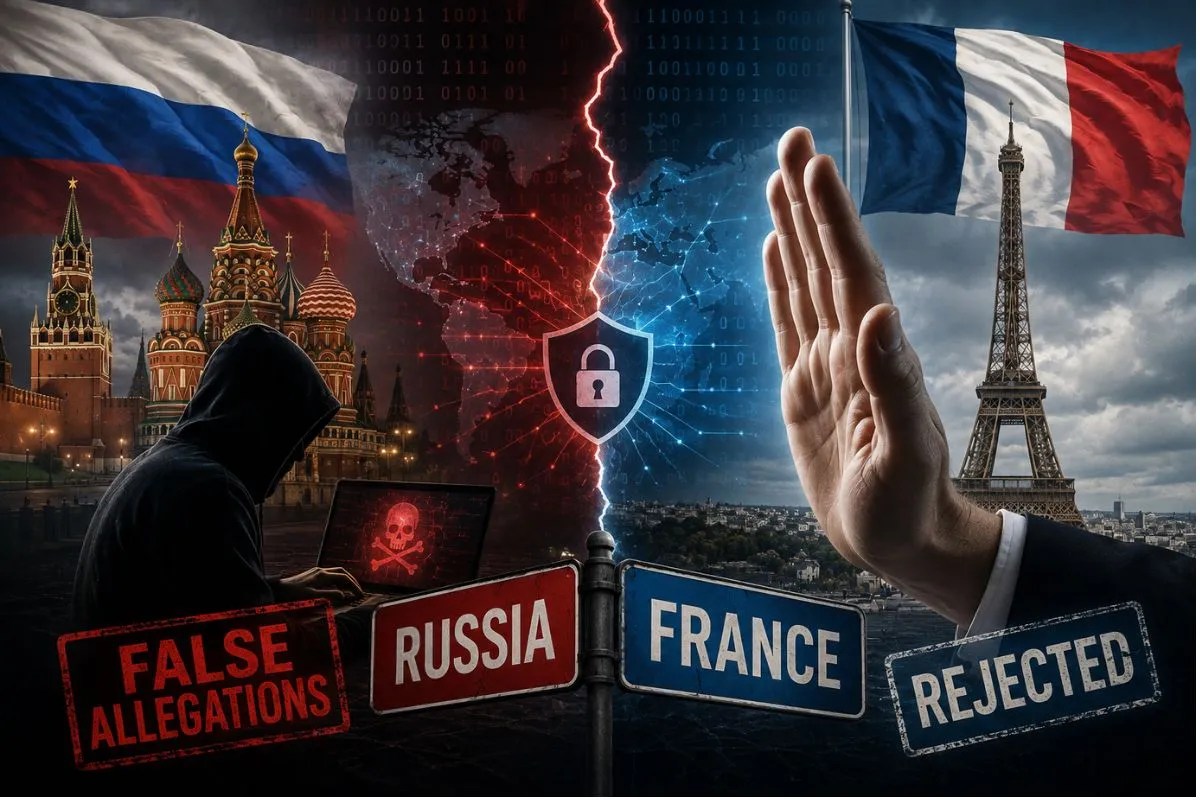
The Cold Air of Paris
The winter wind off the Seine does not care about diplomatic cables. It cuts through wool coats on the Pont Alexandre III, carrying with it the smell of damp stone and a quiet, persistent anxiety that has settled over the European continent.
You feel it in the cafes of the 7th arrondissement, where political aides murmur over espresso about intelligence briefings that never quite stay secret. You hear it in the careful, measured press conferences coming out of the Élysée Palace.
France is worried.
Or, at least, that is the official story broadcast across televisions from Marseille to Lille. Paris has spent months pointing a finger eastward, accusing Moscow of orchestrating sprawling hybrid warfare campaigns—disinformation floods, cyber probes, and covert operations designed to fracture European resolve.
Step inside a secure briefing room, however, and the atmosphere shifts. The maps glow under harsh fluorescent lights. Red pins cluster around undersea fiber-optic cables, power grids, and election servers. French officials speak of a persistent, invisible erosion of stability. They claim the Kremlin is testing the limits of Article 5 without ever firing a single ballistic missile.
It is a ghost war. And France has decided it is time to name the ghost out loud.
The Kremlin Laughs Last
Moscow’s response did not arrive with the thunder of artillery. It came with the dry, bureaucratic sneer of a Foreign Ministry press release.
Maria Zakharova stood before the microphones, her expression a masterclass in practiced disbelief. To hear Moscow tell it, the French allegations are nothing more than a paranoid fever dream—a desperate distraction crafted by a government buckling under its own domestic economic strain.
(Note: When Russian state media frames these events, they paint Paris not as a vigilant defender of democracy, but as a crumbling empire looking for an external villain to rally a restless populace.)
"Russophobia," they call it. An old word, dusted off and polished for a modern digital age.
Moscow denies everything. They deny the bot farms churning out anti-NATO sentiment. They deny the cyber attacks targeting critical municipal infrastructure. They deny the financial backing of fringe political movements meant to tear France apart from the inside.
"Prove it," the Kremlin essentially shrugs, knowing full well that modern attribution in cyberspace is like trying to nail fog to a wall.
Consider what happens next in this high-stakes game of diplomatic poker. One side yells foul; the other side accuses the first of cheating. Meanwhile, the average citizen caught in the middle simply tries to pay their electric bill, wondering if the news anchor on the evening broadcast is reading a script dictated by fear or fact.
The Anatomy of a Phantom Threat
Why now? Why is the tension between Paris and Moscow suddenly boiling over into open verbal warfare?
To understand the current diplomatic fracture, we have to look past the political theater and examine the mechanics of modern survival. Modern conflict does not begin with tanks rolling across the Ardennes. It begins in the quiet hum of server farms in St. Petersburg and the targeted social media feeds of suburban teenagers in Lyon.
Imagine sitting in a modest apartment in the French countryside, scrolling through your phone after a long day at the bakery. You see a video detailing how Ukrainian grain imports are ruining local agriculture, or how your tax dollars are being squandered on foreign wars while public hospitals crumble.
Is the anger real? Yes. The hospital wait times are real. The financial squeeze is real.
Was the video manufactured to amplify that specific rage? Intelligence agencies insist yes. This is the core of the Russian threat as French leadership defines it: not a direct military invasion, but the weaponization of domestic grievances.
Moscow knows it cannot win a conventional war against a united Western coalition. So, it doesn't try. Instead, it plays the judo master, using Europe’s own internal fractures, political polarization, and free-speech protections against it.
France’s mistake, from the Russian perspective, was screaming about it. By dragging these covert operations into the daylight, Paris hoped to inoculate its public against manipulation. By denying everything with a smirk, Moscow hoped to make the French government look hysterical, weak, and paranoid.
Walking the Tightrope
Standing on the banks of the Seine, watching the gray water slide under the bridges, the real tragedy of this diplomatic standoff becomes clear.
It is the erosion of truth.
When every accusation is met with a flat denial, and every defense is dismissed as propaganda, the public retreats into safe, polarized silos. People stop believing the news. They stop trusting their institutions. And that, more than any cyber attack or disinformation campaign, is the ultimate victory the Kremlin seeks.
The French accusations may be entirely accurate. The Russian denials may be a masterclass in cynical gaslighting. But the battlefield is not the negotiating table in Geneva or the muddy trenches of the eastern frontier.
The battlefield is the human mind.
And as the winter dusk settles over Paris, turning the historic rooftops into silhouettes against a bruised violet sky, the ghost war continues—unseen, unfelt by most, yet shaping the very architecture of our shared tomorrow.