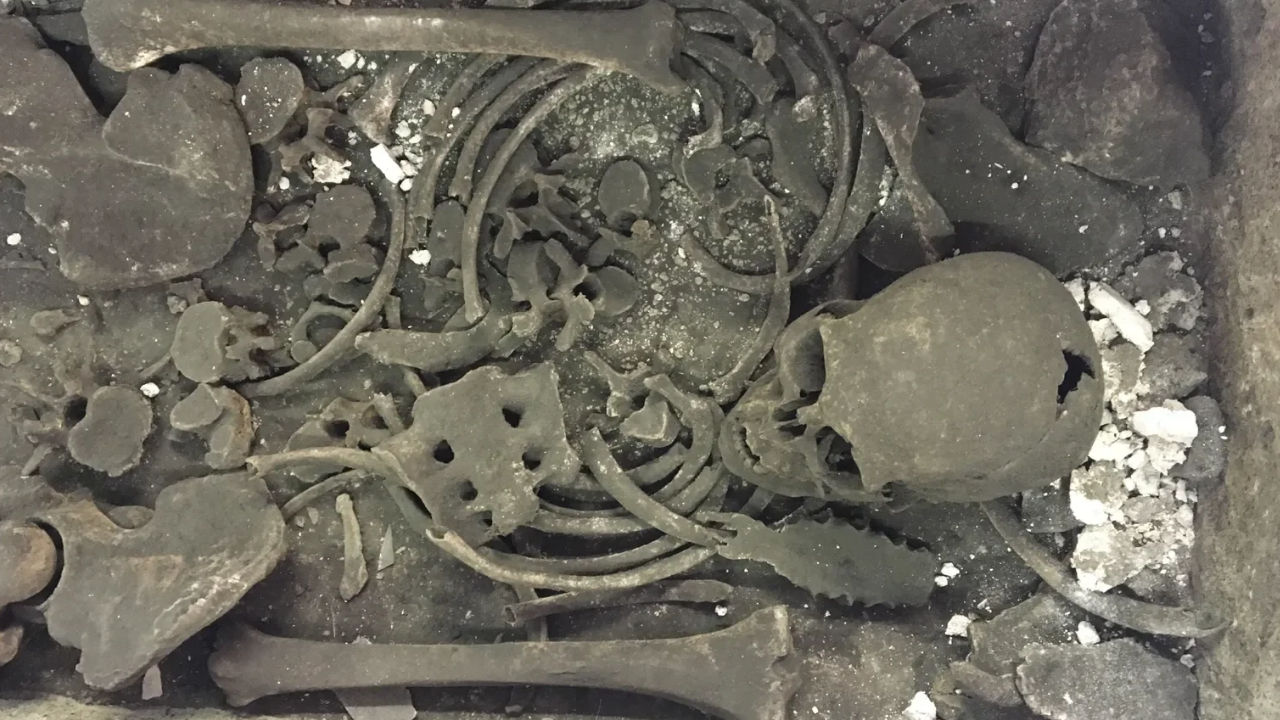
A Roman stone coffin carved for a fourth-century citizen holds a skeleton that died more than six hundred years later. If that sounds like a mix-up in a museum storage room, you're not far off. Except this happened in the ground beneath Westminster Abbey, and Victorians made the mess even worse before scientists finally untangled the timeline.
For over 150 years, historians stared at a stone chest dug up on the Abbey's North Green in 1869 and wondered who on earth belonged inside. The front bore an inscription to a Roman man named Valerius Amandinus, put up by his two sons, Valerius Superventor and Marcellus. Yet the lid carried a large Latin cross from the late Saxon era. New research published in October 2026 in the Journal of the British Archaeological Association by Westminster Abbey consultant archaeologist Warwick Rodwell and collaborators finally narrows the occupant down to a high-ranking medieval churchman—most likely Abbot Ælfwig, though his successor Wulfnoth refuses to step out of the frame.
Even now, nobody gets a neat nameplate. When a tomb has been dug up in 1820, excavated again in 1869, misremembered as empty by Victorians, and re-examined in 2016, certainty gets pretty slippery.
Two Centuries of Confusion Beneath the Abbey
When workers first hit the limestone sarcophagus in 1820, they cracked its lid into six pieces. Antiquaries at the time saw Roman stone and immediately started hunting around for signs of a Roman road, trying to force a tidy classical story onto a complicated site. Forty-nine years later, in 1869, a proper excavation lifted the lid and found bones jumbled in bizarre positions. The skull sat down near the feet, and some observers wondered if the poor guy had been buried face down.
Then came another classic Victorian plot twist. In 1873, architect George Gilbert Scott wrote that the skeleton had vanished. For generations, people assumed the bones were lost during Victorian handling or restoration. Honestly, that's one of the biggest traps in historical research: trusting an old written note over what's actually sitting behind closed doors.
In 2016, the sarcophagus went to a conservation studio. Conservators lifted the lid and found the skeleton was still there after all. They also noticed something subtle that told a deeper story about how the burial worked: evidence of an inner wooden coffin inside the stone one. A body placed inside a wooden coffin, then sealed inside a carved stone chest. That's not a casual grave.
Once osteologist James Young Langthorne of Pre-Construct Archaeology examined the remains, the old nineteenth-century picture fell apart. Victorian observers had pegged the skeleton as a "robust young man" of about 5 feet 7 inches, no older than 30. Modern bone analysis put the man between 35 and 49 years old and closer to 5 feet 9 inches tall. His lower leg showed signs of a past infection, and his surviving teeth had no cavities, though they did carry heavy deposits of hardened plaque. As for how he died, the bones stayed silent.
Why Radiocarbon Dating Rules Out Valerius Amandinus
If you're trying to identify a body in a named tomb, starting with the name carved on the front is natural. Valerius Amandinus probably lived between AD 300 and 400, and the quality of the lettering points to someone of real standing in Roman London—even if nothing else about his career survives in writing.
Radiocarbon dating on bone from the Scottish Universities Environmental Research Centre settled the timeline question. The calibrated date range came back at AD 987 to 1052 (with 95.4% probability). That puts the man squarely in late Anglo-Saxon England, decades before the Norman Conquest of 1066, and rules out Amandinus as the occupant.
So how does a Roman coffin end up holding a Saxon skeleton centuries later? Medieval builders and churchmen reused Roman stonework all the time. Stone was durable, expensive to quarry and shape, and carried a sense of weight and antiquity. Here, though, the sarcophagus wasn't just hidden away as rubble. Only its decorated front received careful finishing, while the back and ends stayed rougher—a clue that it was meant to be seen, perhaps set into a recess, and the cover was reworked with a prominent Latin cross for a Christian burial.
Still, having a Roman coffin at Westminster Abbey doesn't automatically prove there was a bustling Roman settlement right under the cloisters. Objects travel, get moved, and get repurposed across centuries. Anyone reading archaeology headlines needs to separate where a monument was found from where it originally stood.
The Case for Abbot Ælfwig Versus Abbot Wulfnoth
Once radiocarbon dating established a late tenth- or eleventh-century burial, status became the deciding clue. Ordinary monks didn't get grand stone sarcophagi with specially adapted Christian lids. A burial like this points to a senior leader of Westminster's Benedictine community.
Warwick Rodwell highlights two leading candidates among Westminster's abbots. First is Ælfwig, a Westminster monk who rose to become abbot and died around AD 1020. Second is Wulfnoth, Ælfwig's successor as abbot, who died around AD 1049 and is also thought to have been buried at the Abbey.
Why lean slightly toward Ælfwig? Mainly because he was already a monk at Westminster before taking on the abbacy, and his death around 1020 sits comfortably inside the AD 987–1052 radiocarbon window. Yet Wulfnoth's death in 1049 also fits that window, and neither man's exact birth year is known. If you picture an abbot appointed in his early twenties and reaching nearly fifty by the time he dies, both men's timelines line up plausibly with an estimated age of 35 to 49.
Here's where intellectual honesty matters most: neither identification is proven beyond doubt. There's no medieval inscription naming Ælfwig or Wulfnoth on the cross-carved lid, grave goods that might have offered clues are missing after past disturbances, and the bones themselves can't tell one abbot apart from another. Calling the case "closed" makes for a snappy headline, sure, but "narrowed to two strong medieval contenders" is much closer to the truth.
How Past Disturbances Scrambled the Evidence
If you're wondering why the bones were out of place in 1869, later work showed the skeleton had already been disturbed before the Victorians got to it, and past handling left its mark—including repairs where skull pieces were glued, a jaw secured with wire, and bones placed in anatomically wrong spots. Even stray bone material could sneak in during older disturbances when nearby graves were affected.
For anyone working with old archaeological archives, that's a sobering lesson. A weird bone arrangement doesn't automatically mean a strange ritual; sometimes it means an earlier dig, a rebuild, or careless handling centuries later.
What This Means If You Follow Archaeology or Visit London
First, don't treat "mystery solved" headlines at face value when a story involves ancient bones and incomplete records. Look for the actual range: a calibrated radiocarbon window (AD 987–1052), an age estimate (35–49), and a shortlist of historical figures (Ælfwig or Wulfnoth). When a study weighs probabilities rather than DNA or a signed epitaph, that nuance is the real story.
Second, if you're planning a visit to Westminster Abbey, check the displays in The Queen's Diamond Jubilee Galleries—the Abbey museum where the sarcophagus has been on display. Seeing a piece of stone that carried a Roman name, got a medieval Christian cross, survived Victorian mishaps, and came back into focus through modern science gives you a much sharper sense of how messy and layered London's past really is.
Third, if you read primary or secondary history sources, cross-check nineteenth-century excavation notes against modern osteology and radiocarbon dating whenever they conflict. Early antiquaries had sharp eyes for some details, yet their assumptions about age, stature, or "missing" remains often missed what modern lab methods can spot. Read the primary study or Westminster Abbey's official summary when you want the exact wording rather than second-hand hype.