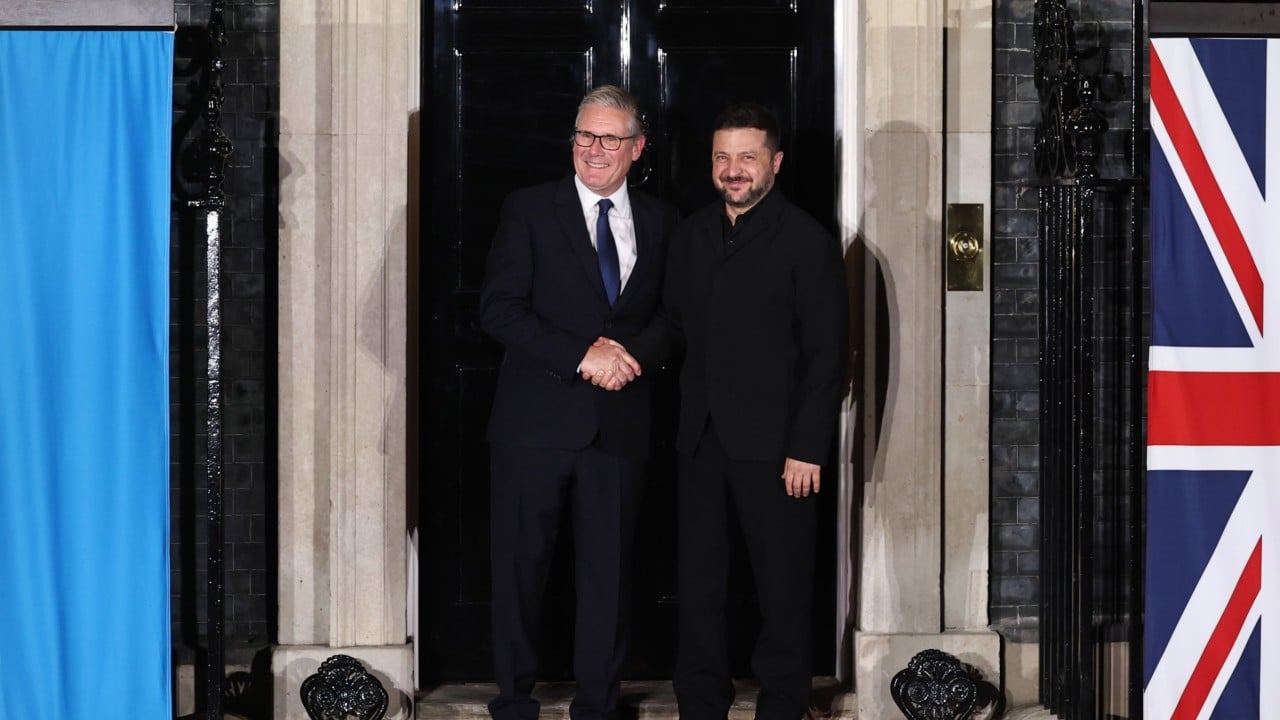
The joint statement from London, Paris, and Berlin sounds comforting. It checked every box in the diplomatic playbook. It spoke of sovereignty, stability, and the urgent need for direct negotiations between Ukraine and Russia. The media swallowed it whole, framing it as a mature, pragmatic step toward regional security.
It is nothing of the type.
This coordinated push for immediate, direct talks is not pragmatism. It is an intellectual surrender disguised as statecraft.
By treating this conflict like a standard border dispute that can be settled with a signed piece of paper and a handshake in Geneva, European leaders are misreading the fundamental nature of modern geopolitical aggression. They are relying on a mid-20th-century diplomatic toolkit to solve a 21st-century ideological war.
The consensus tells you that negotiation is always the goal. The reality is that forced, premature negotiations do not bring peace; they merely subsidize the next invasion.
The Flawed Premise of the "Equal Table"
The core mistake of the UK, French, and German position is the assumption that both sides are operating under the same rational framework. European diplomacy relies heavily on the concept of pacta sunt servanda—the principle that treaties must be respected.
But history proves that revisionist powers view treaties not as permanent settlements, but as tactical pauses.
Look at the Minsk agreements of 2014 and 2015. I spent years analyzing the fallout of those accords while working within security policy circles. The diplomatic establishment lauded them at the time as a triumph of conflict resolution. In reality, they were a disaster. They frozen the conflict, legitimised illegal territorial gains, and gave Moscow the time it needed to restructure its economy, bypass initial sanctions, and build a massive invasion force.
When you force a sovereign nation into direct talks while a foreign army occupies 20% of its territory, you are not negotiating. You are managing a capitulation.
Why the "Minsk Logic" Fails Every Time
- Asymmetric Commitment: One party enters the room to save lives and restore global order; the other enters to freeze their gains and wait out Western attention spans.
- The Validation Principle: Merely sitting down without preconditions validates the use of force as a legitimate tool to alter international borders.
- The Fatigue Factor: Western electorates see the commencement of talks as a signal to stop funding defense aid. The moment the talks begin, Ukraine's leverage evaporates.
Deconstructing the "People Also Ask" Delusions
When people look at this conflict, the questions they ask reveal just how deeply the "lazy consensus" has infected public understanding. Let's dismantle the three most common assumptions.
"Isn't any negotiation better than endless war?"
No. A bad peace is systematically more dangerous than a prolonged conflict. If a ceasefire is signed today along the current front lines, Russia retains control of Ukraine's industrial heartland and its access to the Sea of Azov. This turns Ukraine into a landlocked, economically unviable rump state. A state that cannot fund its own defense will permanently require Western financial lifelines. That is not peace; it is a permanent economic dependency that will eventually collapse when Western political willpower shifts.
"Can't security guarantees protect Ukraine after a treaty?"
This is the ultimate bureaucratic fantasy. What guarantees? The Budapest Memorandum of 1994 already guaranteed Ukraine's security in exchange for giving up its nuclear arsenal. It was signed by the US, the UK, and Russia. It was worth less than the paper it was printed on. Unless those "guarantees" include a binding commitment to deploy Western boots on the ground—which Western capitals have explicitly ruled out—they are empty rhetoric. Paper shields do not stop artillery.
"Won't sanctions force compliance during talks?"
Sanctions are a slow-acting tool. They degrade an economy over decades; they do not dictate immediate battlefield behavior. The Russian economy has adapted by pivoting its supply chains to Asia and utilizing vast shadow fleets to export energy. Expecting sanctions to act as an enforcement mechanism for a new treaty is an act of willful blindness.
The Cold Calculus of Leverage
Negotiation does not happen in a vacuum. It is a reflection of the reality on the ground. Right now, pushing for direct talks ignores the basic rules of game theory.
Imagine a scenario where a burglar breaks into your house, occupies your living room, steals your valuables, and then offers to negotiate from your sofa. If you agree to talk under those conditions, you are not negotiating the return of your property; you are negotiating how much of your own house you get to keep.
+------------------------------------+------------------------------------+
| The Diplomatic Fantasy             | The Hard Reality                   |
+------------------------------------+------------------------------------+
| Dialogue creates trust.            | Dialogue without leverage is       |
|                                    | surrender.                         |
+------------------------------------+------------------------------------+
| Ceasefires save lives long-term.   | Ceasefires allow aggressors to     |
|                                    | rearm and retrain.                 |
+------------------------------------+------------------------------------+
| Neutrality guarantees safety.      | Neutrality creates a security      |
|                                    | vacuum that invites invasion.      |
+------------------------------------+------------------------------------+
For direct talks to yield a stable outcome, the cost of continuing the war must be higher for the aggressor than the cost of withdrawal. We are nowhere near that point. By signaling an eagerness for talks, London, Paris, and Berlin are telling Moscow that Western stamina is running out. That is a catastrophic strategic error. It incentivizes the Kremlin to prolong the fighting, knowing that the West will eventually pressure Kyiv into major concessions.
The Hard Truth of Strategic Stability
If we want actual stability in Europe, we have to stop treating diplomacy as a moral good in and of itself. Diplomacy is a tool, not a solution. Sometimes, the most peaceful thing you can do is refuse to talk until the conditions are entirely in your favor.
The hard truth that European leaders refuse to voice to their publics is this: European security cannot be bought with Ukrainian territory. If Russia's current gains are institutionalized through a negotiated settlement, every authoritarian regime on the planet will receive a clear signal that the international order can be rewritten through violence if you are patient enough to outlast the West.
The risk of my contrarian approach is obvious: it means a longer, more expensive conflict. It means Western taxpayers must continue to fund defense budgets, and it means accepting prolonged instability in energy and commodity markets. It is an uncomfortable, brutal path.
But the alternative is worse. The alternative is a fake peace that guarantees a much larger, much more devastating war five or ten years down the road.
Stop asking when the negotiations will begin. Start asking how to create the material conditions that make negotiations unnecessary. True stability is not achieved by sitting at a table with an adversary who wants you erased from the map. It is achieved by making it physically, economically, and militarily impossible for them to advance another inch. Everything else is just sentimental theater.