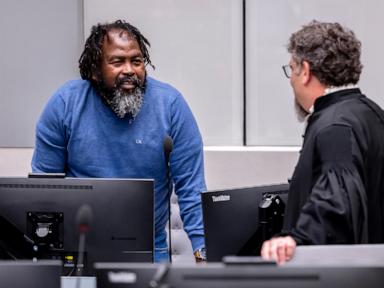
The air inside an international courtroom often smells of old paper, polished mahogany, and the heavy, quiet breath of waiting. It is a sterile smell, carefully scrubbed of blood, dust, and panic. Yet, sometimes, a sound pierces that quiet. It is not the bang of a gavel or the rustle of a legal brief. It is the sound of an invisible reckoning.
Consider the ordinary weight of an afternoon in Bangui, the capital of the Central African Republic, years ago. The heat hangs low, pressing against corrugated tin roofs. A truck rumbles down a dirt road, tires kicking up ochre dust. To an outsider, it might look like any other day in a city scarred by cycles of conflict. But beneath the surface of that routine lies a quieter, more enduring terror: the certainty that power, when left unchecked, recognizes no boundaries between the state and the human body.
Mahamat Said Abdel Kani knew that kind of power.
For months, as a senior commander of the Seleka coalition—an alliance that swept across the Central African Republic in 2013—Said operated in a zone where law was replaced entirely by the whim of a rifle barrel. In the detention facilities under his control, silence was manufactured. Pain was a tool. Fear was the architecture of the rooms.
History rarely records the exact cadence of a victim's breathing in the dark. It prefers numbers. It prefers indictments, warrants, and formal charges. But behind the dry legal architecture of the International Criminal Court in The Hague, where Said finally faced his judgment, those abstract numbers took on a terrifyingly human shape.
The judges did not speak in abstractions when they delivered their verdict. They spoke of torture. They spoke of outrages upon personal dignity. They spoke of acts committed not in the heat of a chaotic battlefield, but in cold, calculated isolation—inside the central office for the suppression of banditry, known locally as the OCRB, and a facility at the M'Poko military camp.
Justice moves at the speed of a glacier. That is its flaw and its defense. By the time a tribunal thousands of miles away in the Netherlands sifts through testimonies, translates dialects, and cross-references medical reports, years have bled away. Children grow into adults. Survivors learn how to walk with limps that never quite mend. Witnesses look over their shoulders long after they have crossed international borders.
Yet, there is a profound defiance in that slow movement.
When the International Criminal Court declared Said guilty of war crimes and crimes against humanity, it did more than sentence a single man to prison. It drew a hard, unyielding line through the impunity that has long haunted the heart of Africa. For too long, the narrative of modern conflict has been written by those holding the weapons, leaving the unarmed to inherit only the grief.
Look closer at the mechanics of accountability. Why does an international trial matter when the village has already been burned, when the family has already been scattered to the wind? It matters because memory is fragile, and oppressors rely on the erosion of time. They bank on the world growing tired, looking away toward the next crisis, the next headline, the next disaster.
A conviction is a stake driven into the shifting sands of history. It says: This happened.
It tells the survivor living in a quiet exile that the night they survived was not an invisible ghost story. It was real. And more importantly, it was wrong.
The courtroom in The Hague is thousands of miles from the banks of the Oubangui River. The distance is physical, cultural, and linguistic. But accountability bridges that chasm. It translates the raw, agonizing vernacular of abuse into the universal language of international law.
When Said was found responsible for charges including torture, forced disappearances, and cruel treatment, the gavel did not just fall on a former militia commander. It fell on the illusion that men with guns can rewrite the basic moral agreements of humanity without a reckoning.
We live in an era obsessed with speed, where atrocities flash across our screens for ten seconds before the algorithm feeds us something lighter, something easier to digest. We scroll past human suffering with the flick of a thumb. We mistake the rapid-fire cycle of news for understanding.
Pause.
Step back from the feed. Think about what it takes to stand before a panel of international judges and recount the worst day of your life, knowing that the man who ordered your suffering might still command loyalists back home. Think about the courage of the witness who refuses to let the dark win.
The verdict against Mahamat Said Abdel Kani is not a cure. It will not rebuild a shattered neighborhood in Bangui. It will not resurrect the dead. Justice, at its best, is merely a repair kit for a broken vessel—it holds the pieces together, but the cracks remain visible.
And that is precisely how it should be. The scars must remain visible so we never mistake the absence of war for the presence of peace.
As the legal proceedings conclude and the prison doors close behind another architect of terror, the dust settles once more over the courtroom in The Hague. But back in the quiet corners of Central Africa, a different kind of sound is rising. It is the sound of an ordinary afternoon, unburdened, for once, by the absolute certainty that cruelty goes unpunished. The air is still warm. The dirt roads still carry the weight of the past. But the horizon, however fractured, looks just a fraction clearer.



