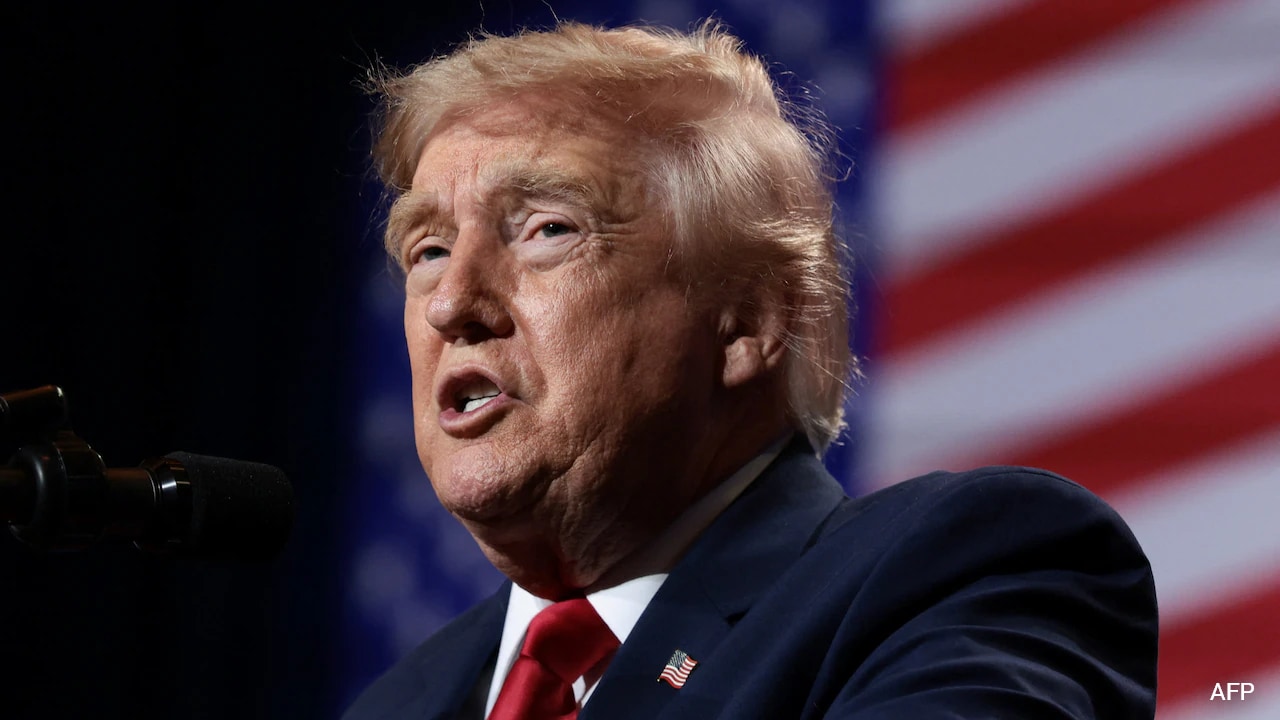
The air inside the Oval Office carried the heavy scent of old paper and high-stakes arithmetic. Outside, Washington was caught in the humid grip of August, but inside, the calculations were global. President Donald Trump leaned forward against the Resolute Desk, looking past the cluster of microphones and notepads, speaking with the casual certainty of a man who believes the final chapter of a very long book is already written.
The war, he predicted, would wrap up soon.
It is a striking thing to hear a commander-in-chief measure human survival in timelines of exhaustion. When he told reporters that the Islamic Republic simply could not go much longer, he was pointing to an invisible ledger of depletion—the burned-out radar installations, the quiet strain on domestic supply chains, and the dwindling stockpiles of precision munitions that take years to manufacture but days to spend.
Consider what happens three thousand miles away, where the map narrows to a watery choke point that dictates the price of a gallon of gasoline and the warmth of a European winter. The Strait of Hormuz is barely twenty-one miles wide at its narrowest point. Imagine standing on the deck of a multi-million-dollar tanker, looking out at the dark, flat water. You know that a single submerged steel shell—a mine dropped with calculated anonymity—can turn iron and cargo into a fireball. That fear keeps captains anchored in place, turning the world's most vital maritime trade artery into a ghost lane.
For months, the rhythm of life along these routes has been dictated by the pulse of escalation and sudden diplomatic freezes. Back in June, a fourteen-point memorandum of understanding offered a brief, fragile ghost of peace, only to dissolve into mutual accusations of bad faith. In Tehran, leaders like Parliament Speaker Mohammad Bagher Ghalibaf took to public platforms to scoff at what they termed theater diplomacy—the cyclical dance of threatened strikes followed by sudden calls to talk.
To look at this conflict only through the lens of executive statements is to miss the human cost etched onto the faces of families from Tehran to the Gulf coast, caught between economic suffocation and state defiance. Acting Defense Minister Brigadier General Seyed Majid Ibn Reza spoke from a playbook of unyielding resilience, promising a crushing response to any external pressure. Yet behind the official defiance lies the reality of an economy squeezed from every conceivable angle, where ordinary citizens bear the brunt of inflation, scarcity, and the ever-present hum of military readiness.
Power, at this level, is an exercise in resource management. Trump acknowledged a fundamental truth about modern high-tech warfare: while the United States maintains a virtually limitless supply of certain heavy ordnance, other categories of high-precision guidance systems are running tight. Factories are scrambling to spin up new production lines for Patriot and Tomahawk systems, a tangible reminder that industrial capacity ultimately sets the boundary for geopolitical ambition. You can command fleets from a mahogany desk, but you cannot manufacture advanced guidance chips overnight.
Diplomacy, meanwhile, moves in strange, circuitous currents. While Washington weighs its military leverage and economic sanctions, regional actors work behind the scenes. Reports point toward emerging maritime arrangements involving neighboring states like Oman, designed to carve out safe, toll-free pathways through the contested waters. These are the quiet mechanics of de-escalation—not signed with grand flourishes of a pen, but pieced together out of sheer necessity because the global economy cannot afford another season of closure.
The promise that the conflict will conclude shortly offers a fragile kind of relief. But peace, when it arrives under these terms, will not be a sudden dawn. It will enter quietly, marked by the cautious movement of cargo ships weighing anchor in the Persian Gulf, the gradual cooling of rhetoric in state media, and the heavy, quiet realization of what it took to reach the end of the line.