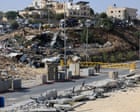
Two months after the rain stopped, the mud in the Kathmandu Valley still smells like iron and crushed pine.
You can wash the silt off a concrete floor. You can scrape the watermark off a plaster wall with a stiff wire brush and a bucket of bleach. You can even rebuild a retaining wall stone by backbreaking stone before the winter frost locks the Himalayan foothills into silence.
What you cannot scrub away is the doorway.
Consider a hypothetical family living along the banks of the Roshi Khola in Kavrepalanchok, just southeast of Kathmandu—let us call them the Tamangs, though their exact surname could belong to any of the hundreds of households carved into the steep, terraced slopes of central Nepal. By the front door of their half-collapsed brick home sits a pair of worn rubber sandals. They are caked in dried gray river clay. Nobody moves them. Nobody throws them out.
To pick up those sandals and put them in a cupboard is to admit that the person who wore them is never coming back.
In late September 2024, the sky over Nepal broke open with a ferocity that meteorological charts struggle to translate into human terms. Over forty-eight hours, relentless monsoon downpours—fueled by a low-pressure system over the Bay of Bengal—dumped record-breaking rainfall across eastern and central Nepal. Kathmandu recorded more than 240 millimeters of rain in a single day, the highest daily deluge the capital had seen in over half a century.
The numbers were immediate, brutal, and neatly packaged for international headlines. Over two hundred dead. Dozens missing. Billions of rupees in destroyed highways, washed-out hydropower stations, and flattened farmland.
Then, as it always does, the news cycle moved on.
The Architecture of Ambiguous Loss
When a disaster strikes, the world focuses on the acute phase—the dramatic helicopter rescues, the submerged roofs, the frantic digging through landslide debris with bare hands and iron rods. That is the visible emergency.
The invisible emergency begins sixty days later.
Psychologists have a clinical term for what happens when a loved one vanishes without a body to bury: ambiguous loss. Unlike ordinary grief, which has a cruel but distinct starting line marked by a funeral pyre or a grave, ambiguous loss freezes time. It traps the living in a permanent hallway between hope and despair.
Think of it like a book with the final chapter torn out. You cannot put it back on the shelf, and you cannot start reading another story, because your mind refuses to accept that the plot simply stopped mid-sentence.
In Hindu and Buddhist traditions across Nepal, death is not merely an emotional rupture; it is a spiritual transition that requires precise ritual stewardship. When someone dies, the family performs antyeshti—the last rites. Bodies are bathed, wrapped in shrouds, and cremated along sacred riverbanks like Pashupatinath, their ashes committed to the water so the soul can safely navigate the passage out of this world. For thirteen days, sons shave their heads, wear white, eat single meals of plain rice and salt, and observe strict mourning rites (kriya) to guide the departed spirit.
Without a body, the ritual engine stalls.
If a family performs funeral rites for someone who was swept into the Bagmati or Sunkoshi River, and that person somehow survived—washed ashore miles downstream, injured and amnesiac in a rural clinic—the family has spiritually severed a living person from the world. Yet if they do not perform the rites, they fear the spirit remains trapped, restless and unguided, caught in the cold current where the landslide took them.
So the sandals stay by the door.
How a Mountain Turns to Liquid
To understand why so many families are still waiting for answers two months after the floodwaters receded, you have to understand what actually happened to the geography of Nepal during those forty-eight hours.
People outside the Himalayas often imagine a flood as water rising slowly across a flat plain, like a bathtub overflowing. In Nepal, a flood is vertical. It is kinetic.
The Himalayas are geologically young, fractured, and steep. When extreme rain saturates the topsoil on a forty-degree slope, the friction holding millions of tons of earth, boulders, and pine trees together simply vanishes. The mountain turns to liquid.
In places like Panauti, Namo Buddha, and the steep gorges lining the BP Highway—the vital artery connecting Kathmandu to the eastern plains—entire hillsides sheared off in seconds. These debris flows do not merely submerge houses; they erase them. They carry boulders the size of delivery trucks at forty miles an hour, grinding concrete into powder and burying settlements under thirty feet of dense, anaerobic silt and rock.
Search and rescue teams operating in the days after the September floods faced a landscape that no longer matched any map. Roads had vanished into riverbeds. Bridges were twisted into unrecognizable ribbons of rebar. When a landslide buries a cluster of homes under twenty feet of wet clay and granite, ground-penetrating radar fails, sniffer dogs lose the scent beneath the dense mud, and excavators cannot even reach the valley floor because the access roads have slid into the gorge.
Within weeks, the mud bakes in the autumn sun until it is nearly as hard as cured concrete.
Local police posts and district administration offices keep meticulous ledgers of the missing. Yet for a mother walking down a dusty, newly bulldozed track to the local ward office every Tuesday morning, an entry in a ledger is cold comfort. She wants a tooth, a scrap of patterned cotton, a tarnished silver ring—anything that allows her to light the butter lamps and let go.
The Bureaucracy of the Unfound
Grief is heavy enough on its own. When you bolt paperwork onto it, it becomes suffocating.
In the aftermath of the 2024 floods, the Nepali government announced relief packages for bereaved families—financial compensation meant to help survivors rebuild shattered homes and survive the looming winter without their primary breadwinners. On paper, the policy is straightforward and compassionate.
In practice, it collides with a brutal legal paradox: you cannot easily claim death benefits for someone who is officially only missing.
Imagine standing at a crowded municipal counter in Kavre or Lalitpur, holding a water-damaged citizenship card and a faded passport photo. The clerk across the desk is exhausted, under-resourced, and bound by statutory rules designed to prevent fraud. To issue a death certificate without a body requires police verification reports, witness affidavits from neighbors who saw the water take the victim, and waiting periods that stretch agonizingly while winter temperatures begin to bite at night.
Meanwhile, the invisible costs compound daily.
If the missing person was the family's sole earner—a driver whose bus was swept off the Tribhuvan Highway at Jhyaple Khola, where over thirty travelers died when a massive landslide crushed vehicles waiting in traffic—the household's income drops to zero overnight. Bank loans taken out to buy a small piece of land or fund a child's schooling do not pause because a river changed its course. Landlords in Kathmandu's dense, flood-prone informal settlements along the Bagmati and Bishnumati rivers still expect rent at the end of the month.
The families left behind are forced into an impossible emotional contortion. To secure the basic financial survival of their living children, they must actively argue to the state that their spouse, parent, or child is dead—even while part of their heart still listens for footsteps on the gravel path every evening at dusk.
The Warning Written in the Rain
It would be comforting to treat the September 2024 floods as a freak historical anomaly, a once-in-a-century storm that caught an unlucky nation off guard.
That comfort is a lie.
Look closely at the pattern across the Hindu Kush Himalaya region over the last decade. From the 2013 Kedarnath disaster in India to the 2022 floods in Pakistan, from the 2023 glacial lake outburst flood in Sikkim to the September 2024 deluge in Nepal, the physics of the atmosphere are rewriting the rules of mountain survival.
Warmer air holds roughly seven percent more moisture for every degree Celsius of temperature rise. When warm, moisture-laden monsoon winds slam into the towering wall of the Himalayas, they are forced upward, cooling rapidly and dumping catastrophic volumes of water in concentrated bursts.
At the same time, human vulnerability has climbed higher up the slopes. Rapid, poorly regulated road construction across Nepal's hills—often carved into fragile slopes with excavators rather than engineered drainage and retaining walls—has destabilized mountainsides across the country. Concrete cities have paved over the natural floodplains of the Kathmandu Valley, leaving roaring rivers nowhere to go except straight through ground-floor apartments and squatter settlements.
The disaster was not solely made in the clouds. It was built, bit by bit, in the gap between rapid development and fragile geology.
What Remains When the Cameras Leave
Walk through the affected neighborhoods along the Bagmati River in Kathmandu or the terraced villages of Kavre sixty days after the rain, and you will notice a strange quiet.
The emergency relief trucks with their bright banners have mostly gone back to the city. The international news crews have packed their tripods and flown to the next crisis. What remains is the slow, unglamorous work of endurance.
Neighbors share sacks of lentils and corrugated zinc sheets. Local youth clubs organize makeshift health camps to treat the skin infections and respiratory illnesses that bloom in damp, unheated temporary shelters. Elderly grandparents sit in the weak November sunlight, shelling corn and watching the river—which has shrunk back into a thin, innocent-looking silver ribbon winding through a massive scar of boulders and uprooted trees.
It is astonishing how small a river looks in November when you know what it did in September.
For the families still waiting for closure, time does not move forward in a straight line. It loops. It returns to the sound of heavy rain hammering on a tin roof at two in the morning. It returns to the frantic, unanswered phone calls before the cell towers went dark. It returns to the exact moment the earth groaned beneath the floorboards.
Closure, when it comes at all in the wake of a mountain flood, rarely arrives as a neat official stamp or a recovered body. More often, it arrives quietly, through sheer exhaustion and the stubborn demands of the living—a child needing shoes for school, a field needing to be cleared before planting season, a winter roof needing nails before the frost sets in.
In that house above the Roshi Khola, the morning sun eventually reaches the front threshold, warming the dried river clay on the rubber sandals by the door, while inside, someone strikes a match to light the stove and boil water for tea.