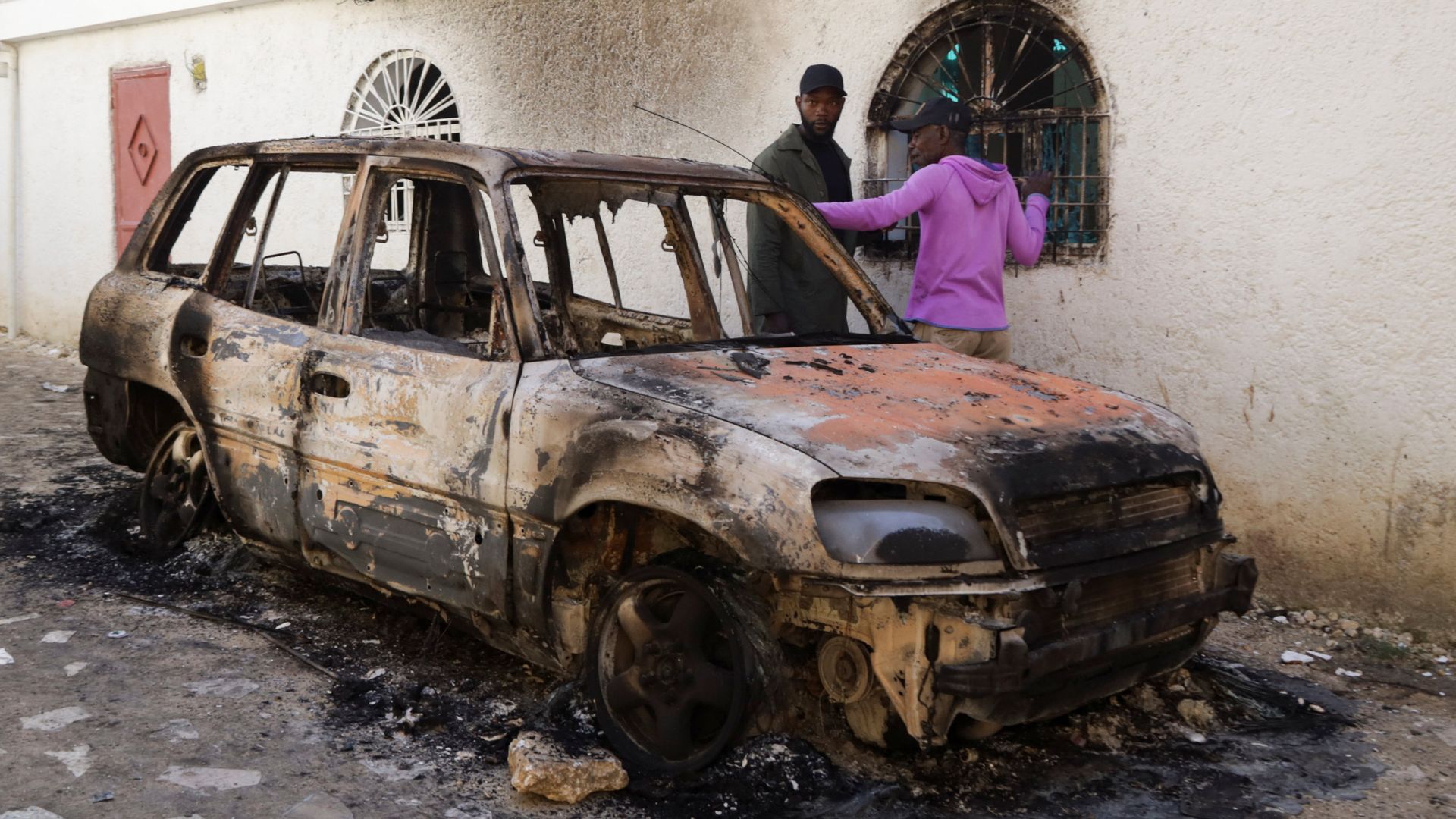
The rain in Port-au-Prince does not fall gently. It arrives as a sudden, heavy violence, turning the red dust of the street into thick, sluggish clay that swallows the ankles of anyone foolish enough to walk through it after dark. In the neighborhoods where the concrete is half-finished and the electricity arrives like a rumor, the sound of the rain is a mercy. It briefly drowns out the other sound. The distant, rhythmic concussions of automatic gunfire. The sound that tells everyone within earshot that the perimeter has shifted again. That another block has changed hands. That the state, thin and brittle as dried leaves, has snapped somewhere else.
Consider what happens next when a cargo door opens on a tarmac thousands of miles away. Also making news recently: Why Getting Thrown Off a Cruise Over Half a Bottle of Wine Will Cost Them Millions.
A metal staircase hits the concrete. Down walk the deportees. They step out of the chilled cabin of a charter flight into the heavy, wet heat of an island they may not have seen in a decade. Some carry everything they own in a heavy plastic trash bag, the kind issued by municipal jails or immigration holding facilities. They have traded the sterile gray of an institutional waiting room for a city caught in the tightening grip of a coordinated gang coalition known as Viv Ansanm. They step off the plane and directly into a vacuum.
The numbers on a spreadsheet are clean. Fifty hostages. Dozens of deportees. A surging crisis. Government officials in Washington sign manifests, balancing legal obligations against domestic optics, while diplomats in quiet rooms draft statements condemning the violence. But numbers do not sweat. Numbers do not stand on the tarmac in cheap sneakers, staring at a smoking tire track on the runway, wondering if their cousin’s house in Delmas is still standing or if it was burned to the ground for protection money three weeks ago. Additional details on this are covered by Reuters.
To understand the human cost of this friction, imagine a man named Jean. This is a hypothetical portrait built from the accumulated weight of hundreds of identical arrivals. Jean left Haiti when the asphalt roads still had names people used. He spent fifteen years working construction in Florida, sending remittances back through wire services that carved away a percentage of every single paycheck. He missed funerals. He missed the birth of a niece. He paid his taxes, kept his head down, and believed that distance was a temporary inconvenience.
Then came the knock. Then came the paper. Then came the cell with twenty other men waiting for a signature that meant departure.
When Jean's plane touched down, he didn't smell the sea. He smelled burning rubber and charcoal. The terminal was half-emptied, skeleton-staffed by workers whose own families were sheltering from crossfire twenty blocks away. He had no phone that worked on local towers. He had no car. He had three hundred dollars cash tucked into the lining of his belt, a beacon for anyone looking at new arrivals with predatory eyes.
The gangs do not wait for policy papers to clear committee. They operate in the spaces between administrative decisions. When armed factions control eighty percent of the capital, every port of entry becomes a front line. When a threat is issued—an ultimatum to execute fifty hostages unless specific demands are met or certain conditions change—it is not an abstract political bargaining chip. It is a stopwatch counting down in real time. Every tick echoes through concrete cellars where families listen for the boots of young men carrying rifles that cost more than a suburban house.
The international community looks at Haiti through the lens of humanitarian intervention, security assistance, and police training missions. We talk about multinational security support forces, armored vehicles, and logistical supply chains as if we are assembling a piece of heavy machinery. But security is not an engine you drop into a chassis. It is an atmosphere. It is the absolute absence of dread when the sun goes down. Right now, that atmosphere does not exist.
Instead, there is a terrible calculus happening in the alleys of Cite Soleil and Carrefour. When planes land carrying dozens of individuals back into an active warzone, the local infrastructure absorbs them the way dry sand absorbs a cup of water. There are no halfway houses waiting with social workers. There are no reintegration seminars. There is only the street, the gang checkpoint, and the terrifying realization that speaking English with an American accent or wearing clothes that look slightly too modern marks you as someone who might have savings, someone who might have family abroad, someone worth kidnapping.
The architects of foreign policy in Western capitals often suffer from a specific kind of geographical blindness. They view deportation as an administrative closure, the final keystroke in a legal file. Case closed. Problem solved on ledger books three thousand miles away. But geography is stubborn. A human being dropped into a war zone does not vanish; they become fuel for the fire. They swell the population of the dispossessed. They strain the resources of families who are already eating one meal every two days to survive the blockade on fuel and food imports.
Listen closely to the silence that follows a volley of gunfire in downtown Port-au-Prince. It is not peaceful. It is pregnant with the terror of what is coming next.
The fifty hostages held by gang leadership are not strangers to the deportees. They are cousins, market women, teachers, mechanics, and children. They are the exact people who stayed behind when everyone else who could run, ran. To threaten their lives while fresh planeloads of citizens are funneled back into the theater of conflict is a calculated escalation, a crude and brutal method of signaling dominance to a transitional government that barely controls the ground beneath its own feet.
We tell ourselves stories about order. We construct legal frameworks to justify the movement of populations across borders, leaning heavily on statutory language and judicial precedent. But when the legalistic dust settles, the reality remains stark and unyielding. A human life cannot be divorced from its context. Dropping vulnerable people into a collapsing state while armed factions trade ultimatums over human lives is not law enforcement. It is abandonment by another name.
The rain stops as quickly as it started. The steam rises from the asphalt, thick and white against the bruised evening sky. Somewhere in the dark, a car engine revs, and the metallic clatter of a bolt being pulled back on a rifle rings out sharp and clear. The plane has long since turned around and flown back north, leaving the runway empty, quiet, and waiting for whatever the night decides to bring.