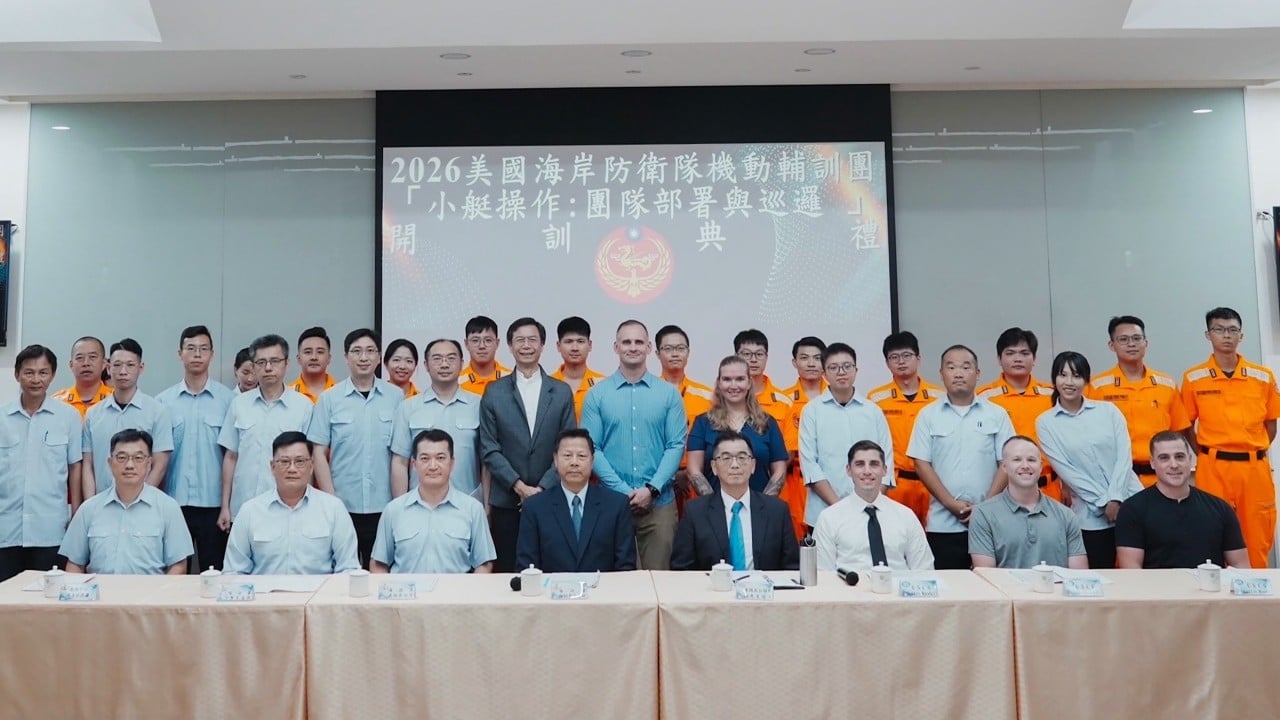
Every major media outlet covered the headline with breathless urgency: American military personnel quietly deploying to Taiwan to drill the island's coast guard against mounting mainland pressure. The narrative writes itself. A David and Goliath struggle in the Taiwan Strait, America reinforcing the ramparts, deterrence in action.
It is a comforting script. It is also entirely wrong.
I have watched defense policy for two decades, and I have seen Washington blow billions on symbolic posturing that satisfies cable news segments while rotting away actual strategic readiness. Deploying a handful of Coast Guard advisers to train maritime law enforcement in Kinmen or Penghu is not a masterstroke of deterrence. It is a psychological pacifier. It substitutes tactical checkbox ticking for the brutal, unglamorous math of real deterrence.
The lazy consensus in the defense press is that more uniforms on the ground equals higher friction for Beijing. That logic collapses the moment you examine how modern gray zone warfare actually operates.
The Flawed Premise of Gray Zone Deterrence
Let us look at what this deployment is supposed to achieve. The standard line is that embedding U.S. personnel within Taiwan's Coast Guard Administration upgrades their interoperability, sharpens their search-and-rescue capabilities, and signals ironclad American resolve.
Stop right there. Resolve is not measured by the number of advisory billets on a foreign island. Resolve is measured by survivability under fire and logistics at scale.
When Beijing increases pressure around Taiwan, it does not do so by inviting a clean, symmetrical naval battle where coast guards politely trade paint and legal citations. China deploys maritime militia vessels backed by heavy China Coast Guard cutters that dwarf almost everything in Taipei's fleet, all while the People's Liberation Army Navy hovers just over the horizon.
Dropping a few American trainers into this mix does not alter the physics of displacement. A 4,000-ton mainland cutter outmasses a typical Taiwanese patrol boat by a factor of three. If a crisis escalates, those American advisers become immediate hostages to fortune—high-value political liabilities trapped in a theater where air and missile supremacy belongs entirely to the other side within the first six hours.
We are playing checkers while the PLA is playing a three-dimensional game of economic and infrastructural encirclement.
The Misunderstood Mechanics of Maritime Law Enforcement
To understand why this training mission misses the mark, you have to define what the Taiwan Coast Guard is actually facing. Most commentators confuse military escalation with police actions. They assume maritime law enforcement is just a smaller version of naval warfare.
It is not. It is an exercise in administrative exhaustion.
Beijing uses its coast guard and maritime militia to choke the administrative life out of Taiwan without firing a shot. They board vessels, establish jurisdiction through persistent presence, and rewrite the operational baseline day by day. By treating this as a military training problem—teaching tactical maneuvers, small-boat handling, and boarding procedures—Washington is helping Taiwan fight the last war.
Taipei does not need better boarding parties right now. Taipei needs decentralized sensor grids, redundant communications that cannot be jammed by mainland electronic warfare, and an asymmetrical commercial shipping strategy that keeps supply lines open when a blockade goes live.
Teaching a coast guard crew how to run standard law enforcement drills while their surrounding waters are electronically blinded and physically blockaded is like teaching someone how to parallel park while the car is already on fire.
The Cost of Symbolic Substitutes
I have sat in rooms where defense contractors and policy wonks pat themselves on the back for delivering incremental capability packages. They call these initiatives stepping stones. I call them distractions.
Every dollar, every transport slot, and every ounce of institutional bandwidth spent on high-visibility, low-impact advisory deployments to Taiwan pulls resources away from the unsexy, critical work that actually deters aggression.
What is that work? It is hardening fuel reserves on the island. It is stockpiling precision munitions in decentralized bunkers. It is buying thousands of cheap, loitering anti-ship cruise missiles rather than maintaining elite, high-maintenance platforms that can be wiped out in the opening salvo.
When you focus the spotlight on a handful of American trainers working with local coast guards, you create a false sense of security among the public. It invites the dangerous assumption that Uncle Sam has everything under control, which in turn lets political leaders in Taipei delay the painful, expensive domestic reforms needed for true porcupine defense.
Dismantling the Escalation Trap
There is a school of thought that argues any U.S. uniform on Taiwanese soil raises the political cost for Beijing. The theory is that if Chinese forces strike or intercept Taiwanese assets while Americans are present, they risk accidentally killing U.S. personnel and triggering a broader war.
This is wishful thinking bordering on negligence.
Beijing’s strategists are not easily spooked by tripwire forces if those forces lack mass and operational depth. In fact, an exposed, token U.S. presence gives Beijing a strategic menu of options it would not otherwise have. They can isolate the island, enforce selective quarantines, and watch as Washington debates whether a Coast Guard adviser counts as an act of war.
Deterrence fails when the adversary believes your commitments are broad in rhetoric but shallow in execution. By sending trainers instead of hard combat power, and by hyping it as a major policy shift, Washington is advertising the limits of its appetite for risk, not the depth of its resolve.
If we want to change the calculus in the Taiwan Strait, we need to stop treating deterrence as a public relations campaign. Stop sending small teams to teach tactics they cannot scale, and start delivering the hard, unglamorous inventory that makes an invasion mathematically impossible.
Until then, these training missions are just expensive theater playing to an audience that refuses to look at the scoreboard.