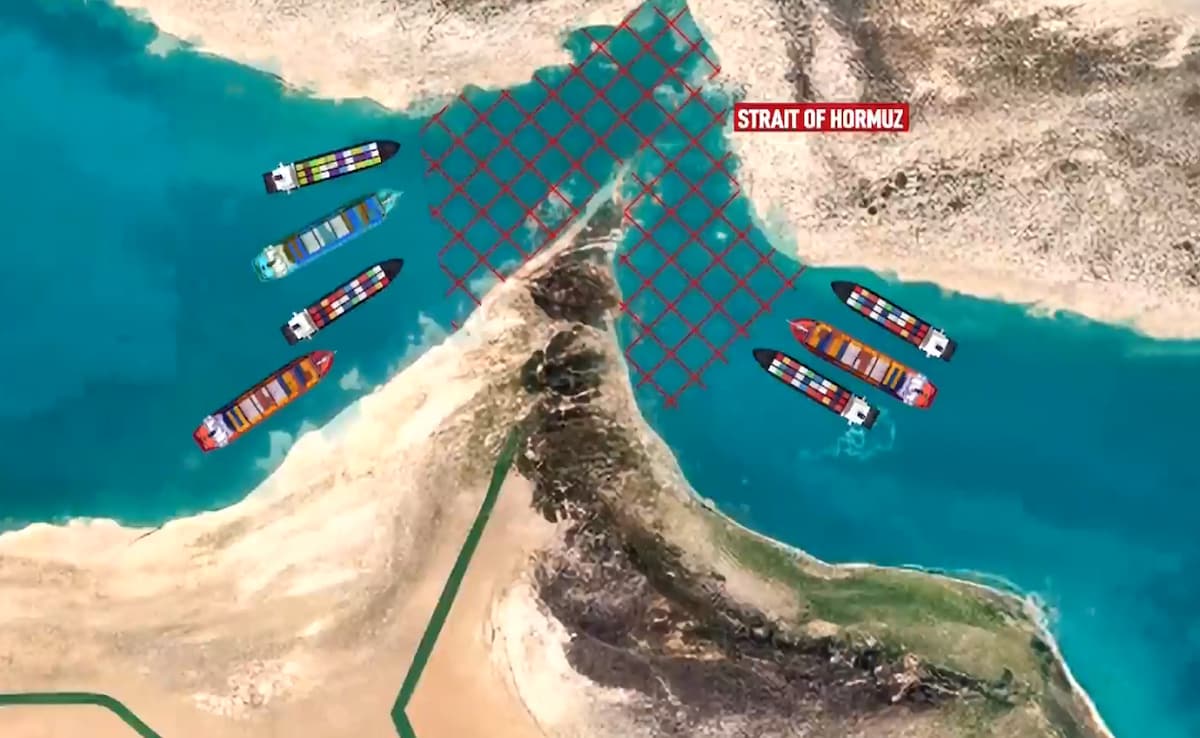
The silence was the first thing they noticed. For weeks, the horizon off the coast of Bandar Abbas had been an empty, haunting blue. No churning wakes. No deep, rhythmic thrum of massive diesel engines vibrating through the soles of boots. No rusted hulls stacked high with the multicolored building blocks of global commerce. The Strait of Hormuz, a narrow throat of water through which the world breathes, had been constricted by the iron grip of conflict.
Then, the static on the radio cleared. A ceasefire—fragile as spun glass but holding—was announced. The order went out. The anchors began to rise. Meanwhile, you can read other events here: Why the Nepal Airlines Map Error is a Major Diplomatic Headache.
To a floor trader in Chicago or a policy analyst in D.C., the reopening of the Strait is a data point. It is a line graph of Brent Crude dipping back toward normalcy. But for Elias, a second mate on a Panamax tanker, it is the smell of salt spray returning after days of stifling heat in a holding pattern. It is the end of the hyper-vigilance, the scanning of the waves for the telltale wake of a fast-attack craft or the shadow of a drone.
The Strait is barely twenty-one miles wide at its narrowest point. Imagine a bottleneck where twenty percent of the world’s petroleum and nearly a third of its liquefied natural gas must squeeze through a passage flanked by jagged mountains and shifting political allegiances. When it closes, the world’s heart skips a beat. To understand the full picture, check out the detailed report by The New York Times.
The Physics of the Bottleneck
Economics is often treated as a series of abstract spreadsheets, but in the Strait, it is a matter of physical clearance. Every day, roughly 20 million barrels of oil move through these waters. If you lined those barrels up end-to-end, they would stretch from New York City to Los Angeles and halfway back again. This is not just "energy." This is the fertilizer that grows the wheat in Kansas. It is the plastic in a life-saving IV bag in a London hospital. It is the fuel for the freighter bringing the latest smartphone to a teenager in Tokyo.
During the shutdown, the global supply chain didn't just slow down; it rerouted. Massive vessels were forced to circumnavigate entire continents, adding weeks to voyages and millions to fuel costs. The "insurance premium" on a single transit rose to levels that made even the wealthiest shipping magnates wince.
Now, with the ceasefire in place, the logistics of the restart are a logistical ballet of terrifying complexity. You cannot simply turn a key and move a fleet. There are mine-sweeping operations to verify. There are backlogs of hundreds of vessels waiting for their turn in the narrow shipping lanes. Marine traffic controllers are working thirty-six-hour shifts, guiding these steel giants through a gap so narrow that two tankers passing each other look like skyscraper-sized shadows brushing shoulders in the dark.
The Invisible Toll on the Human Element
We talk about "vessels" and "tonnage," but we rarely talk about the twenty people living inside those steel shells. During the height of the tension, crews were living in a state of suspended animation. Many were stuck on board long past their contracts, unable to dock in ports that had become high-risk zones.
Consider a hypothetical engineer named Aris. For three weeks, he sat in the engine room of a stalled crude carrier. He hadn't seen his daughter in six months. He watched the news on a grainy satellite feed, seeing the price of oil skyrocket while his ship sat motionless, a billion-dollar target. The reopening isn't just about trade; it’s about Aris finally getting to dock in Fujairah, stepping onto solid ground, and booking a flight home.
The psychological weight of a maritime blockade is heavy. It is a slow-motion crisis. Unlike a sudden earthquake or a storm, a blockade is a human-made vacuum. It sucks the certainty out of the room. When the Strait reopens, that pressure eases. The first whistle blasts from the lead tankers are more than just navigational signals. They are a collective exhale.
The Technology of Peace
The ceasefire relies on more than just signatures on a piece of parchment. It is being enforced by a digital web of surveillance that would have been science fiction a decade ago. Automated Identification Systems (AIS) are being monitored by constellations of private satellites, ensuring that no "dark fleet" vessels try to exploit the chaos.
Sophisticated sonar arrays have been deployed to listen for the signature of underwater threats. This is the new reality of the Strait: a blend of ancient geography and 21st-century sensor fusion. Peace, in this part of the world, is something that must be measured in decibels and heat signatures.
The technology doesn't just watch for war; it watches for the environment. The frantic rush to restart shipping carries the risk of collisions and spills in one of the most delicate marine ecosystems on the planet. The coral reefs of the Persian Gulf are already stressed by rising temperatures. A single error in navigation during the post-ceasefire scramble could result in an ecological catastrophe that would outlast the political conflict that caused the shutdown in the first place.
The Fragility of the Flow
There is a temptation to see the reopening as a "return to normal." It isn't. The "normal" we knew before the closure was an illusion of stability. We have been reminded of just how thin the thread of global stability truly is.
If you look at the Strait on a map, it looks like a claw. On one side, the Musandam Peninsula of Oman; on the other, the coast of Iran. It is a geographic fluke that has dictated the fate of empires for centuries. In the 1500s, the Portuguese fought for control of this water. In the 1980s, the "Tanker War" saw hundreds of ships attacked. History here doesn't move in a straight line; it moves in a circle.
The ceasefire is a reprieve, a chance for the global economy to catch its breath. But the scars remain. Supply chain managers are already looking for ways to bypass the Strait entirely—pipelines across the desert, new rail links through Central Asia, or the melting Arctic passages. The world is trying to grow a new set of veins because it no longer trusts the old ones.
But for today, the ships are moving.
Deep in the hull of a tanker, a pump begins to groan. The massive propellers bite into the turquoise water, churning it into a frothy white. On the bridge, the captain adjusts his cap and looks toward the horizon. The mountains of the Musandam Peninsula loom to the south, jagged and silent, watching as the lifeblood of the modern world begins to flow through the narrow throat once more.
The first ship through the gap is a grain carrier. It is followed by a gas tanker. Then another. And another. A parade of steel and necessity, stretching as far as the eye can see, proving that while we can stop the world for a moment, the hunger of eight billion people for heat, light, and movement will eventually force the gates back open.
The tension hasn't vanished. It has simply submerged, waiting for the next tide.