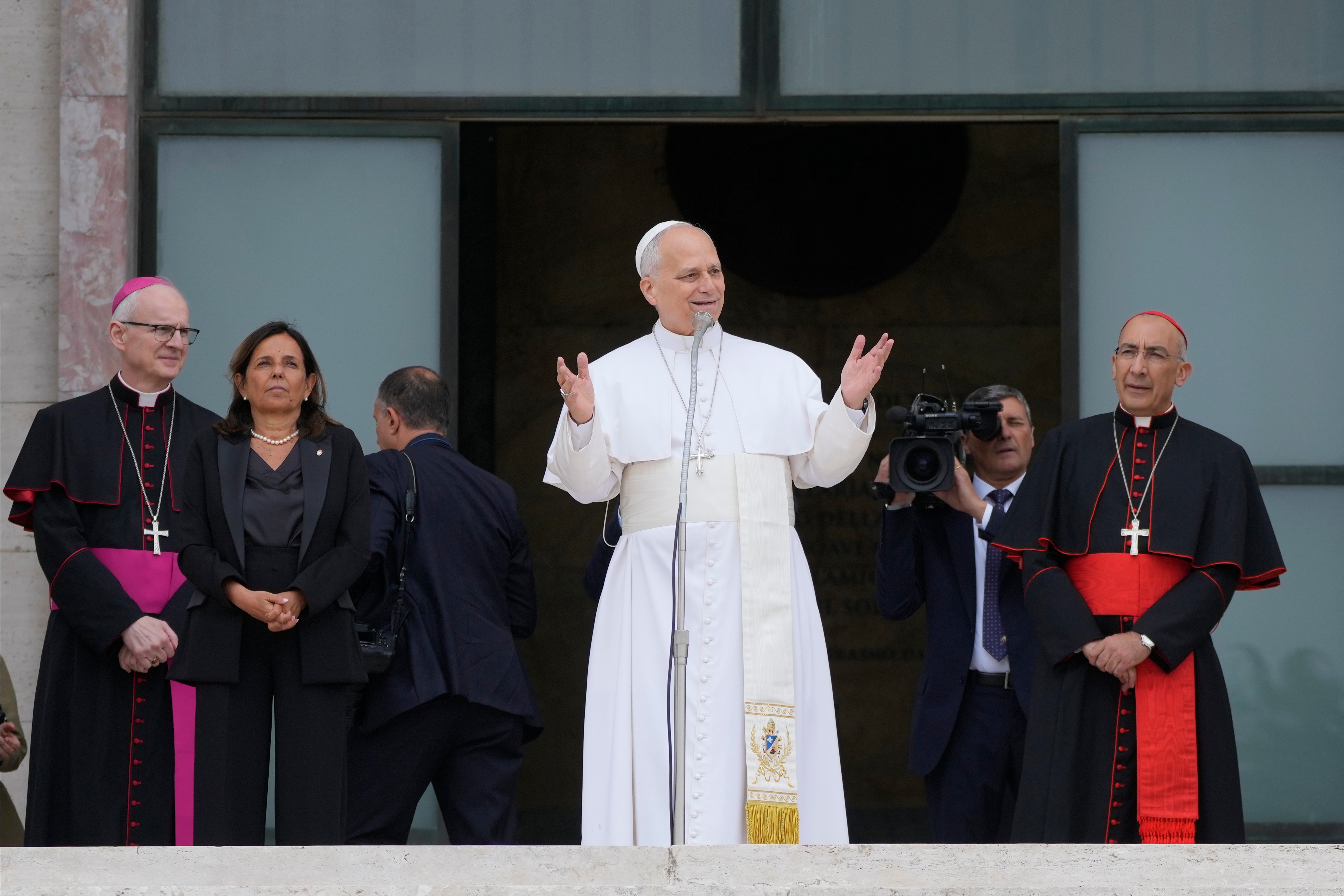
The Pope is not a Luddite, but he is a realist about human nature when it is handed a remote control that requires no finger to pull the trigger. When Pope Francis addressed the G7 summit to warn against the "spiral of annihilation" inherent in AI-directed warfare, he wasn't just offering a Sunday homily on peace. He was identifying a specific, mechanical shift in how modern states are outsourcing the moral weight of killing to lines of code. The central problem is not that machines will become "evil," but that they are becoming efficient enough to make war a frictionless choice for political leaders.
This push toward Lethal Autonomous Weapons Systems (LAWS) represents a total divorce between action and accountability. When a human pilot makes a mistake and hits a wedding procession instead of a convoy, there is a chain of command, a court martial, and a public reckoning. When a neural network misidentifies a group of farmers as an insurgent cell because of a low-resolution thermal signature and a flawed training set, the blame evaporates into the ether.
The Algorithmic Erasure of Mercy
War has always been a messy, visceral human endeavor. It is governed—at least in theory—by the Geneva Conventions and the concept of "proportionality." AI cannot feel the weight of these legal frameworks because it does not understand what a human life is. It only understands data points and probability thresholds.
Current military AI development focuses on the "OODA loop"—Observe, Orient, Decide, Act. The goal of every major power right now is to shrink that loop until it is faster than human thought. If your enemy’s AI can target and fire in 50 milliseconds and your human commander needs five seconds to verify the target, you lose. This creates a race to the bottom where "meaningful human control" is stripped away in the name of tactical survival. We are building systems that require us to take our hands off the wheel just to stay competitive.
The Vatican’s intervention focuses on the "sanctity of human agency." This isn't just theological fluff. If a machine decides who lives and who dies, we have fundamentally altered the social contract between a state and its citizens. We are moving toward a world where death is delivered by an optimized script, making the decision to go to war as easy as hitting "deploy" on a software update.
The Black Box Problem in the Trenches
One of the most dangerous aspects of AI in combat is the "black box" nature of deep learning. Even the engineers who build these models cannot always explain why an AI reached a specific conclusion. In a civilian context, this leads to biased credit scores or bad movie recommendations. In a conflict zone, it leads to unintended escalation.
Consider a hypothetical scenario where two opposing AI systems are patrolling a disputed border. One system makes a minor movement that the other’s algorithm interprets as an imminent kinetic threat based on a pattern it "learned" from a simulated training environment. The second system strikes. The first system’s retaliation is instantaneous. By the time a human general realizes what happened, a full-scale conflict is underway. This is the "flash crash" of the stock market applied to global security, where trillions of dollars aren't at stake, but millions of lives are.
The pushback from the tech sector often involves the claim that AI will be more "precise" than humans. They argue that machines don't get tired, they don't get angry, and they don't seek revenge. While true, this ignores the reality of data poisoning and "edge cases." A human soldier can look at a child holding a toy gun and recognize the lack of intent. An AI, trained on thousands of images of weapons, sees a silhouette and a high probability of a firearm. The machine lacks the context of "humanity" that acts as the final safety catch on a weapon.
The Commercial Engine of Autonomous Death
We cannot discuss the rise of AI warfare without looking at the massive shift in the defense industrial base. The traditional "Big Five" defense contractors are being challenged by "defense tech" startups backed by Silicon Valley venture capital. These companies operate on a "move fast and break things" ethos that is terrifying when applied to munitions.
For these firms, war is a software problem. They sell the idea of the "Software-Defined Front Line." This business model depends on constant iteration and the deployment of autonomous sensors, drones, and targeting suites. The profit incentive is geared toward more automation, not less. When your stock price is tied to the efficiency of your targeting algorithm, you have very little incentive to build in "slow" human checkpoints.
The Myth of the Clean War
Governments love the idea of AI because it promises "clean" war. No body bags coming home, no traumatized veterans, just drones and servers doing the dirty work. This is a dangerous illusion. When war becomes painless for the aggressor, the threshold for starting it drops to near zero.
The "spiral of annihilation" the Pope refers to is the inevitable result of making war too easy to start and too fast to stop. If you can wage war with zero domestic political cost, you will wage it more often. We are seeing this play out in modern conflicts where "loitering munitions"—suicide drones—are used to saturate defenses. These are the precursors to fully autonomous swarms that will operate without any human input once they are launched.
The Global Policy Void
Currently, there is no binding international treaty governing the use of AI in weapons. While groups like the Campaign to Stop Killer Robots have lobbied for years, the major powers—the US, China, Russia, and Israel—have consistently blocked any move toward a total ban. They argue that "responsible" use is the answer, but no one can agree on what that looks like in practice.
The Vatican's role here is to act as a moral counterweight to the cold logic of the Pentagon and the Kremlin. By bringing this issue to the G7, Francis is forcing world leaders to acknowledge that this is not just a technical evolution, but a civilizational crossroads.
The Accountability Gap
If an autonomous drone commits a war crime, who goes to the International Criminal Court?
- The programmer who wrote the code?
- The general who authorized the mission?
- The CEO of the company that manufactured the hardware?
- The AI itself?
Our current legal systems are built on the concept of intent. A machine has no intent. It has objectives. This creates a massive loophole in international law that allows states to hide behind "technical failures" to avoid responsibility for atrocities. This lack of accountability is a feature, not a bug, for many military planners. It provides "plausible deniability" on a global scale.
The Inevitability of Proliferation
One of the most sobering facts about AI warfare is that, unlike nuclear weapons, AI is relatively cheap and easy to replicate. You don't need a multi-billion dollar uranium enrichment facility to build a lethal autonomous drone. You need off-the-shelf components, a decent GPU, and open-source code.
We are entering an era of "democratized" autonomous killing. Non-state actors, cartels, and smaller nations will soon have access to the same targeting capabilities as superpowers. By leading the charge into AI warfare, the G7 nations are opening a Pandora’s box that they will not be able to close. Once the algorithms are out there, they will be used against the very people who created them.
The Pope’s warning is a call to reclaim the "human" in "human rights." If we allow the decision of life and death to be reduced to a binary calculation, we aren't just changing how we fight. We are changing what it means to be human.
We are currently building a world where the most consequential decisions are made by entities that have no soul, no skin in the game, and no capacity for remorse. This is not progress. It is a surrender. The only way to stop the spiral is to mandate, through international law with teeth, that a human must always be the one to choose to end a life. Anything less is a countdown to a conflict that no one can control and no one can win.
The silence of a machine-led battlefield is not peace; it is the quiet of a graveyard where the killers don't even know they've won.
Stop thinking of AI as a tool and start seeing it as a surrender of the very thing that makes us civilized—the burden of moral choice. If we give that up to save a few seconds on a battlefield, we have already lost the only thing worth fighting for.