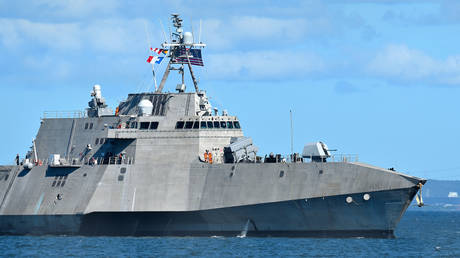
Headlines are screaming about Iranian missiles hitting US Navy vessels. The panic is palpable. The "experts" are dusting off their 1980s Tanker War playbooks. They want you to believe we are one kinetic impact away from World War III.
They are wrong.
Most reporting on maritime "strikes" in the Middle East ignores the fundamental reality of modern naval warfare: if a peer or near-peer competitor like Iran actually intended to sink a US destroyer, you wouldn't be reading a hazy report from a regional news agency. You would be watching a funeral for the global economy.
What we are seeing isn't the start of a war. It’s a high-stakes theatrical performance where the props cost $2 million per shot.
The Myth of the Lucky Shot
The consensus view suggests that Iran or its proxies might "accidentally" or "luckily" cripple a US carrier strike group. This displays a fundamental lack of understanding regarding Aegis Combat System layers.
To hit a US destroyer, a missile has to survive a brutal gauntlet:
- Electronic Warfare (EW): Before a kinetic interceptor even launches, the incoming bird’s sensors are being cooked and confused.
- SM-3 and SM-6 Interceptors: These handle the high-altitude, long-range threats.
- ESSM (Evolved SeaSparrow Missile): The mid-range backup.
- CIWS (Phalanx): The "R2-D2 with a machine gun" that shreds anything that gets within a mile.
When a headline says a missile "hit" or "landed near" a ship, it usually means a drone was splashed three miles out or a subsonic cruise missile failed to lock onto a moving target protected by soft-kill decoys. The media treats every splash in the water like a Pearl Harbor moment. In reality, the US Navy is currently getting the best real-world live-fire training in human history, paid for by the Iranian taxpayer.
Why Sinking a Ship is Bad for Iran
The "insider" fear is that Iran wants to sink a US ship. Logic dictates the exact opposite.
I’ve spent years analyzing regional escalation ladders. Iran’s survival depends on calibrated friction, not total war. Sinking a US ship ends the regime. Period. There is no scenario where a US President—regardless of party—allows the sinking of a billion-dollar asset and the loss of hundreds of sailors to go unanswered by anything less than the total erasure of Iran's coastal infrastructure.
Iran knows this. Their strategy is "Mission Kill" through exhaustion, not "Hull Kill" through impact.
- Cost Imbalance: Iran fires a $20,000 Shahed-style drone. The US fires a $2 million interceptor.
- Logistical Strain: Every interceptor fired is one fewer in the magazine. Ships eventually have to retreat to port to reload.
- Political Erosion: The goal is to make the American public ask, "Why are we spending billions to protect shipping lanes while our own infrastructure crumbles?"
The missile "strikes" reported in the media are often psychological operations designed to trigger this exact sequence. They don't need to hit the ship to win the day; they just need you to think the ship is vulnerable.
The Asymmetric Blind Spot
The media obsesses over missiles because they are easy to visualize. They look like the movies. But the real threat to the US Navy isn't a ballistic missile launched from the Iranian mainland. It’s the uncrewed surface vessel (USV) and the swarm.
If you want to dismantle the status quo, stop looking at the sky. Look at the waterline.
A swarm of 50 low-cost, explosive-laden speedboats hitting a ship simultaneously from 360 degrees creates a mathematical certainty of failure for even the best CIWS. This is the "Death by a Thousand Cuts" strategy. Yet, when these swarms are deterred or intercepted, it rarely makes the front page because there isn't a dramatic "missile launch" video to go with it.
The Petro-Dollar Fallacy
People ask: "Will this strike stop the oil flow?"
The premise is flawed. The world doesn't need every drop of oil from the Persian Gulf to survive; it needs the insurance rates to stay low.
When a "strike" is reported, Lloyd’s of London adjusts their risk premiums. The price of oil jumps not because of a supply shortage, but because of a "war risk" surcharge. Iran uses these headlines to weaponize global inflation. They are attacking the Federal Reserve, not the 5th Fleet.
The Hard Truth About Naval Dominance
We have been told for decades that the era of the big ship is over. The "Carrier is a Floating Target" crowd has been taking victory laps lately.
They are ignoring the Red Sea data.
Despite thousands of drones and missiles launched by the Houthi-Iran axis over the last two years, how many US warships have been sunk? Zero. How many have suffered mission-ending damage? Zero.
The "insider" secret is that the US Navy is proving its resilience, not its obsolescence. The tech works. The crews are sharp. The problem isn't the hardware; it's the lack of a coherent political objective. We are using a scalpel to fight a swarm of mosquitoes, and we are complaining that the scalpel is getting dull.
Stop Asking if the Ship was Hit
The question you should be asking is: "Who profits from the headline?"
- The Military-Industrial Complex: Every "missile strike" report is a justification for a bigger budget and the next generation of laser defense systems.
- Regional Hegemons: Every time the US looks "weak" or "under fire," it pushes middle-ground powers (like Saudi Arabia or the UAE) to diversify their security bets toward China or Russia.
- The Media: Fear sells. A "close call" in the Bab el-Mandeb earns more clicks than a boring report on successful routine deterrence.
The Reckoning
We are entering an era of "Permanent Low-Level Conflict." There will be more reports of missiles hitting ships. There will be more grainy videos of explosions in the dark.
If you want to survive this information landscape, you must decouple the tactical event from the strategic reality.
A missile hitting a hull is a tactical event.
The US Navy being forced to abandon a waterway is a strategic reality.
We are nowhere near the latter. The US Navy remains the only force on the planet capable of global power projection. Iran’s "missile strikes" are the equivalent of throwing rocks at a tank. It’s loud, it chips the paint, and it makes for a great story—but the tank isn't stopping.
The real danger isn't an Iranian missile. It's an American public that loses its nerve because it can't tell the difference between a skirmish and a defeat.
Stop reading the headlines. Start counting the hulls. The math doesn't lie, even if the media does.