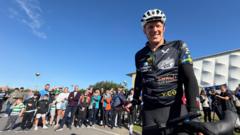
Former England rugby captain Lewis Moody recently announced his diagnosis with Motor Neurone Disease (MND) and immediately jumped onto a bicycle to log a grueling 500-mile ride for charity. The media reacted with the standard playbook: standing ovations, tear-jerking headlines, and praise for his "indomitable spirit." It is an inspiring narrative. It is also part of a deeply flawed systemic cycle that keeps MND research perpetually underfunded and structurally misunderstood.
We have turned neurodegenerative disease advocacy into a circus of physical suffering. We demand that elite athletes destroy their remaining physical reserves to prove a point, while the public treats their suffering as a spectator sport. Meanwhile, the actual science languishes in the background. It is time to stop cheering for the 500-mile bike rides and start asking why our strategy for curing terminal diseases relies on turning sick people into endurance stuntmen.
The Toxic Romance of the Suffering Athlete
For decades, the sports world has responded to catastrophic neurological diagnoses by organizing grueling physical challenges. Doddie Weir cycled. Rob Burrow pushed through unimaginable physical limits with Kevin Sinfield running marathons by his side. Now, Lewis Moody is pedaling through the early stages of a brutal, muscle-wasting condition.
The underlying message is clear: Look at this warrior fighting the disease with physical grit.
This sentiment is fundamentally flawed. MND is not a motivational deficit. It is a progressive, fatal neurodegenerative disorder characterized by the premature degeneration of motor neurons in the motor cortex, brainstem, and spinal cord. You cannot out-pedal protein misfolding. You cannot out-run the aggregation of TDP-43 proteins in the central nervous system.
When the media frames these physical stunts as "fighting back," it subtly shifts the burden onto the patient. It creates a toxic hierarchy of survival where those who can still ride bikes or crush marathons are seen as fighting harder than the patient suffocating in a specialized bed who can no longer move their thumb. Grit does not fix biology. Aggressive metabolic stress from ultra-endurance cycling might actually be the exact opposite of what an early-stage MND patient needs, considering the growing body of research linking strenuous physical activity and hypermetabolism to accelerated ALS/MND progression.
The Micro-Donation Myth: Funding Science on Pocket Change
The primary justification for these grueling events is always fundraising. "We raised £100,000!" the headlines scream.
Let us look at the actual math of drug discovery.
Developing a single disease-modifying therapy for a neurodegenerative condition costs, on average, between $1 billion and $2.6 billion. This process spans over a decade, navigating the brutal gauntlet of Phase I, II, and III clinical trials, where the failure rate for neurological drugs hovers around 90%.
When an ex-athlete raises a few hundred thousand pounds on a bicycle, it is a drop of water in an ocean of dry financial powder. It keeps the lights on at a few localized care centers. It funds a couple of isolated PhD stipends. But it does absolutely nothing to shift the macroeconomic landscape of global biotechnology.
By celebrating these micro-donation milestones, we let governments and massive pharmaceutical conglomerates off the hook. We treat MND as a charitable cause to be solved by bake sales and bike rides, rather than a public health emergency that demands massive, centralized state funding and aggressive regulatory reform. The UK government, for instance, pledged £50 million for MND research in 2021, but patients and scientists spent years fighting through bureaucratic red tape just to get the funds released. That is the bottleneck—not a lack of cycling miles.
The Misdirection of Awareness
If you ask any charity executive why these rides matter, they will use a specific buzzword: Awareness.
"We are raising awareness for MND."
This argument is decades out of date. Thanks to the monumental, tragic sacrifices of figures like Doddie Weir, Rob Burrow, and Stephen Hawking, the western world is fully aware that MND exists. They know it is terrible. They know it kills people. Raising more "awareness" among the general public does not magically synthesize a therapeutic molecule.
What we lack is not awareness; we lack infrastructure, capital efficiency, and translational pipeline speed.
Imagine a scenario where every person who liked a tweet about Lewis Moody's bike ride instead lobbied their local representative to mandate accelerated access to experimental drugs, similar to the FDA's Expanded Access Program or the UK's Early Access to Medicines Scheme (EAMS). Imagine if the focus shifted from cheering for a bicycle ride to demanding that the regulatory approval time for neurodegenerative clinical trials be slashed from 18 months to 18 days.
Instead, the public gets to feel a warm glow of empathy, deposit £5 into a digital bucket, and go back to their day, believing they helped "fight" the disease. They didn't. They funded the status quo.
The Brutal Reality of the Biotech Bottleneck
The real battle against MND is not happening on the tarmac of a 500-mile cycling route. It is happening in sterile rooms where researchers are trying to figure out how to safely deliver antisense oligonucleotides (ASOs) across the blood-brain barrier to silence mutated SOD1 or C9orf72 genes.
The bottleneck is entirely institutional and structural:
- Patient Stratification Faults: MND is not one single disease. It is a clinical umbrella covering multiple distinct biological pathologies. We waste years throwing heterogeneous patient populations into the same clinical trials, causing potentially effective drugs to fail because they only worked on a specific 10% sub-population that we failed to identify beforehand.
- The Biomarker Deficit: Unlike oncology, where doctors can track specific tumor markers in the blood to see if a drug is working within weeks, neurodegeneration has historically lacked reliable, fast-responding biomarkers. We are only recently seeing progress with neurofilament light chain (NfL) as a marker of axonal damage, but the validation framework moves at a glacial pace.
- The Academic Publishing Trap: Brilliant scientists waste months writing grant proposals to secure tiny pots of money from charitable funds raised by events like Moody's. Instead of researching, they are marketing their work to non-scientists who sit on charity boards.
If we want to honor Lewis Moody's diagnosis, we should be furious that he feels compelled to ride 500 miles to get people to care. We should be deeply uncomfortable with the fact that our society requires a dying elite athlete to perform physical feats for our entertainment just to secure basic funding for a disease that could strike any one of us tomorrow.
Stop Riding. Start Demanding.
The current model of celebrity medical charity is broken. It is a comforting palliative for a society that refuses to fund foundational science properly. It turns a horrific biological reality into an inspirational narrative arc with a convenient donation button at the bottom.
If you want to actually move the needle on MND, close the charity donation page. Stop demanding that sick men ride bicycles across the country.
Instead, turn your attention to the systems that control the money and the medicine. Demand that the National Institute for Health and Care Research (NIHR) pool risk with private venture capital to build massive, multi-billion-pound translational drug funds. Force the regulatory agencies to adopt adaptive trial designs that test dozens of drugs simultaneously against a single control group, matching the speed of modern genomic sequencing. Demand that terminal patients have the legal right to try experimental therapeutics without being blocked by corporate liability fears.
Lewis Moody deserves to spend his remaining healthy years with his family, conserving his energy and managing his health, free from the societal expectation that he must become an endurance martyr to justify his relevance to the medical research machine. The greatest tragedy of his 500-mile ride is that we are still clapping for it, instead of admitting that the system that requires it is an absolute failure.