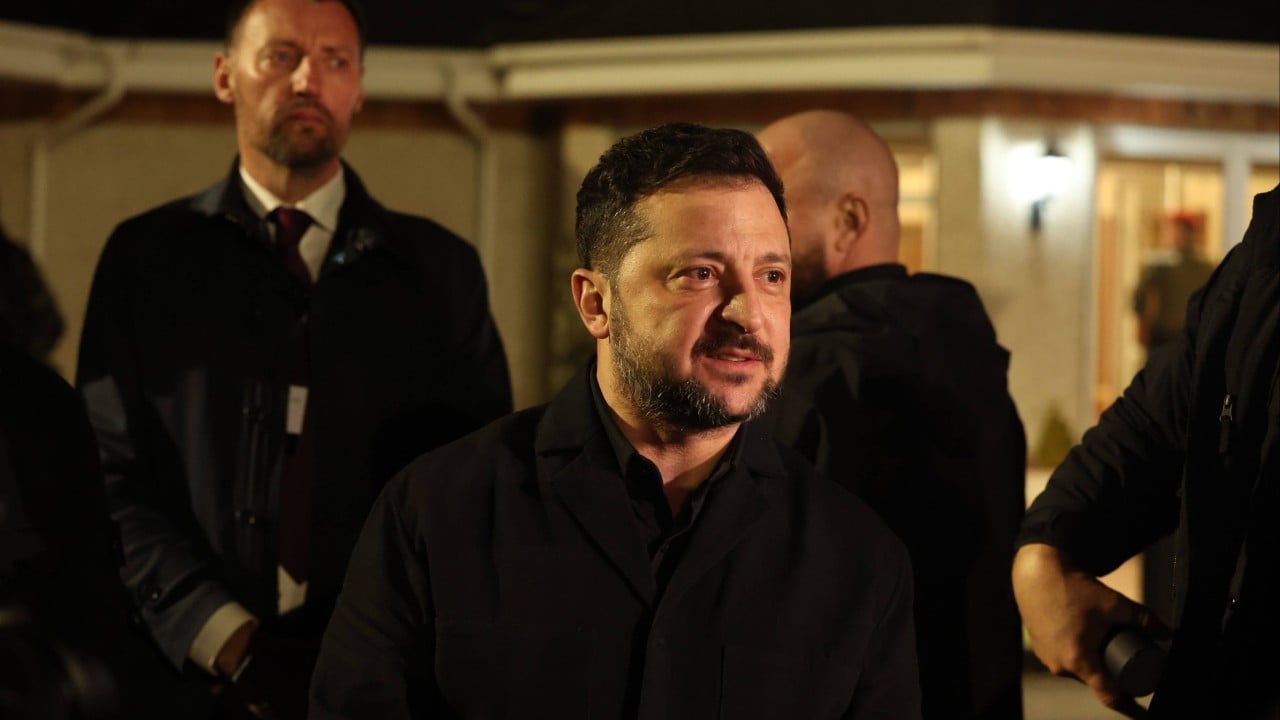
When Volodymyr Zelensky announced that Ukraine’s relationship with NATO was suddenly "back on the table," diplomatic corridors in Brussels and Washington went noticeably quiet. For years, the standard line from Western capitals was polite deflection. Ukraine could join eventually, after the war ended, once reforms were met, when the timing was right. That cautious consensus has fractured. Facing shifting political winds in Washington, grinding battlefield realities, and a European defense sector scrambling to rearm, Kyiv has forced a binary choice onto the alliance. Either NATO offers a concrete security umbrella now, or Western leaders risk watching a negotiated settlement harden into a permanent, unstable gray zone on Europe's eastern flank.
The timing is no accident. Diplomatic signals rarely happen in a vacuum, especially when survival is on the line. For an alternative perspective, check out: this related article.
For nearly two decades—stretching all the way back to the infamous 2008 Bucharest Summit—Western powers have treated Ukrainian membership as a theoretical prize rather than an operational necessity. They promised an open door while quietly bolting it shut from the inside. Now, with bilateral security agreements proving too slow to deter sustained Russian attrition, Zelensky is stripping away the diplomatic pleasantries. By putting NATO accession directly back into active negotiation, Kyiv is attempting to establish maximum leverage before any serious ceasefire talks begin.
The Architecture of Strategic Ambiguity
To understand why this shift matters, you have to look at how NATO actually operates. The alliance is built on consensus decision-making, a polite term for a system where a single member state can hold thirty-one others hostage. For years, the United States and Germany served as the primary brakes on Ukrainian integration, arguing that admitting a nation at war would immediately trigger Article 5 and pull NATO troops into a direct shooting war with a nuclear-armed Russia. Related coverage on the subject has been published by Al Jazeera.
That fear is entirely rational. Nobody in the Pentagon wants a hot war between superpowers.
Yet the alternative—leaving Ukraine in a permanent buffer state—has proven equally disastrous. Every time Western capitals hesitated on weapons deliveries or membership timelines, Moscow read that caution as weakness. The history of post-Cold War European security is littered with half-measures. From the 1994 Budapest Memorandum, which traded Ukraine's nuclear arsenal for paper assurances, to the Minsk agreements that merely froze a conflict until Russia was ready to reignite it, ambiguity has consistently favored the aggressor.
Zelensky’s team knows this history intimately. When the Ukrainian president states that the NATO relationship is back on the table, he is explicitly rejecting another Minsk-style freeze. Kyiv is demanding an invitation now, even if the full application of collective defense guarantees is phased in geographically or chronologically.
Consider how a phased model might work in practice. Under a hypothetical framework discussed among European foreign policy circles, NATO could extend an official invitation to Ukraine while stipulating that Article 5 protections apply immediately only to territories firmly under Kyiv’s administrative control. The remaining occupied regions would be designated for diplomatic recovery rather than alliance military intervention. It is messy. It breaks traditional treaty orthodoxy. And it terrifies legal purists in Brussels.
The West German Precedent Nobody Wants to Mention
Critics of this approach immediately point to the alliance's founding charter, arguing that a country with active border disputes cannot join. That is a convenient myth. It ignores the alliance's own history.
In 1955, West Germany joined NATO while divided, with millions of Germans living under Soviet occupation in the East and Berlin carved into military sectors. The alliance explicitly extended its security umbrella over the Federal Republic while leaving the question of German reunification to future political developments. Nobody pretended the border was settled. They simply decided that deterring Soviet expansion mattered more than bureaucratic neatness.
Norway joined in 1949 despite unresolved maritime boundaries with the Soviet Union. Spain entered while contesting Gibraltar with the United Kingdom. When political will exists in Washington and European capitals, treaty interpretations become remarkably flexible.
The real obstacle today is not legal technicality. It is political appetite.
Bringing Ukraine into the fold requires convincing skeptical populations in Western Europe and North America that defending Kharkiv or Odesa is as vital to their own security as defending Warsaw or Tallinn. That is a hard sell when inflation bites at home and domestic political polarization dominates every news cycle. Leaders in Berlin, Paris, and Washington have spent years framing support for Ukraine as charity or moral solidarity rather than cold, hard self-interest. Now they are struggling to pivot their messaging to explain why formalizing that commitment is cheaper than fighting a wider European war ten years down the road.
What Bilateral Security Deals Actually Deliver
Over the past two years, Kyiv signed dozens of ten-year bilateral security agreements with major allies, including the United States, the United Kingdom, Germany, and France. At the time, Western officials hailed these pacts as a "bridge to NATO."
In reality, they are bridges to nowhere without enforcement mechanisms.
Look closely at the fine print of these bilateral agreements. They commit signatories to consult within twenty-four hours if Russia attacks again. They promise continued intelligence sharing, training, and weapons supplies. What they conspicuously lack is a binding obligation to put boots on the ground or enforce a no-fly zone. They are executive agreements, not ratified treaties. A change of administration in Washington or a shift in coalition politics in Europe can gut their funding overnight.
Ukrainian officials understood the limitations of these pacts the moment the ink dried. A promise to send artillery shells after an invasion starts does not stop the initial barrage from leveling your power grid. Only the certainty of overwhelming, immediate retaliation deters a revisionist power. That certainty is the sole currency NATO trades in, and nothing short of formal membership carries the same weight in the Kremlin.
The Domestic Calculus Driving Kyiv
There is also a stark domestic reality behind Zelensky’s hardened stance. Ukraine is exhausted. Years of relentless bombardment, demographic flight, and economic strain have tested the resilience of a society that has already endured far more than any Western nation could stomach.
If Kyiv is eventually forced toward a negotiated cessation of hostilities—whether due to ammunition shortages, manpower constraints, or pressure from Western donors—Zelensky cannot sell a bad deal to his own people. Surrendering territory, even temporarily, without securing ironclad Western security guarantees would be political suicide in Ukraine. Worse, it would trigger deep internal instability, fracturing the very state Western allies spent billions trying to preserve.
For Zelensky, putting NATO membership squarely back on the table is a survival mechanism. If Washington and Brussels want Kyiv to show flexibility on territorial realities down the line, they have to pay for it upfront with an irreversible path into the alliance. You cannot ask a nation to trade land for peace if the peace comes with an expiration date.
Resistance Inside the Alliance
Even if Washington were to suddenly endorse immediate accession, the road through Brussels remains mined. NATO expansion requires unanimous ratification by every member parliament. That gives outsized leverage to spoilers.
Hungary’s Viktor Orbán has repeatedly used EU and NATO procedures to extract concessions, delay aid packages, and signal alignment with Moscow. Slovakia’s leadership has echoed similar skepticism regarding deep integration with Kyiv. Meanwhile, Turkey treats every enlargement vote as a transactional bazaar, extracting fighter jet deals and diplomatic concessions before lending its signature, as Sweden and Finland learned during their own grueling accession processes.
Then there is the quiet resistance from the alliance's core heavyweights. Behind closed doors, diplomats from several Western European nations still express deep anxiety about absorbing a battle-hardened Ukrainian military of nearly a million personnel. Integrating a force of that size would instantly alter the balance of power inside NATO, elevating Kyiv into one of the alliance's most potent military actors and diminishing the relative influence of traditional Western European capitals.
A smaller, weaker neighbor is easy to patronize. A massive, combat-tested ally demands an equal seat at the table.
The Industrial Reality Behind the Diplomacy
Strip away the speeches and summit communiqués, and the debate over Ukraine and NATO comes down to factories and supply chains. For three decades following the collapse of the Soviet Union, European members of NATO cashed in their peace dividend. They hollowed out their armored divisions, shuttered munitions plants, and outsourced continental security to the American taxpayer.
The war in Ukraine exposed that negligence in brutal detail. European militaries realized they lacked enough artillery shells to last a month of high-intensity combat. Air defense interceptors were scarce. Armored vehicle production lines moved at a glacial pace.
Integrating Ukraine into NATO is no longer just about extending American protection eastward. Increasingly, European defense planners recognize they need Ukraine’s military-industrial complex just as much as Kyiv needs Western hardware. Over the course of the conflict, Ukrainian engineers and manufacturers built a decentralized, rapid-iteration defense sector from scratch. They produce millions of drones annually, modify Soviet-era air defenses to fire Western missiles, and maintain an operational tempo no peacetime European bureaucracy can match.
Keeping Ukraine outside the alliance risks leaving that immense military capacity unmoored—or worse, allowing it to be degraded in an endless war of attrition. Bringing Kyiv inside transforms Europe's eastern border from a vulnerable perimeter into a fortified wall manned by the only army on the continent with actual experience fighting modern peer-to-peer warfare.
The Cost of Another Delayed Decision
Diplomats love buying time. Delaying hard choices allows leaders to survive the next election cycle without confronting angry voters or risking escalation. Yet in geopolitics, time is rarely neutral.
Every month that Ukraine remains in strategic limbo allows Russia to adapt its war economy, deepen its military ties with Iran and North Korea, and test the cohesion of Western alliances through hybrid warfare, sabotage, and disinformation. The belief that freezing the conflict without NATO membership will restore stability to Europe is pure fantasy. Without a credible deterrent, any ceasefire simply becomes an operational pause for Moscow to rearm and try again.
Zelensky’s push to put NATO membership back at the center of diplomatic talks forces Western leaders to confront an uncomfortable truth they have spent years trying to dodge. You cannot have a stable Europe with a massive, heavily armed, neutral Ukraine trapped between Russia and the West. History has already run that experiment, and the results are visible in the rubble of Mariupol and Bakhmut. Western capitals now face a stark choice between managing the controlled risk of bringing Kyiv inside the alliance today, or confronting the uncontrolled catastrophe of a wider European conflict tomorrow.