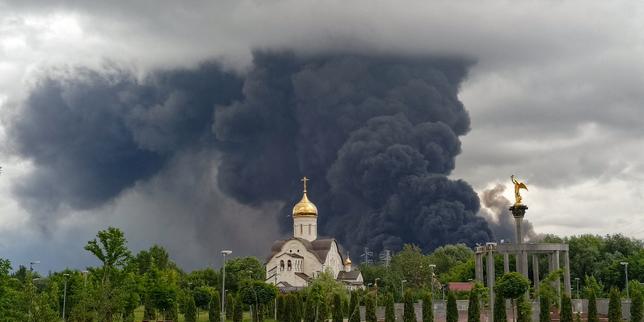
Ukraine has fundamentally altered the geography of its conflict with Russia by executing synchronized drone strikes deep within Russian territory, successfully targeting major oil processing facilities. These operations are no longer sporadic, retaliatory gestures. They represent a deliberate, systematic campaign designed to choke the Kremlin’s primary economic engine and disrupt military logistics at the source. By targeting the highly specialized distillation columns that Russia cannot easily replace under Western sanctions, Kyiv is exploiting a critical vulnerability in Moscow's heavily defended backyard.
The strategy aims to force a dilemma upon Russian high command. They must either pull air defense systems away from the front lines to protect civilian infrastructure, or watch their domestic fuel refining capacity degrade week by week.
The Mechanics of Vulnerability
To understand why these strikes matter, one must look past the dramatic footage of burning fuel tanks. The real target is almost always the atmospheric and vacuum distillation units. These massive towers separate crude oil into usable fractions like diesel, gasoline, and aviation fuel. They are the heart of any refinery.
Russia possesses the largest landmass on earth, but its economic lifeblood flows through a relatively small number of highly concentrated nodes. When a drone carrying a modest explosive payload strikes a distillation column, the resulting thermal damage does not just pause production for a weekend. It halts it for months.
Replacing these specialized components requires advanced Western engineering, much of which is now legally inaccessible to Moscow due to international export controls. While Russia has proven adept at smuggling dual-use microchips for missiles, importing a multi-ton, custom-engineered industrial distillation tower through backchannels is an entirely different logistical nightmare. Kyiv knows this. The strategy relies on targeting components that represent single points of failure in the Russian energy supply chain.
The Shell Game of Russian Air Defense
For months, the Kremlin operated under the assumption that its strategic depth was an impenetrable shield. Kyiv’s domestic drone program shattered that illusion. Ukraine is now deploying long-range uncrewed aerial vehicles (UAVs) that travel over a thousand kilometers, navigating low to the ground to evade traditional radar networks.
This creates a math problem that Moscow cannot solve.
- Frontline Protection: Russia must maintain a dense network of surface-to-air missile systems along a 1,000-kilometer front line to prevent Ukrainian aviation and tactical drones from operating freely.
- Infrastructure Defense: Russia has thousands of vital economic sites, including refineries, power plants, and ports, scattered across its European territory.
- The Deficit: There are simply not enough Pantsir or S-400 systems in the Russian arsenal to cover both requirements simultaneously.
When Russia moves air defense assets to protect a refinery complex in Samara or St. Petersburg, it creates a gap somewhere else. Ukraine’s intelligence services monitor these shifts in real-time, often using satellite imagery and electronic intelligence to find the newly opened corridors. They strike where the shield is thinnest.
Economic Ripples and the Domestic Fuel Crunch
The Kremlin’s immediate response to these attacks has been a mix of public denial and frantic market intervention. Behind the scenes, the anxiety is palpable. Russia has previously been forced to implement temporary bans on gasoline exports to prevent shortages and price spikes at home. For an authoritarian regime, domestic inflation—especially at the pump—is a potent source of public discontent.
Refinery Status Following Systematic UAV Campaign:
+--------------------+------------------------+-------------------------+
| Region Targeted    | Primary Impact         | Estimated Repair Window |
+--------------------+------------------------+-------------------------+
| Western Russia     | Distillation Shutdown  | 3 to 6 Months           |
| Southern Corridors | Storage Destruction    | 1 to 2 Months           |
| Baltic Terminals   | Export Delays          | Indefinite (Sanctions)  |
+--------------------+------------------------+-------------------------+
This creates a cascading effect on the Russian agricultural sector, which relies heavily on subsidized diesel during the planting and harvest seasons. If the military commands priority access to dwindling fuel reserves, civilian sectors face rationing. The Russian economy is resilient, but it cannot run on unrefined crude. It runs on the products these burning facilities produce.
The Friction with Western Allies
This campaign has not been without geopolitical friction. Washington has occasionally expressed reservations about deep strikes inside Russia, fearing a volatile spike in global crude prices that could disrupt Western economies.
Kyiv’s calculation, however, is distinct from Washington's. Ukraine distinguishes between raw crude oil exports and refined petroleum products. By striking the refineries, Ukraine reduces Russia's internal capacity to produce military-grade diesel and jet fuel while leaving the broader global crude supply relatively untouched, as Russia can still export unrefined oil via pipelines and tankers. It is a nuanced economic distinction that Ukrainian officials use to justify the continuation of the campaign despite quiet diplomatic pressure from risk-averse allies.
The Shift to Attrition Warfare
We have entered a phase where the side that adapts faster wins. Ukraine cannot match Russia in raw artillery output or manpower. It must fight asymmetrically.
By taking the war to Russia’s energy infrastructure, Ukraine is attempting to equalize the economic burden of the conflict. The cost of a Ukrainian-made long-range drone is a fraction of the cost of a single Russian air defense missile, and a microscopic percentage of the value of a destroyed industrial refinery column. This asymmetric cost ratio is the core driver of the strategy. As long as Kyiv can produce drones cheaper than Russia can repair its infrastructure or intercept the incoming threats, the pressure on Moscow’s refined energy sector will continue to intensify.