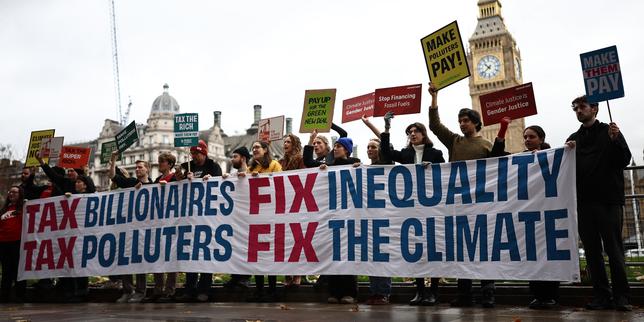
The obsession with the Gini coefficient is the intellectual equivalent of staring at a thermometer while the house burns down. We are told, with breathless urgency, that UK inequality has hit "record levels." The narrative is predictable: the rich are hoarding gold like dragons, the middle class is a vanishing species, and the only solution is a tax-and-transfer scheme that would make a Soviet central planner blush.
It is a seductive story. It is also fundamentally wrong.
If you want to understand why Britain feels stuck, you have to stop looking at the gap between the top 1% and the bottom 10% and start looking at the absolute stagnation of the entire floor. Inequality is not the disease; it is a side effect of a much more lethal condition: a total collapse in productivity and a pathological hatred of wealth creation.
The Gini Trap
Most commentators use the Gini coefficient to "prove" the UK is a Victorian dystopia. But here is the reality: UK income inequality has remained remarkably flat for nearly three decades.
If you look at the Office for National Statistics (ONS) data, the Gini coefficient for disposable income has hovered between 32% and 35% since the late 1980s. The "record levels" screamers are often cherry-picking specific data points—like wealth vs. income—to hide the fact that the UK’s redistribution system is actually one of the most aggressive in the developed world.
The top 1% of taxpayers contribute roughly 30% of all Income Tax. We don’t have an inequality problem; we have a dependency problem. When a tiny fraction of the population carries the entire fiscal weight of the state, the system isn't "unfair" to the poor—it is fragile for everyone.
Why "Equal" Poverty is a Policy Choice
Imagine two countries. Country A has a high level of inequality, but the poorest 10% can afford a home, high-speed internet, and a car. Country B has perfect equality, but everyone is equally miserable, living in crumbling gray blocks with rationed energy.
The UK is currently obsessed with becoming Country B.
We focus so much on "the gap" that we ignore the fact that the median UK household is now poorer than its peers in most of North-Western Europe and trailing behind many US states that we look down upon. According to data from the Financial Times and the World Bank, if the UK were a US state, it would rank lower than Mississippi in terms of per capita GDP.
That isn't because the rich are too rich. It’s because we have stopped growing.
When a country stops growing, the economy becomes a zero-sum game. If I want more, I have to take it from you. That is where the "inequality" anger comes from. In a booming economy, nobody cares if a tech founder buys a yacht as long as their own wages are rising 5% a year. In a stagnant economy, every penny the "rich" earn feels like a theft from the public purse.
The Productivity Scandal
The real villain in the British story isn't the billionaire; it’s the planning system.
The UK has essentially banned growth. We have a "Town and Country Planning Act" that functions as a national suicide note. By making it nearly impossible to build houses where people want to live (London and the South East) or to build the energy infrastructure needed to power industry, we have created an artificial scarcity of assets.
This is where the wealth inequality comes from. It isn’t from entrepreneurial brilliance; it’s from property prices. If you bought a house in London in 1990, you are now "wealthy" on paper, not because you contributed anything to society, but because the state prevented anyone from building a house next to yours.
The left attacks the "rich," but they should be attacking the NIMBYs (Not In My Back Yard). The true "inequality" in the UK is between those who own land and those who are forced to rent it at extortionate rates. Taxing "income" won't fix this. It just punishes the hard-working surgeon or engineer while the passive landlord continues to collect rent.
The False Idol of Redistribution
Every time the "inequality" headline hits, the solution offered is always the same: tax the rich more.
I have spent twenty years in the room with high-net-worth individuals and business owners. I have seen what happens when you push the "fairness" argument to its logical extreme. People don't just pay up; they leave. Or, more dangerously, they stop trying.
The UK is currently experiencing a "brain drain" of wealth creators. When you combined the highest tax burden since WWII with a rhetorical environment that treats profit as a dirty word, you get capital flight.
The "Lazy Consensus" argues that more redistribution will fix social mobility. Logic dictates the opposite. Social mobility requires a ladder. If you tax the middle rungs of that ladder—the £100k to £150k earners—to the point where the marginal benefit of a promotion is negligible, you destroy the incentive to climb.
The Regional Myth
The competitor article likely moans about the North-South divide. They'll say London is too rich and the North is too poor.
The contrarian truth? London isn't rich enough.
In a globalized world, London competes with New York, Singapore, and Dubai. If we "level down" London to make it more like Blackpool, the UK doesn't become more equal; it becomes irrelevant. The North doesn't need London's tax receipts; it needs London's deregulation.
We treat the regions like charity cases instead of economic engines. We send "Levelling Up" grants to paint storefronts and build community centers while the underlying business environment remains choked by high energy costs and a lack of transport infrastructure.
Stop Asking the Wrong Question
The question isn't "How do we reduce inequality?"
The question is "How do we make the UK the most attractive place in the world to build a company?"
If we answer the second question, the first one becomes irrelevant. When you have a glut of high-paying jobs, a surplus of housing, and energy prices that don't bankrupt manufacturers, "inequality" drops down the list of public concerns.
We are currently managed by a class of technocrats who prefer a smaller, more equal pie to a massive, slightly uneven one. They are managing decline and calling it "social justice."
The Actionable Pivot
If we want to actually help the people at the bottom, we need to do three things that will make the "inequality" lobby scream:
- Ditch the Planning Act: Build 500,000 houses a year. Flood the market. Crash the artificial wealth of the landed gentry and make housing affordable for the working class.
- Energy Sovereignty: Stop importing expensive gas and start drilling, fracking, and building nuclear plants. Cheap energy is the ultimate tax cut for the poor.
- Abolish Capital Gains Tax for Startups: Make the UK a haven for those who want to build, not just those who want to sit on existing assets.
The obsession with the gap is a distraction. It’s a way for politicians to avoid the hard work of fixing the foundations. They want you to hate your neighbor for earning more so you don't notice that the government has failed to provide the basic infrastructure of a first-world nation.
Stop worrying about the billionaire. Start worrying about the fact that your country hasn't had a real pay rise since 2008.
Fix the growth. The gap will take care of itself.