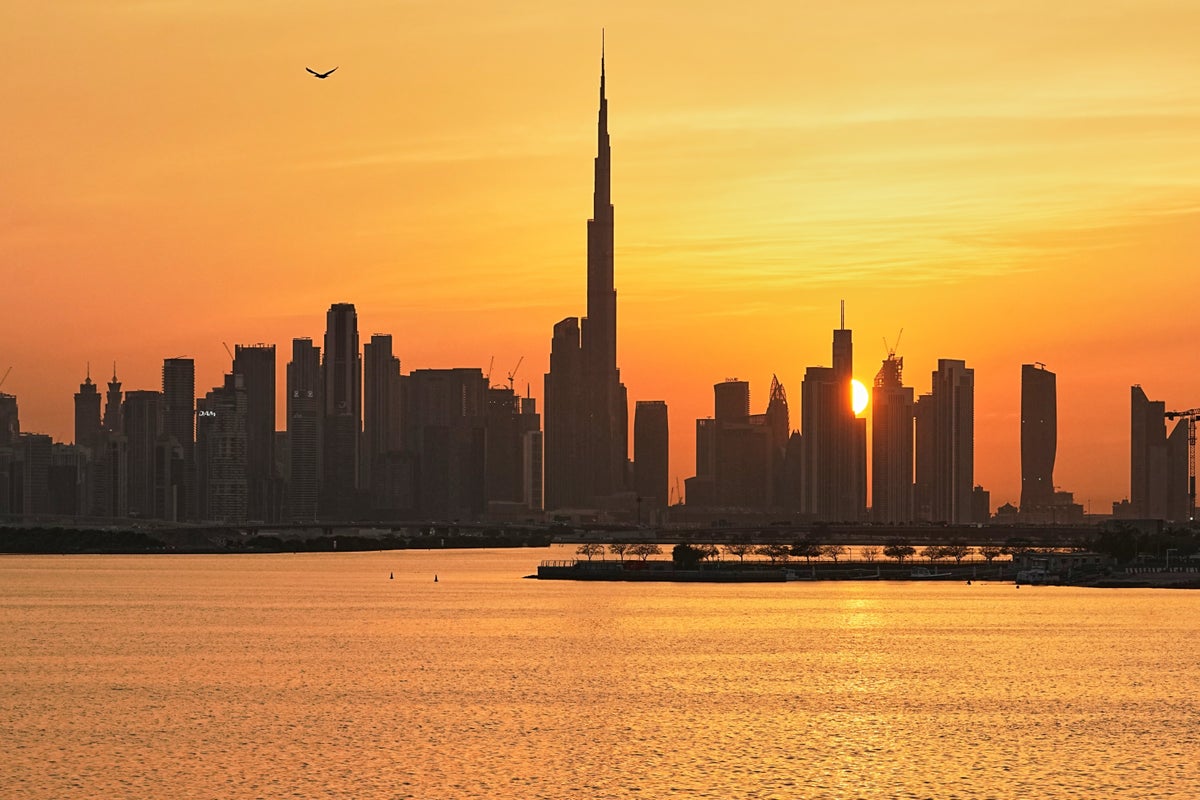
The lazy consensus among Western analysts is that the United Arab Emirates is a fragile glass house. They see a map, see the proximity to regional flashpoints, and assume that every missile launch in the Levant sends a shiver through the skyscrapers of Dubai. They frame the UAE’s "haven" status as something under siege, a delicate balance that could shatter at any moment.
They are wrong. They are looking at the mechanics of power through a 20th-century lens that no longer applies.
The UAE isn't surviving despite the regional chaos. It is thriving because of its ability to institutionalize the management of that chaos. While the "competitor" narrative suggests that war tests the UAE’s image, the reality is that conflict acts as a stress test that the Emirates passes every single year, further decoupling its economic fate from the volatile politics of its neighbors.
The Neutrality Arbitrage
Most analysts mistake neutrality for passivity. They think the UAE is "walking a tightrope." In reality, the UAE has built a massive, profitable industry out of being the only adult in the room. This is "Neutrality Arbitrage."
When capital flees instability, it doesn't go to London or New York as quickly as it used to. Those jurisdictions are now weaponized by sanctions and shifting domestic politics. Instead, that capital flows into the Dubai International Financial Centre (DIFC) and the Abu Dhabi Global Market (ADGM). These aren't just hubs; they are fortresses of pragmatism.
The UAE has mastered the art of being "everybody’s friend and nobody’s puppet." They maintain a Comprehensive Economic Partnership Agreement (CEPA) with India, trade billions with China, host US military assets, and keep the doors open for Russian wealth—all while being the first Arab nation to normalize ties with Israel via the Abraham Accords.
Critics call this a "risky bet." I call it a diversified portfolio. If you think a regional war "tests" this model, you don't understand how deep the roots go. In a world of forced binaries, the entity that refuses to choose a side becomes the most valuable player on the board.
The Misconception of the "Tourism Trap"
A common argument is that the UAE’s economy is too dependent on the "image" of safety, and that one stray drone would collapse the tourism sector. This ignores the sheer scale of the UAE’s sovereign wealth.
We aren't talking about a Caribbean island dependent on cruise ships. We are talking about the Abu Dhabi Investment Authority (ADIA) and Mubadala. These are trillion-dollar engines that buy the bottom of every market cycle. When the world panicked during the 2008 crash, the UAE bought. When COVID-19 emptied the hotels, the UAE doubled down on infrastructure.
I have watched fund managers in London wring their hands over "geopolitical risk" in the Gulf while the UAE was busy acquiring the very tech stacks and logistics chains those managers use every day. The UAE’s "image" is a marketing tool for tourists, but its "reality" is a global landlord that doesn't care if a hotel in Dubai is 40% empty for a quarter because they own the ports that move the world's goods.
Foreign Direct Investment as a Weapon
While the "competitor" piece worries about FDI slowing down, the data tells a different story. In 2023, the UAE saw a record surge in FDI projects. Why? Because investors aren't looking for a world without risk—they are looking for a world where risk is priced correctly and the rules don't change every time a new prime minister is elected.
The UAE offers something Western democracies currently cannot: absolute policy continuity.
In the US or UK, your tax rate or regulatory environment might flip every four years. In the UAE, the 50-year plan is the 50-year plan. For a billionaire or a multinational corporation, the "risk" of a regional conflict is secondary to the "risk" of a sudden wealth tax or a radical change in labor laws.
The UAE hasn't just built a haven; it has built a jurisdictional product that is more stable than the "developed" world.
The "Haven" is a Tech Stack, Not a Feeling
People ask: "Can the UAE remain a haven if the region burns?"
The question is flawed because it assumes a "haven" is a feeling of safety. It’s not. A haven is a collection of laws, high-speed fiber optics, world-class logistics (DP World), and a golden visa program that captures the world's most mobile talent.
Consider the "brain drain" from Europe and the chaotic regulatory environment in Silicon Valley. The UAE is aggressively importing the world’s AI developers and crypto founders. They aren't coming because they think Dubai is "pretty." They are coming because the UAE provides a regulatory sandbox that actually functions.
If war breaks out 1,000 miles away, a coder in Dubai continues to code. The ports continue to move containers. The desalination plants continue to run. The UAE has achieved the ultimate goal of a modern state: it has made itself a "utility" for the global economy. You don't stop using your electric company because the neighbors are fighting.
The Sanctions Trap and the Multi-Polar Pivot
The Western media loves to harp on the "risks" the UAE faces regarding its relationship with Russia or its proximity to Iran. They frame it as the UAE being "on the brink" of Western disapproval.
This is a fundamental misunderstanding of the current power shift. The UAE knows that the era of Western hegemony is over. We are in a multi-polar world. By refusing to blindly follow Western sanctions regimes that don't serve its national interest, the UAE is actually increasing its value to the rest of the world (the "Global South").
Being a "grey area" is a massive competitive advantage. When the West shuts doors, the UAE builds bridges. This isn't a sign of weakness; it’s a strategic play for the next century of global trade. The UAE is betting that the world will always need a place where people who hate each other can still do business. Historically, that bet pays out every single time.
The Real Threat Nobody Talks About
If you want to talk about real risks to the UAE, stop looking at missiles and start looking at the heat.
The obsession with regional war is a distraction from the actual existential challenge: climate change and the global energy transition. But even here, the UAE is outplaying the critics. They are using their oil wealth to buy the future of green energy through Masdar. They are hosting COP conferences not for "image," but to ensure they have a seat at the table when the new rules of the global economy are written.
The UAE is not a "tested" haven. It is a laboratory for how a small nation-state can exert disproportionate influence by being more agile, more pragmatic, and more ruthless than the lumbering giants of the West.
Stop Asking if the UAE is Safe
The question "Is the UAE safe?" is the wrong question. The right question is: "Where else are you going to go?"
Switzerland is stagnant. Singapore is cramped and increasingly expensive. London is a tax trap. The US is a polarized mess.
The UAE’s growth isn't a fluke of a quiet neighborhood. It is the result of an aggressive, well-funded strategy to become the default operating system for global nomads and international capital. Every time a bomb goes off in the Middle East, it only highlights how unique and essential the UAE’s stability has become.
The war doesn't test the haven. The war proves the haven't existence is a necessity for a global economy that has nowhere else to hide.
Don't bet against the house, especially when the house owns the desert, the sea, and the servers.