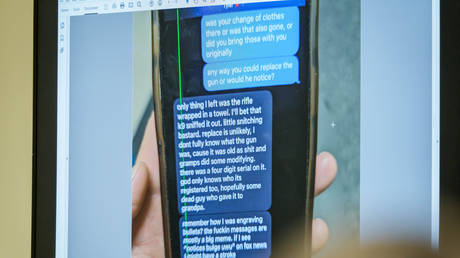
High-profile courtroom battles usually stick to a strict script. Attorneys argue, judges rule, and the public gets a carefully curated view of the evidence. On Thursday, that script ripped wide open during a tense evidentiary hearing in Utah. A handwritten note, explicitly barred from public broadcast by judicial order, accidentally flashed across the official court livestream.
It lasted only a brief moment before Utah Judge Tony Graf caught the slip and yanked it down. But in the digital age, a brief moment is all it takes.
The document in question belongs to Tyler James Robinson, the 23-year-old accused of assassinating Turning Point USA founder Charlie Kirk. The contents of that note, paired with newly aired testimony from Robinson's former romantic partner, give the clearest look yet at the chaotic hours surrounding the September 10, 2025, shooting at Utah Valley University.
What spilled out in open court changes how we view the state's case.
The Flashed Confession and the Roommate's Story
The prosecution didn't just stumble into a piece of paper. They found a partially burned note and a backup photograph of it tucked away on a cell phone. Addressed to Robinson's roommate and romantic partner, Lance Twiggs, the text reads with chilling clarity.
“If you are reading this per my text, then I am so sorry,” the letter says. “I had the opportunity to take out Charlie Kirk, and I took it.”
This wasn't some vague political manifesto. It was an explicit admission of execution. Prosecutors also pointed to accompanying text messages where Robinson allegedly laid out his rationale, writing that he had "enough of his hatred" and claiming "some hate can't be negotiated out."
Twiggs took the stand on Thursday, delivering testimony that stripped away any lingering ambiguity about Robinson's actions immediately after the shooting. Under an immunity agreement, Twiggs described finding Robinson pacing wildly around their St. George apartment the day after the assassination, desperately trying to distract himself. When Twiggs asked point-blank if the admission from the night before was real, Robinson confirmed it.
He also added a detail that the defense will undoubtedly cling to as the case progresses. Robinson reportedly confessed that he already wished he hadn't done it.
The High-Stakes Battle Over Redactions
The accidental leak of the letter highlights a massive, ongoing fight behind the scenes regarding transparency. High-profile political trials are a logistical nightmare, and this one is proving exceptionally volatile.
Defense attorney Richard Novak fought tooth and nail to keep Twiggs's recorded statements out of the hearing entirely, arguing that broadcasting these "confessions" would inevitably taint the potential jury pool and compromise Robinson’s right to a fair trial. Novak even tried to downplay the political angle, fighting the inclusion of statements regarding Turning Point USA's traditional Christian values by arguing the court shouldn't try to map out where politics and religion intersect.
On the other side of the courtroom, the Kirk family is pushing for total exposure.
Jeffrey Neiman, the attorney representing Kirk’s widow Erika and his parents, made their position unmistakably clear to the court. The family demands no redactions. They want the world to see every shred of evidence as it drops, arguing that hiding facts behind judicial black marker only builds doubt and distrust in the legal system.
Judge Graf is stuck walking that razor-thin line. He eventually allowed a heavily edited version of Twiggs’s statement to play, cutting out roughly 16 minutes that focused heavily on Robinson's text logs.
Moving Past the Shock Value
If you are following this case, don't get entirely sidetracked by the courtroom screen-share blunder. While an accidental broadcast of a barred confession looks terrible for the court's tech team, legal experts are quick to point out it won't derail the prosecution.
Former federal prosecutor Neama Rahmani noted that because a jury hasn't been seated yet, the slip-up carries very little legal weight. Preliminary and evidentiary hearings routinely handle radioactive pieces of evidence that might get sliced up or banned by the time a formal trial starts. The judge's decision on whether there is enough probable cause to send Robinson to trial won't change just because the public caught a glimpse of the note.
What it does change is the jury selection strategy. When the formal trial approaches, lawyers will have to weed out prospective jurors who watched the livestream or saw the leaked images online.
The state’s case doesn't rely solely on a burned letter, either. Over the week-long hearing, prosecutors systematically built a deep physical timeline. They introduced:
- DNA Evidence: FBI testing found Robinson’s DNA on a screwdriver recovered from the roof where the fatal shot was fired, as well as on a towel wrapped around the rifle found near the scene.
- Surveillance Footage: Video shows a figure identified as Robinson walking onto the Utah Valley University campus and climbing up onto the roof on the day of the shooting.
- Ballistics and Witness Timelines: Law enforcement trackable movements matching the moments Kirk addressed the crowd of thousands before being targeted.
Next Steps for the Legal Teams
The preliminary hearing is winding down, and the prosecution has rested its initial presentation after calling four crucial law enforcement witnesses. Robinson hasn't entered a formal plea yet, but he faces a charge of aggravated murder, which carries the death penalty in Utah.
If you are tracking the defense strategy, look for Novak to focus heavily on challenging the link between the weapon and the crime, especially since previous bullet analyses didn't yield an airtight match to the recovered rifle. Expect the defense to also leverage Robinson’s expressed immediate regret and his decision to turn himself into law enforcement the day after the shooting to fight the death penalty specification.
The case now rests with Judge Graf to formally determine if the state has cleared the bar to move to a full trial. Given the DNA evidence and the explicitly detailed timeline provided by the state, a trial order is almost a certainty.