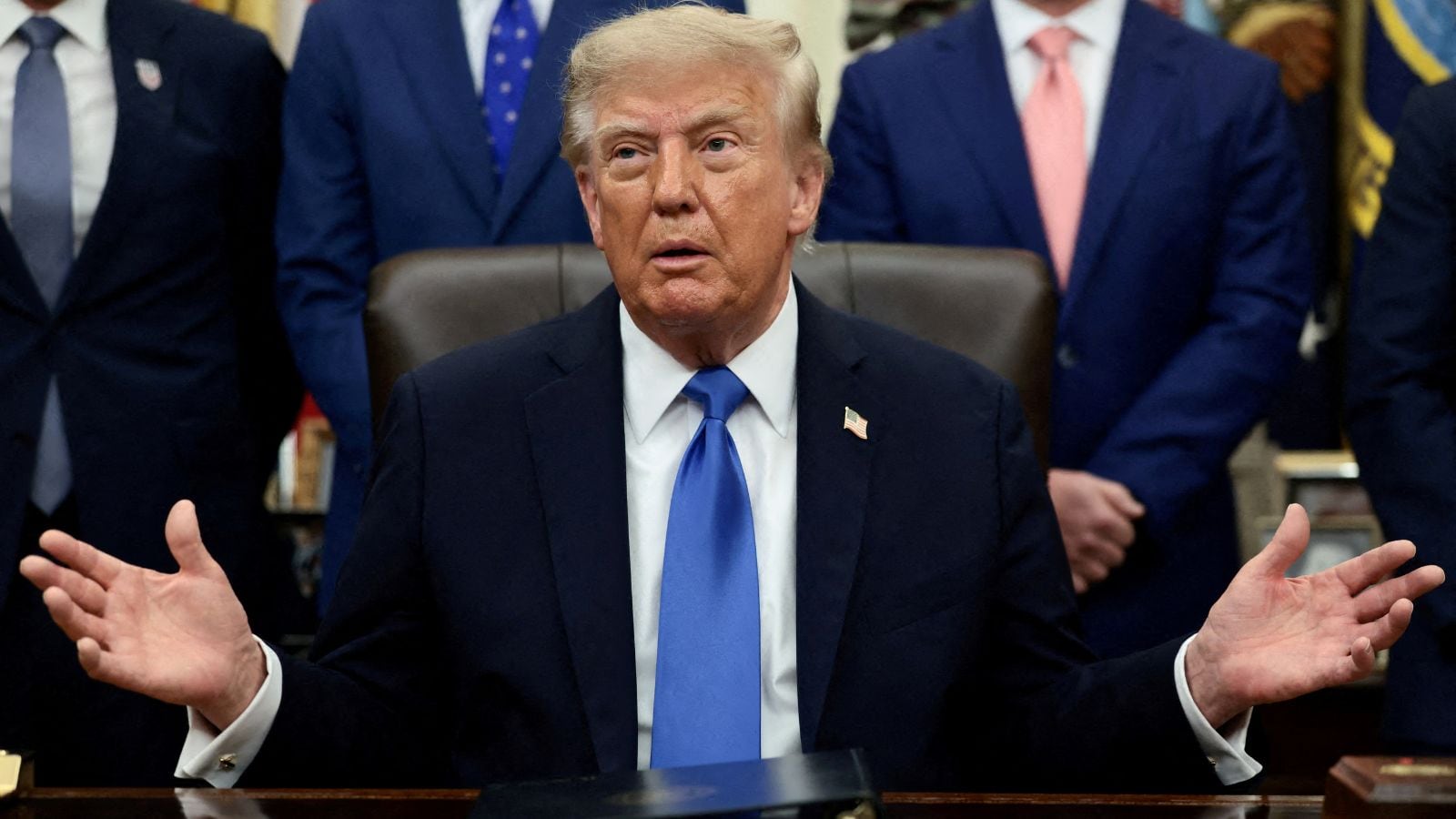
The ink dries fast on heavy cotton paper.
You can hear the scratch of the felt-tip marker across a mahogany desk in Washington, a sharp, rhythmic sound that takes less than four seconds to complete, yet carries the kinetic force to rattle coffee cups on kitchen tables three thousand miles away. Since January 2025, that specific scratch has echoed through the Oval Office more than two hundred and ninety times.
Stop and let that number sit in the room with you. Two hundred and ninety.
On a spreadsheet, or buried inside a three-hundred-word wire report, 290 is just a sterile metric. It looks like a box score from a game nobody remembers watching. We read the headline, nod at the sheer volume of executive orders issued by the Trump administration, and scroll past toward something louder. We treat unilateral governance like background weather—a distant low-pressure system that doesn't require an umbrella until the rain actually hits our windshield.
Yet numbers of this magnitude are never just math. Every single one of those signatures is an instruction manual handed directly to the federal bureaucracy, bypassing the slow, grinding gears of Congress to immediately alter the rules of the American game. When an administration issues nearly three hundred directives in under two years, the sheer velocity creates a gravitational pull that bends everyday life around it.
To understand what 290 strokes of a pen actually feel like, we have to leave the marble corridors of Capitol Hill and step into the fluorescent-lit reality of people who never asked to become footnotes in constitutional history.
The Architecture of Whiplash
Consider a hypothetical character we will call Elena, a mid-level compliance officer at a regional logistics firm in Ohio. Elena does not watch cable news panels. She cares about diesel prices, warehouse square footage, and whether her kids make it to soccer practice before dark.
In early 2025, Elena’s job was predictable. Then came the first wave of executive actions—sweeping directives targeting federal procurement rules, environmental reporting standards, and cross-border freight inspections. Suddenly, the regulatory ground beneath her desk liquefied. A directive signed on a Tuesday afternoon in Washington meant Elena spent Wednesday morning rewriting vendor contracts, Thursday explaining new customs protocols to frustrated truckers, and Friday wondering if the rules would survive a federal injunction by Monday.
Multiply Elena by ten million.
That is the hidden, unquantified tax of governing by executive order. An executive order is, at its core, a directive from the President to the executive branch—essentially the CEO of the United States telling his department heads how to enforce existing laws and spend allocated money. Unlike legislation, which requires months of committee hearings, compromises, and votes in both chambers of Congress, an executive order requires only one person, one desk, and one pen.
Because they are so fast to deploy, they function like an architectural renovation carried out while the tenants are still sleeping inside the house. Walls go up overnight. Doorways vanish. You wake up to the smell of wet plaster and discover the hallway to the kitchen now requires a different security clearance.
I remember sitting in a cramped administrative office during a previous transition of power years ago, watching career civil servants stare at a newly printed directive from the Federal Register. Nobody was shouting. There were no dramatic speeches. Just the quiet, heavy rustle of paper as twenty-year veterans tried to figure out how to dismantle a program they had spent five years building, all because a single paragraph signed the night before had redirected their agency's funding priorities. You could smell the stale coffee and the sudden, collective exhaustion. That is what administrative whiplash tastes like. It is not cinematic; it is deeply, numbingly bureaucratic.
The Historical Echo Chamber
If you feel a sense of vertigo watching this rapid-fire deployment of presidential authority, you are not imagining things, nor are you alone. The question haunting constitutional scholars and everyday citizens alike is simple: Is this normal?
Yes. And no.
To make sense of 290 orders, we need a clear lens. Think of the American presidency like a pendulum swinging inside a clock case. For over two centuries, presidents have tested the width of that case. George Washington issued just eight executive orders during his entire eight years in office—mostly housekeeping notes telling federal officials how to organize reports. Abraham Lincoln used them to suspend habeas corpus and issue the Emancipation Proclamation during an existential civil war. Franklin D. Roosevelt, confronting the Great Depression and World War II, shattered every precedent by signing an astonishing 3,721 executive orders, reshaping the American economy and social safety net with the stroke of a pen.
In the modern era, however, the tempo stabilized into a predictable rhythm. Barack Obama signed 276 executive orders across eight full years. Donald Trump, during his first term from 2017 to 2021, issued 220. Joe Biden signed 162 during his four-year presidency.
Look at those numbers side by side again. Two hundred and seventy-six in eight years. Two hundred and twenty in four years. One hundred and sixty-two in four years.
Now look at the current ledger: over 290 executive orders since January 2025.
The Trump administration has blown past its own entire first-term output—and outpaced Obama’s two-term total—in less than twenty-four months. We are no longer watching a pendulum swing gently back and forth. We are watching someone grab the pendulum and shove it hard against the glass.
Why the sudden acceleration? The answer lies in the paralysis of the legislative branch. When Congress becomes too fractured to pass major bills, presidents of both parties inevitably reach for the only lever that still moves without permission. What makes the post-January 2025 surge historically distinct is not the tool itself, which is as old as the republic, but the industrial scale of its application. The pen has stopped being a scalpel for emergencies and has become a primary assembly line for national policy.
What Actually Happens When the Ink Dries
There is a dangerous myth that an executive order is a royal decree—that the moment the cameras flash in the Oval Office, reality instantly bends to the president’s will. The truth is far messier, and frankly, much more stressful for anyone trying to plan their life around federal policy.
Let’s trace the anatomy of a single order to see where the friction lives.
Suppose the White House issues a directive overhauling federal student loan repayment terms, or restricting certain categories of work visas, or altering energy lease permissions on public lands. Here is the chain reaction that immediately ignites:
- The Shockwave: Within hours, the text hits the Federal Register. Agencies scramble to interpret broad presidential language into actionable rules. Ambiguity is rampant. Does the order apply to applications already in the pipeline, or only new ones? Nobody knows yet, so everything freezes.
- The Courthouse Sprint: Before the ink is even cold, state attorneys general, advocacy groups, or corporate coalitions file lawsuits in federal district courts. They argue the president overstepped statutory authority—that the order doesn't just interpret the law, it illegally rewrites it.
- The Injunction Limbo: A federal judge issues a temporary restraining order, halting enforcement nationwide. Suddenly, what was law on Tuesday is paused on Friday. Appeals rocket upward toward circuit courts and eventually the Supreme Court.
Now, step out of the courtroom and meet Marcus—another hypothetical figure, this time a software engineer in Austin waiting on an employment visa renewal, or a small-scale solar contractor in Nevada relying on federal tax guidance.
For Marcus, constitutional theory is irrelevant. What matters is limbo. When an executive order triggers months of litigation, people live inside a legal Schrödinger’s box. You cannot safely buy a house, hire a new crew, or enroll your child in a local school because the legal foundation beneath your status might evaporate after an appellate ruling in New Orleans or Washington, D.C.
I will be honest with you: tracking this volume of orders is disorienting even for people who study government for a living. The sheer velocity makes it nearly impossible for any single citizen to read, verify, and understand the downstream effects of every directive. When policy moves at the speed of a press release, public scrutiny inevitably falls behind. You start questioning what is permanent law and what is merely a temporary weather pattern that will be erased the moment a new administration takes the oath of office—because anything done with a pen can be undone with a pen on Day One of the next presidency.
Living Inside the Unfinished Sentence
We have arrived at a strange crossroads in American self-governance.
The headline telling us the administration has crossed 290 executive orders is an invitation to look beneath the surface of our civic life. It forces us to confront a quiet reality: we have grown accustomed to watching one branch of government do the heavy lifting for all three. Whether you applaud the specific policies inside those 290 directives or fiercely oppose them, the mechanism itself carries a steep, structural cost.
Policies built on executive orders are houses built on sand. They deliver immediate gratification to political allies and immediate shock to opponents, yet they lack the deep concrete pilings that only come from debating, compromising, and passing durable laws through Congress. They trade long-term stability for short-term speed.
So how do you navigate a world where the rules can change before your morning coffee cools? You stop treating executive orders as the final word, and start recognizing them as the opening salvo. You pay attention not just to the triumphant photo-op at the Resolute Desk, but to the quiet filings in federal district courts three weeks later, and the dry implementation memos buried on agency websites three months after that. You build margin into your finances, your business contracts, and your expectations, knowing that federal policy is currently written in pencil, not carved in stone.
Late tonight, somewhere in the West Wing, an aide is likely placing another thick folder onto a polished wooden desk. Inside is order number 291, or 292, waiting for a signature. Outside, the city sleeps, unaware of which border, budget, or backyard will wake up tomorrow under a slightly different sky.