Cold rain in Brussels does not fall so much as it settles into the wool of your coat, turning every street corner into a mirror of gray stone and reflection. Outside the European Parliament, security barriers divide the plaza into neat, bureaucratic corridors where diplomats hurry past with leather briefcases and lanyard badges swinging against their chests. Then a black vehicle pulls up to the curb, the doors swing open, and the atmosphere shifts.
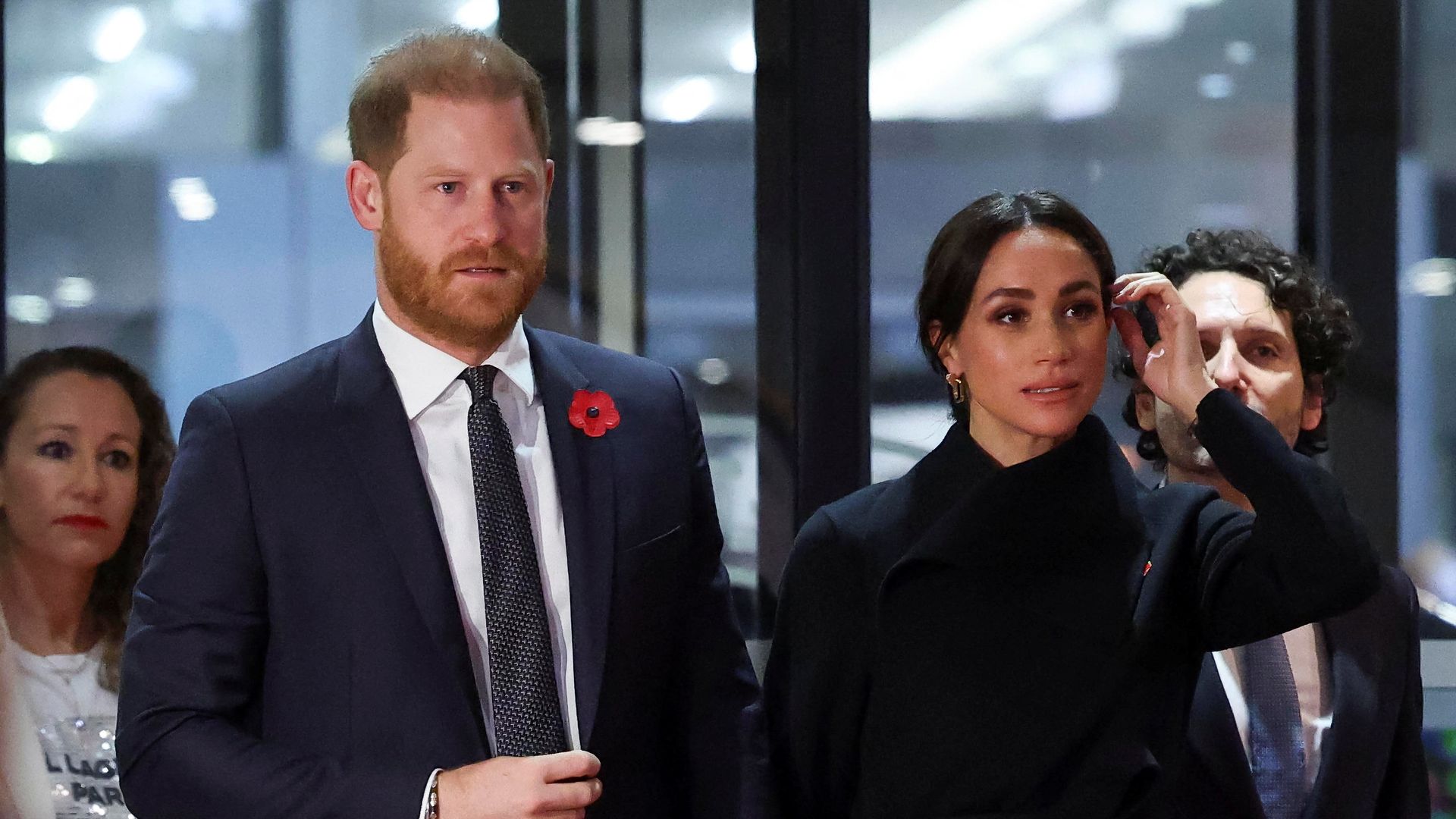
Prince Harry steps out first, turning back toward the open door before taking a single stride toward the glass facade of the building. Meghan Markle follows, her hand already reaching out to meet his, their fingers locking together with the practiced ease of two people who have spent years navigating rooms designed to keep them apart. If you enjoyed this article, you might want to look at: this related article.
Cameras click in a rapid, metallic chorus. To the casual observer scrolling past a headline on a Tuesday morning, it is just another celebrity sighting in a European capital, a fleeting moment of royal fashion against a backdrop of institutional architecture. Yet if you stand close enough to watch the posture of their shoulders and the deliberate slowness of their walk across the wet flagstones, you realize that holding hands in front of the European Parliament is not a photo opportunity. It is a thesis statement.
The Weight of Unspoken Protocol
To understand why two intertwined hands on a Belgian sidewalk carry so much friction, you have to understand the invisible machinery of royal etiquette. For centuries, the British monarchy operated on an unwritten rulebook that treated physical affection in public as a minor breach of statecraft. Royals wave. Royals shake hands with dignitaries. Royals stand at a respectful, symmetrical distance from their spouses while reviewing troops or unveiling plaques, projecting an image of stoic, unshakeable duty where personal emotion never clouds the institution. For another angle on this story, see the latest update from BBC.
Consider a hypothetical young woman watching from a cramped apartment in London or Brussels, someone who has spent her entire career dimming her own instincts to fit the rigid expectations of a corporate boardroom or a traditional family. She knows the exhaustion of performing composure while feeling entirely isolated inside a crowd. When she sees Harry and Meghan walk into one of the most formal political chambers in the world with their fingers laced together, she is not looking at a fairy tale. She is looking at a refusal to perform emotional detachment.
I have covered political summits and high-stakes diplomatic arrivals across Europe for over a decade, and the air around these buildings usually smells of damp pavement, stale espresso, and carefully rehearsed talking points. Almost everyone who walks through those revolving doors wears an invisible armor, terrified of showing a single seam of vulnerability before the cameras. Seeing a couple enter that exact environment anchored to one another rather than to protocol breaks the rhythm of the entire plaza.
Silence. For three seconds, even the veteran press photographers stop shouting directions, caught off guard by how ordinary and yet defiant the gesture looks against the towering glass walls of the Parliament.
Why Brussels Matters More Than a Red Carpet
A film premiere in London or a charity gala in New York demands glamour, and public affection on a red carpet is practically part of the dress code. Brussels is different. The European Parliament is a place of legislative machinery, regulatory debates, and slow, grinding policy work that shapes the daily lives of four hundred and fifty million people. Nobody comes to the Place du Luxembourg by accident, and nobody walks through those doors without an agenda.
Harry and Meghan's arrival in Brussels signals a deliberate pivot from celebrity spectacle toward institutional influence, specifically around issues they have championed since stepping back from senior royal duties in 2020. Digital safety, mental health accountability for technology platforms, and humanitarian relief do not get solved through glossy magazine covers; they get debated in committee rooms where lawmakers draft the rules that govern global tech giants. By stepping onto European parliamentary grounds, the Duke and Duchess of Sussex placed themselves directly inside the arena where the Digital Services Act and cross-border online protections are actively enforced.
Think of the European Parliament as a massive, slow-turning lighthouse on a rocky coastline, casting beams of regulation across waters where technology companies once sailed without a map. For years, Harry and Meghan spoke about the toxicity of social media algorithms from the outside, sharing their own experiences with relentless online harassment and misinformation. Walking into Brussels means moving from the shore into the control room, trading the vulnerability of being talked about for the agency of shaping the conversation itself.
The Anatomy of a Gesture
Critics have spent years dissecting every glance, posture, and hand-hold between the pair, often framing their closeness as theatrical or overly curated for American audiences. That reading misses the basic human psychology of shared trauma. When two people endure years of coordinated public scrutiny, tabloid distortion, and institutional isolation, physical touch ceases to be a performance for onlookers and becomes a nervous-system regulator.
Watch the footage closely and you will notice the mechanics of how they move together. Harry's thumb rests lightly over the back of Meghan's hand, while her other arm stays relaxed at her side, matching his pace step for step without pulling ahead or lagging behind. Behavioral psychologists who study couples under chronic stress often point out that synchronized gait and sustained hand contact are instinctive ways partners establish a shared perimeter against a hostile environment.
Let us imagine a hypothetical diplomatic aide standing just inside the glass lobby of the Parliament, holding a clipboard with the morning's briefing schedule. He has greeted prime ministers who barely make eye contact with their own spouses on the walk from the motorcade, couples separated by three paces of cold formality and years of unspoken compromise. When the doors slide open and Harry and Meghan step inside, still holding hands until the exact moment they must greet their parliamentary hosts, the aide sees something rare in political life: alignment.
It is easy to dismiss gestures like this as sentimental, especially in an era that rewards cynicism. Yet anyone who has ever walked into a room full of strangers knowing that half of them have already formed an opinion about you knows the quiet courage it takes to reach for the one person who knows the truth of your life.
Navigating the Atlantic Divide
Since relocating to Montecito, California, and establishing the Archewell Foundation, the couple has occupied an unusual diplomatic gray zone. They hold no official government portfolio, represent no sovereign crown in an executive capacity, and wield no legislative vote. Critics in the British press frequently ask what standing they actually possess to meet with European lawmakers or international policymakers.
The answer lies in how modern advocacy actually works. In the twenty-first century, cultural convening power often moves faster than traditional diplomacy, drawing media attention and public urgency to legislative hearings that would otherwise unfold in obscurity. When Harry and Meghan arrive at the European Parliament to discuss youth online safety or global humanitarian partnerships, television crews from twenty countries follow them to the door, turning a dry policy briefing into front-page news across continents.
Still, walking that tightrope carries real risk. Lean too far into celebrity, and lawmakers treat you as a distraction; lean too far into policy without institutional backing, and critics accuse you of overreach. You can see that tension in the way they carry themselves in Brussels—dressed in sharp, understated tailoring that echoes European diplomatic norms, keeping remarks measured, and letting their physical unity do the talking before a single word is spoken into a microphone.
There is something disarmingly human about watching two people figure out their public identity in real time under a global magnifying glass. Most of us get to make our career pivots, boundary adjustments, and family decisions behind closed doors, testing what works before inviting the neighbors over. Harry and Meghan have had to build their post-royal life on a stage where every misstep is amplified and every boundary is contested.
What the Cameras Miss Once the Doors Close
Once they pass through security and ascend toward the meeting rooms, the flashbulbs fade and the real work begins. Behind closed doors in Brussels, conversations revolve around concrete mechanisms: how platforms verify user ages, how algorithmic amplification harms adolescent mental health, and how philanthropic initiatives can partner with European frameworks to support vulnerable communities.
Yet the image that travels around the world—the one printed in newspapers from London to Los Angeles and shared millions of times before noon—is not a photograph of a briefing paper or a committee table. It is the frame captured outside in the drizzle, two figures moving as one across the plaza, fingers intertwined against the gray stone.
Why does that single image refuse to fade from public conversation? Because beneath all the noise about royal titles, transatlantic politics, and media strategy, people recognize a universal truth when they see it. Every person who has ever chosen loyalty to a partner over the approval of an institution understands what that grip means.
Outside the Parliament, the rain begins to fall a little harder, washing the footprints off the flagstones where the motorcade paused minutes earlier. Inside, down a long corridor lined with the flags of twenty-seven nations, two people sit side by side at a polished conference table, and beneath the edge of the wood, out of sight of the cameras, their hands remain joined.