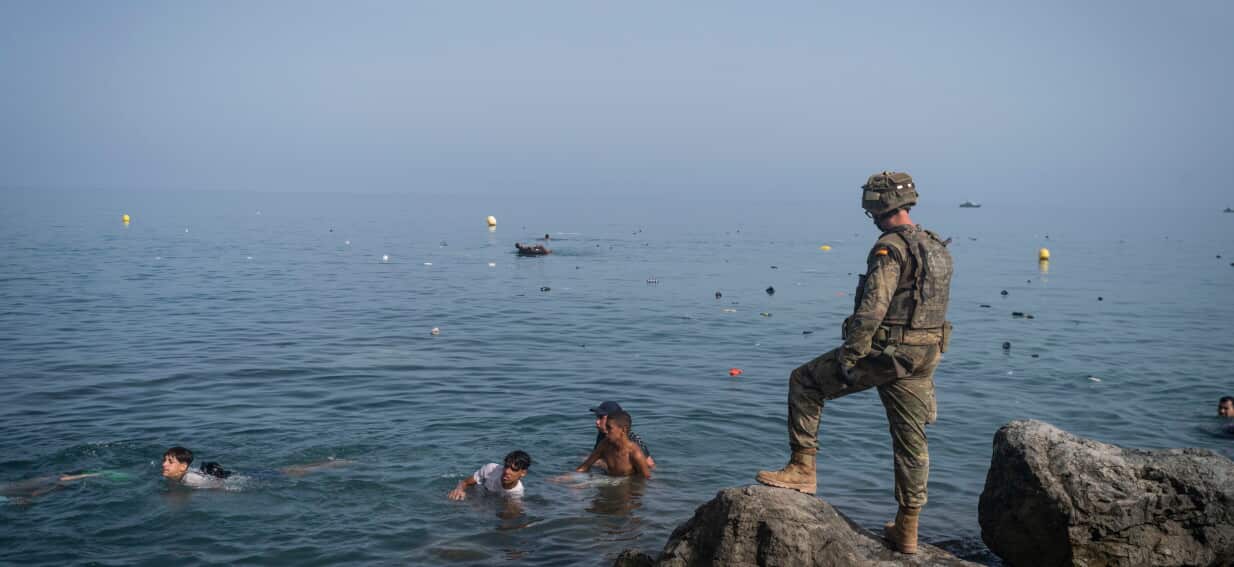
The salt in the air tastes different here. It carries the weight of a thousand miles crossed on foot, the heavy scent of diesel from crowded hulls, and the sharp, metallic tang of desperation.
Stand at the southern tip of the Iberian Peninsula, and Africa feels close enough to touch. On clear mornings, the mountains of Morocco rise from the blue expanse like jagged teeth, mocking the invisible lines drawn on maps. Between that distant coastline and the stone walls of Ceuta lies a narrow strip of water. For most, it is a barrier. For thousands every year, it is a bridge.
Ceuta is not just a city. It is a paradox.
Owned by Spain since the late sixteenth century, this two-flat enclave clings to the northern coast of Morocco like a barnacle on a ship's hull. It spans roughly seven square miles. Seven square miles of concrete, steep hillsides, and ancient fortifications where Europe meets Africa head-on.
Imagine walking its perimeter. You would follow a double fence of galvanized steel, standing twenty feet high, topped with razor wire that glints maliciously under the Mediterranean sun. Motion sensors hum. Closed-circuit cameras track every shifting shadow. Yet, people still climb.
Why?
To understand that, you have to look past the bureaucratic language of migration flashpoints and look at a human face.
Meet Ibrahim. He is a hypothetical composite, built from the stories of dozens who have made the crossing, yet his struggle is entirely real. Back in his village in sub-Saharan Africa, the earth stopped yielding crops years ago. Drought baked the soil into grey dust. Inflation turned a loaf of bread into a luxury item. When your choices are slow starvation or the gamble of the sea, the choice ceases to be a choice at all.
Ibrahim spent eighteen months moving north. He crossed the Sahara, dodging extortionists and surviving on scraps of water, before arriving at the Moroccan border hills known as Mount Gurugu. He waited there for months, shivering in makeshift tents made of plastic sheeting and scavenged branches, watching the lights of Europe sparkle across the water.
When he finally ran toward the double fences of Ceuta, he wasn't thinking about geopolitical treaties, European Union funding allocations, or immigration quotas. He was thinking about survival.
The fences are only part of the story. The geography itself conspires against stability. Because Ceuta and its sister enclave Melilla represent the only land borders shared between the European Union and the African continent, they act as natural magnets. Desperate populations flow toward them because gravity pulls water downhill.
The numbers tell a stark story. According to data from the Spanish Ministry of Interior and Frontex, thousands attempt unauthorized entries annually. Some swim around the jagged breakwaters, battling icy currents and heavy swells in wetsuits bought with pooled family savings. Others hide beneath floorboards of cars, wedged into spaces no human body should fit.
When they touch the asphalt of Ceuta, they cross a threshold. Under Spanish and international law, they enter a complex labyrinth of detention, identification, and potential repatriation. But first, they arrive. Wet, exhausted, bleeding from razor wire, and overwhelmingly human.
The local residents of Ceuta live inside this constant pressure cooker. With a population of around eighty thousand people packed into a tight urban grid, the city feels the strain immediately. Resources stretch thin. Social services buckle. Tensions flare between those who see humanitarian duty as an absolute moral imperative and those who feel overwhelmed by an infrastructure stretched past its breaking point.
Politicians in Madrid and Brussels debate the crisis in polished assembly halls, tossing around terms like border fortification, containment strategies, and bilateral agreements. They treat migration as a technical glitch to be patched with software or concrete.
They are wrong.
Migration is not a software bug. It is a human tidal wave driven by climate change, economic inequality, and conflict. Building higher fences only changes the altitude of the desperation. It does not stop it.
Consider what happens next when a wave of arrivals breaches the perimeter. The local immigration centers, designed to hold hundreds, suddenly house thousands. Makeshift cots line gymnasiums. Aid workers distribute blankets and bottled water while translators work through the night, sorting through dialects from Guinea, Senegal, Syria, and beyond.
The air inside these centers smells of antiseptic, sweat, and collective anxiety. Children play listlessly with plastic bottle caps while their parents stare blankly at distant walls, suspended in a legal and physical limbo. Will they be sent back? Will they catch a ferry to the Spanish mainland? Nobody knows. Uncertainty hangs heavier than the humidity.
This is the hidden cost of our interconnected world. We consume goods shipped across these very waters, yet we turn our gaze away from the human cargo moving in the opposite direction. We build fortresses of affluence while ignoring the foundations of global disparity upon which they rest.
Ceuta remains the ultimate test case for Europe's conscience. It forces a continent that prides itself on human rights to look directly into the mirror and ask difficult questions. Can a border be secure without losing its humanity? Can a tiny Spanish city bear the weight of global migration shifts indefinitely?
There are no easy answers. The patrols continue. The fences remain electrified with surveillance. Across the strait, another young man looks up from his phone, packing a single small bag, preparing to make the journey of his life.
The sun dips below the horizon, painting the Mediterranean in shades of bruised purple and gold. The lights of Ceuta flicker on, casting long shadows against the steel wire. The waves crash softly against the breakwater, washing away the footprints in the sand.