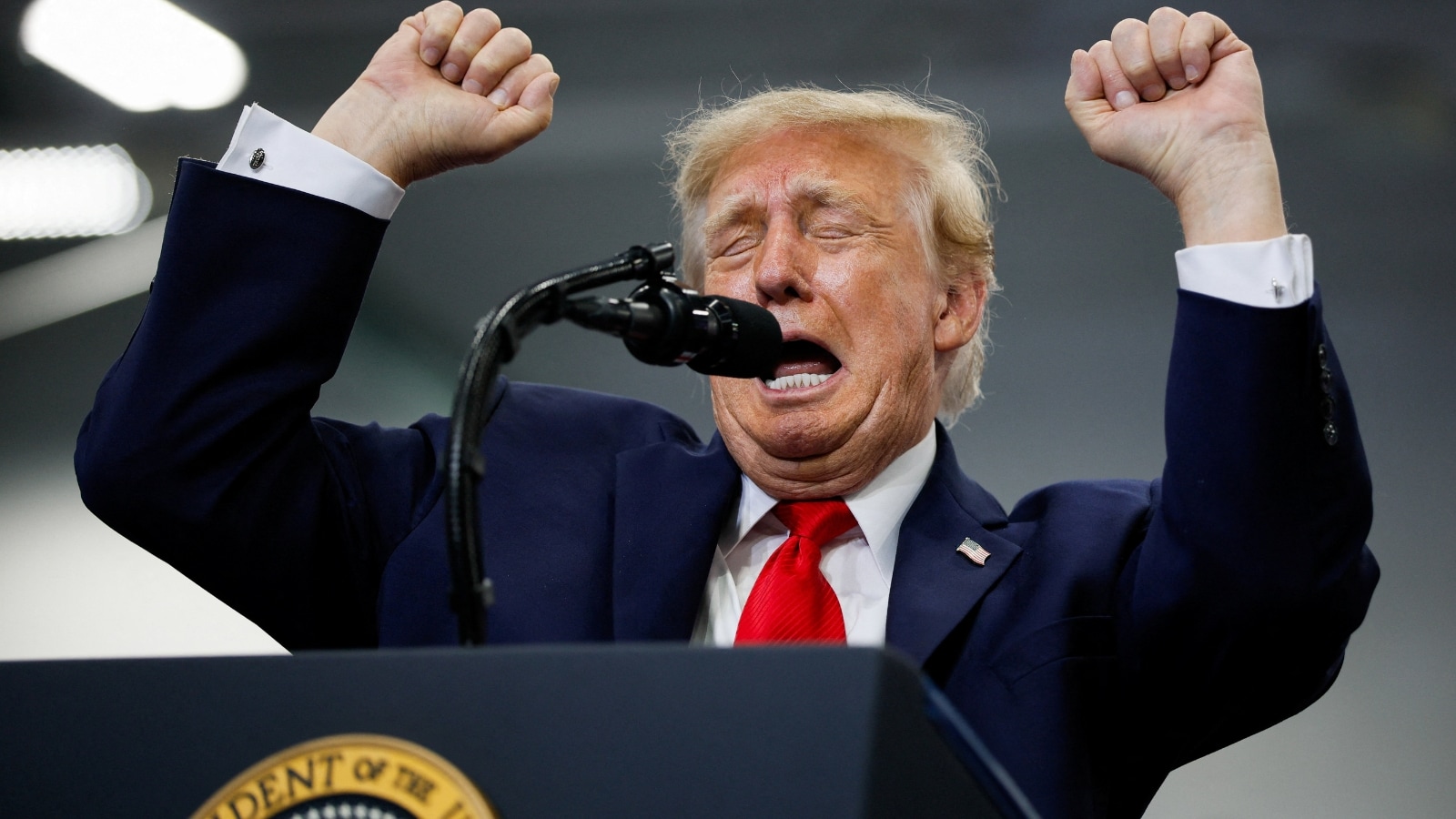
Everybody is laughing at the headline. Donald Trump floating the idea of banning the term "artificial intelligence" sounds like peak political theater, a linguistic distraction designed to hijack a news cycle while the real regulatory battles happen behind closed doors. The tech press is already running victory laps, mocking the notion that a government can simply outlaw two words that have defined the last four years of global capital allocation.
They are missing the entire point. In other updates, we also covered: The Ninety-Six Bags We Left Behind on the Moon.
While pundits treat this as an absurd attack on innovation, anyone who has spent time inside enterprise software procurement or venture capital boardrooms knows a dirty secret. "Artificial intelligence" is the single most dishonest, bloated, and financially destructive buzzword in modern corporate history. If Washington actually forced companies to stop hiding behind those two syllables, half of Silicon Valley's current valuation would evaporate overnight—and the companies actually building real, functional technology would finally get the oxygen they deserve.
The Lazy Consensus on Tech Semantics
The mainstream reaction to any political threat against AI terminology follows a predictable script. Journalists quote policy wonks who explain that you cannot regulate vocabulary without running straight into the First Amendment. They argue that "artificial intelligence" is a standard scientific classification dating back to the 1956 Dartmouth Conference, coined by John McCarthy to describe machines performing tasks that typically require human intelligence. MIT Technology Review has also covered this fascinating topic in extensive detail.
That historical trivia is accurate. It is also completely irrelevant to how the phrase functions today.
In 1956, "artificial intelligence" was an aspirational academic umbrella. Today, it is a corporate smokescreen. When a software vendor slaps "AI-powered" onto a basic linear regression model or a glorified if-then script, they aren't honoring John McCarthy. They are executing a pricing strategy. They are justifying a 40% markup on a SaaS renewal by convincing a non-technical Chief Information Officer that their database now possesses a digital brain.
I have sat in countless enterprise software pitches over the last three years where vendors burned millions in marketing budgets rebranding decade-old automation tools as "generative agents." In one instance, a mid-market logistics firm spent $1.8 million on an "AI routing engine" that turned out to be a standard Dijkstra’s shortest-path algorithm wrapped in a sleek chat interface. The code hadn't changed since 2014. The marketing deck had.
When politicians threaten to strip away the label, they aren't attacking computer science. They are threatening the greatest rebranding grift since the dot-com bubble.
What We Actually Mean When We Say AI
To understand why banning the phrase—or at least restricting its commercial use—would trigger a massive market correction, you have to separate the engineering reality from the boardroom fiction.
There is no single technology called "artificial intelligence." There is a hierarchy of distinct mathematical and computational disciplines, each with vastly different capabilities, costs, and failure modes:
- Machine Learning (ML): Algorithms that parse data, learn from that data, and make informed decisions based on what they have learned. Think spam filters, credit card fraud detection, and Netflix recommendations. It is statistical pattern matching at scale.
- Deep Learning: A subset of machine learning that structures algorithms in layers to create an artificial neural network capable of learning and making intelligent decisions on its own. This powers image recognition and voice transcription.
- Large Language Models (LLMs): Deep learning models trained on massive text corpora to predict the next most probable token in a sequence. They are extraordinary statistical parrots, capable of synthesizing human-like prose, writing boilerplate code, and summarizing documents.
- Artificial General Intelligence (AGI): A theoretical machine capable of understanding, learning, and applying knowledge across any intellectual task that a human being can perform. It does not exist.
Notice what happens when you force a vendor to use the precise term instead of the umbrella buzzword.
If a startup pitches a venture capitalist on "an AI platform that revolutionizes customer support," checks get written. If that same founder has to pitch "a probabilistic next-token predictor fine-tuned on your Zendesk tickets that hallucinates 4% of the time," the valuation drops by an order of magnitude.
The phrase "artificial intelligence" deliberately blurs the line between probabilistic math and actual human cognition. It tricks buyers, investors, and voters into believing that software thinks, understands, and reasons. As computer scientist Yann LeCun—Chief AI Scientist at Meta and a Turing Award winner—has repeatedly pointed out, current autoregressive LLMs do not possess true reasoning, planning, or persistent memory. They do not understand the physical world. Yet the industry insists on calling them "intelligence" because intelligence sounds autonomous, infallible, and worth a premium.
Can You Actually Ban a Phrase in the United States?
Let’s address the obvious legal reality before the constitutional scholars start hyperventilating. No president can sign an executive order making it a crime for a citizen or a journalist to utter the words "artificial intelligence." The First Amendment protects speech, including corporate puffery and terrible tech journalism.
Anyone claiming Trump is literally going to send federal agents to arrest programmers for saying "AI" is peddling clickbait.
However, the federal government holds massive, unchallenged power over commercial labeling, federal procurement, and deceptive trade practices. This is where the contrarian reality lives.
The Federal Trade Commission (FTC) already polices deceptive marketing under Section 5 of the FTC Act. You cannot legally sell a bottle of tap water and label it "organic spring water." You cannot sell a synthetic blend and call it "100% cashmere." The Food and Drug Administration (FDA) strictly regulates what can be called "milk," "chocolate," or "clinically proven."
Why? Because consumers and businesses cannot make rational economic decisions when labels obscure the underlying product.
Imagine a scenario where the federal government applies that exact same consumer-protection logic to software procurement and commercial advertising. Suppose the General Services Administration (GSA)—which manages tens of billions of dollars in federal IT contracts—bars vendors from using the term "artificial intelligence" in federal bids, requiring them instead to specify the exact computational method: statistical regression, convolutional neural network, retrieval-augmented generation, or deterministic rule engine.
Suddenly, the magic vanishes. Government agencies stop overpaying for vaporware. And because enterprise software companies build one product line for both government and private-sector clients, that enforced precision immediately bleeds into the Fortune 500.
The AI Washing Epidemic
We already have a name for the corporate abuse of this terminology: AI washing.
In 2024, the Securities and Exchange Commission (SEC) began cracking down on investment advisers who made false and misleading statements about their use of artificial intelligence. Firms like Delphia and Global Predictions paid hundreds of thousands of dollars in penalties because they claimed to use proprietary machine learning to predict market movements when, in reality, they had no such capabilities.
That was just the tip of the iceberg.
Across every major industry—healthcare, finance, human resources, cybersecurity—companies are hiding behind the mystique of AI to dodge accountability.
- When an algorithm denies a mortgage: The bank claims "the AI model flagged a risk profile," obscuring the fact that a poorly weighted logistic regression model penalized an applicant based on zip code proxies.
- When a hiring tool filters out qualified veterans: The HR vendor blames "machine intelligence," avoiding scrutiny over a keyword-matching script that failed to translate military occupational specialties into corporate jargon.
- When a medical triage system misprioritizes patients: The hospital system points to "clinical AI," masking a brittle decision tree trained on skewed insurance billing data rather than actual patient outcomes.
By anthropomorphizing software as "intelligent," corporations successfully launder their own negligence. People are psychologically conditioned to defer to "intelligence" in ways they would never defer to "statistics." If a doctor tells you a statistical regression model has a 15% error rate, you ask for a second opinion. If they tell you an "artificial intelligence" diagnosed you, you accept the verdict.
Stripping the word "intelligence" out of commercial software removes that psychological shield. It forces companies to own their math.
The Counter-Intuitive Risk of Linguistic Precision
Now, let’s be brutally honest about the downside of blowing up the AI label. If you force the market to abandon the term, you don't just pop a marketing bubble—you create massive friction in capital formation and talent recruitment.
The tech ecosystem runs on narrative velocity. Venture capital does not fund incremental improvements in statistical modeling; it funds world-altering transformations. When Andreessen Horowitz or Sequoia Capital raises a multi-billion-dollar fund, limited partners—pension funds, university endowments, sovereign wealth funds—commit that capital because they believe they are buying a stake in the next industrial revolution.
If you replace the sweeping narrative of "artificial intelligence" with dry, granular engineering classifications, several things happen immediately:
- The Valuation Haircut: Public equities tied to the AI trade—chipmakers, hyperscale cloud providers, and enterprise SaaS—would face an immediate multiple compression. Investors pay 40x forward earnings for "intelligence." They pay 12x earnings for "database optimization and text summarization."
- The Talent Drain: Elite researchers from Stanford, MIT, and Carnegie Mellon do not move across the country and work 80-hour weeks to build "automated linear algebra pipelines." They do it because they believe they are building artificial intelligence. Language shapes ambition. Kill the grand narrative, and you slow down the sheer human obsession that drives genuine breakthroughs.
- Geopolitical Disadvantage: While Washington debates semantic purity, Beijing does not care about marketing accuracy. China’s state-backed tech champions will happily use whatever terminology attracts global talent and state subsidies while aggressively deploying computer vision, autonomous drones, and large-scale neural networks across their industrial base.
This is the core tension nobody in the political commentary class wants to touch. The term "artificial intelligence" is simultaneously a massive commercial lie and the primary psychological fuel powering the largest infrastructure buildout in human history.
Stop Asking If It’s Legal and Start Asking Who Profits
When people search for news about Trump banning the term "artificial intelligence," they usually ask the wrong questions. They ask, "Can a president ban a word?" or "Does Trump understand how AI works?"
Those questions are traps designed to keep you distracted by political tribalism.
The real question every business leader, investor, and technologist should be asking is: What happens to my business model if my customers stop believing in magic?
If you are building a company whose primary value proposition relies on the mystery of "AI," you are living on borrowed time. Whether a politician forces a terminology shift or the market naturally sobers up after burning hundreds of billions of dollars on unmonetized GPU clusters, the reckoning is identical.
Look at the numbers. Right now, tech giants are pouring hundreds of billions of dollars into data centers, custom silicon, and power generation capacity. Meanwhile, actual enterprise revenue generated directly from generative models remains a fraction of that capital expenditure. Sequoia Capital partner David Cahn famously dubbed this discrepancy "AI’s $600B Question"—the massive gap between the implied revenue expectations of the hardware infrastructure being built and the actual end-user software revenue being generated.
You cannot bridge a $600 billion revenue gap with buzzwords. Eventually, Chief Financial Officers demand to see hard return on investment. When they look under the hood and realize they are paying "intelligence" prices for basic text autocomplete, the budget cuts will be merciless.
How to Survive the End of the Buzzword Era
Whether Washington ever touches a single regulation regarding AI terminology, smart operators should behave as if the phrase was banned yesterday. Here is how you insulate your work, your investments, and your company from the inevitable linguistic collapse:
- Audit Your Vendor Stack Immediately: Call every software vendor currently charging you an "AI tier" or "Copilot add-on." Demand a technical architecture diagram showing exactly what model is running, whether your data is actually fine-tuning weights or simply being stuffed into a standard prompt context window, and what the deterministic accuracy rate is. If they cannot explain it without using the word "intelligence," cancel the renewal.
- Ban the Acronym in Internal Pitch Decks: If you run a product team or a startup, forbid your engineers and product managers from using "AI" in internal product requirement documents. Force them to state the exact mechanism: "We are using a vector database for semantic search" or "We are deploying a gradient-boosted decision tree to predict churn." Precision exposes weak ideas before you waste six months coding them.
- Price on Outcomes, Not Compute: The quickest way to spot a grifter is by how they charge. Companies selling real utility price their product based on the measurable business outcome—hours saved, tickets resolved without human escalation, fraud prevented. Companies selling buzzwords charge per "AI seat" or per token generated, shifting the financial risk of hallucination and failure entirely onto the buyer.
- Bet on the Plumbing, Not the Poetry: In every technological gold rush, the people selling the narrative eventually get wiped out, while the people selling the physical constraints get rich. Focus on the unglamorous bottlenecks: high-voltage transformers, grid interconnects, liquid cooling systems, memory bandwidth, and proprietary, clean datasets that cannot be scraped from the open web.
The political circus will move on to a new headline by Tuesday. The pundits will go back to arguing over whether machines are going to achieve consciousness or destroy humanity.
Let them argue. Meanwhile, take a red pen to your contracts, strip the buzzwords out of your vocabulary, and start demanding proof that the math actually works.


