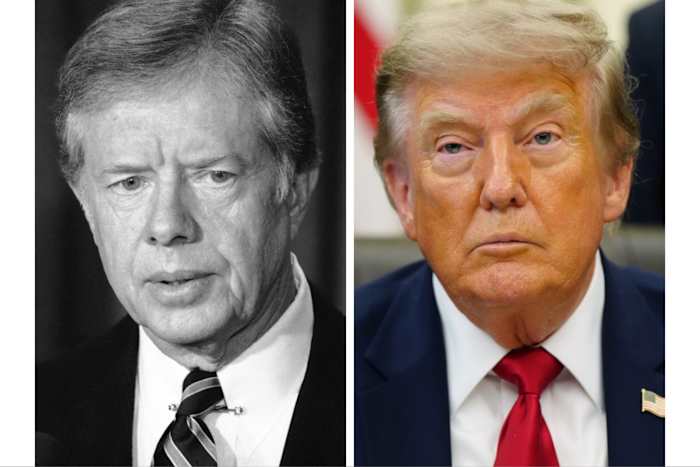
Donald Trump spent years using Jimmy Carter as a political punching bag. During the 2024 campaign trail, it was a guaranteed applause line. He would tell roaring crowds that Joe Biden was so incompetent he made Carter look like a absolute genius. It was an easy, effective way to evoke a bygone era of gas lines, rampant inflation, and humiliating foreign crises.
Things look very different from the Oval Office in 2026. Read more on a similar subject: this related article.
With the United States and Israel deeply mired in a grinding war against Iran, global energy markets are in freefall. The Strait of Hormuz is choked off. Oil prices are spiking. Domestically, consumer prices hit a painful three-year high of 4.2% this past May. Suddenly, the historical ghosts of 1979 aren't just ancient history. They look like a mirror.
This brutal reality explains why Trump has undergone a dramatic, quiet rhetorical shift toward the late 39th president. He isn't just mocking Carter anymore. He's studying him. He's trying to avoid his fate. Further journalism by Reuters highlights related perspectives on this issue.
The Haunting of the Strait of Hormuz
You can't understand Trump's sudden shift without looking at the map of the Persian Gulf. When the US-led military campaign against Iran kicked off in February, the initial promise was quick, decisive action. Instead, Tehran responded by aggressively choking shipping traffic through the world's most critical energy chokepoint.
History repeats itself in waves. In 1980, Carter stood before Congress and issued the Carter Doctrine, declaring that any attempt by an outside force to gain control of the Persian Gulf region would be regarded as an assault on the vital interests of the United States. He even weighed military options to seize Kharg Island to protect the global oil supply but backed down to protect American hostages.
Trump didn't hesitate where Carter did. Early in this conflict, American airstrikes targeted Kharg Island to crush Iranian oil exports. Yet, months into this campaign, the waterway remains functionally blocked. The administration recently had to reimpose a strict naval blockade on Iranian ports, even resorting to disabling commercial tankers trying to run the gauntlet.
It's a terrifying test of wills. Iran's Revolutionary Guard has explicitly threatened that energy exports from the Middle East will be for everyone or for no one. That sort of hardline defiance creates a massive headache for an American administration that promised an easy victory. Trump recently admitted to reporters that he passed on a high-stakes special operations raid to capture Iran’s enriched uranium stockpile for one specific reason. He didn't want to have a Jimmy Carter moment, directly referencing the tragic 1980 Desert One helicopter crash that sealed Carter's political doom.
The Inflation Monster Returns
High-altitude foreign policy crises are bad enough, but they become politically fatal when they hit the local gas pump. This is where the Carter parallels get truly uncomfortable for the current administration.
The short-lived June ceasefire briefly brought gas prices down, offering some temporary political breathing room. But that fragile deal is now completely in tatters. With the resumption of daytime airstrikes hitting Iranian infrastructure, power grids, and transit bridges in southern provinces like Hormozgan, energy markets are panicking again.
Consider the raw economic numbers:
- Peak Carter Inflation: 14.7% in April 1980.
- Current US Inflation: Hit a three-year high of 4.2% this spring.
- Iranian Economic Collapse: Projected to hit 70% inflation this year due to the naval blockade.
While a 4.2% inflation rate is nowhere near the double-digit misery of the late seventies, the psychological impact on voters is identical. People are tired of paying more for basics. The administration long insisted that a businessman's touch would permanently tame the inflation monster. Instead, the war has dragged out the economic pain.
Behind closed doors, Trump is hyper-aware that Carter’s undoing wasn't just the embassy seizure in Tehran. It was the fact that regular Americans couldn't afford to fill up their tanks while the crisis dragged on. He has openly remarked that he agreed to the brief June truce specifically to avoid the kind of total economic catastrophe that destroyed Herbert Hoover, but the ghost he's really running from is Carter.
A White House Walk of Fame
The shift isn't just visible in raw policy decisions. It's showing up in the physical space of the White House.
In a move that surprised both his critics and his allies, Trump recently installed a presidential Walk of Fame along the White House Colonnade. While the displays dedicated to recent Democrats like Barack Obama are filled with sharp, biting criticisms, the section for Jimmy Carter is remarkably respectful. It lists his actual legislative achievements and foreign policy efforts, treating him with a historical dignity that Trump rarely grants his political opponents.
This isn't sudden altruism. It's legacy management.
Trump is facing an uphill battle heading into the critical November midterm elections. The public is weary of an open-ended conflict in Asia that has already cost the lives of 14 US service members and wounded over 400 more. By quietly rehabilitating Carter's image, Trump is attempting to reframe his own struggle. If Carter was an honorable man caught in an impossible geopolitical vice, then perhaps Trump’s current struggles with Iran are simply the price of projected strength, rather than a failure of strategy.
The Glaring Differences Trump Can't Escape
Despite the overlapping geopolitical challenges, comparing these two men only goes so far. Their fundamental approaches to governance, personal morality, and communication are light-years apart.
Carter famously placed his family's Georgia peanut farm into a strict blind trust to avoid even the hint of a conflict of interest. He gave regular fireside chats urging Americans to conserve energy and face hard truths. He was a deeply religious man who promised he would never lie to the public.
Trump operates on a completely different blueprint. He openly boasts about his financial successes, including the massive revenues generated by his various digital assets and commercial properties while in office. When faced with bad news from the front lines or rising consumer prices, his instinct isn't to ask for public sacrifice. It's to double down on claims of total victory, insisting that the military is winning big and that the fruits of that labor will arrive shortly.
Foreign policy experts point out that this stylistic difference changes the stakes entirely. Carter refrained from full-scale war because he feared the unpredictable escalation of a Middle Eastern conflict. Trump dove right in, betting that overwhelming military pressure would force a quick regime collapse in Tehran. Now that Iran has dug in for a protracted war of attrition, the administration is stuck trying to navigate a conflict that Carter successfully avoided starting, even during 444 days of national humiliation.
Navigating the Midterm Minefield
The clock is ticking down to November, and Iran knows it. Geopolitical analysts widely believe that Tehran is intentionally prolonging the conflict and enduring immense economic pain specifically to hurt the administration's chances at the polls. They understand American political vulnerability. They know that high prices at home create chaos for the party in power.
For anyone trying to make sense of the current political climate, the lesson is clear. Stop looking at modern political playbooks and start reading the history of the late 1970s. The administration is actively trying to rewrite the ending to a script we've all seen before.
Pay close attention to the rhetoric coming out of the White House over the next few weeks. Watch how the administration handles the Strait of Hormuz blockade and whether they pivot toward another temporary truce or escalate the bombing campaign. The ghost of 1980 is driving every single decision.