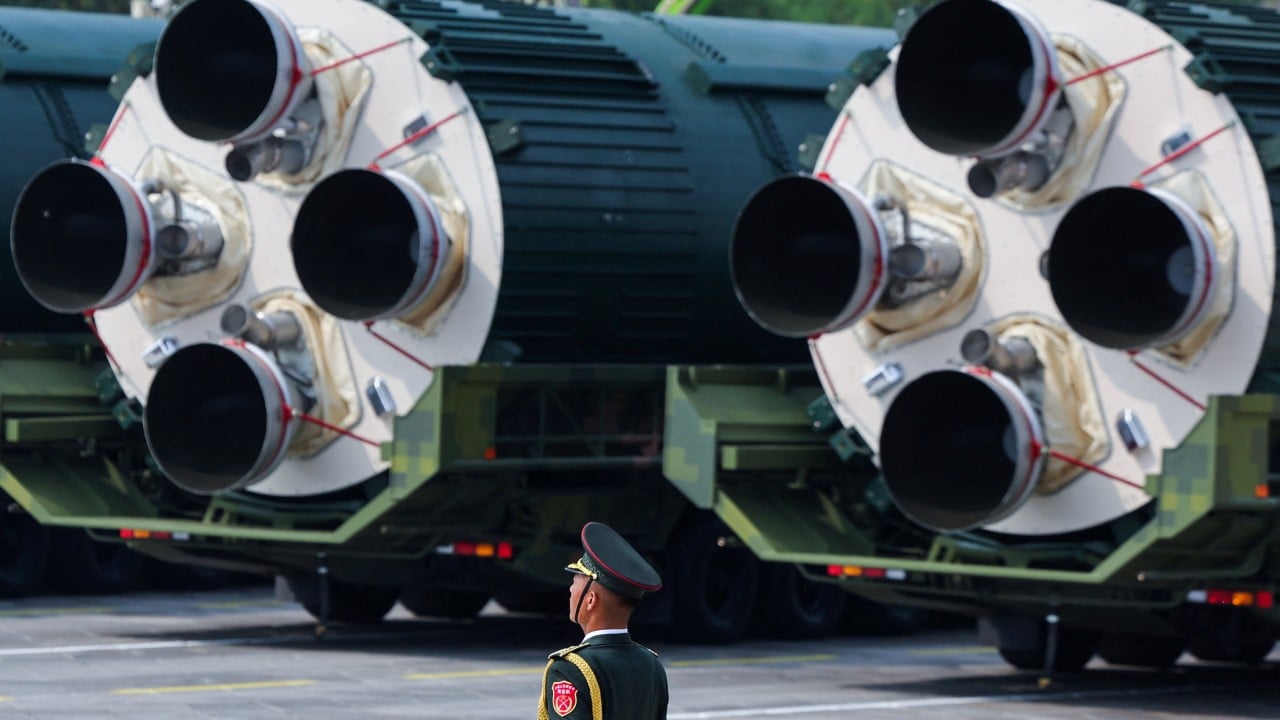
The traditional architecture of global security is crumbling because the math no longer works. For fifty years, nuclear stability rested on a simple, binary scale between Washington and Moscow. That era is over. As China aggressively expands its silo fields and diversifies its delivery systems, the United States is facing a strategic nightmare that cannot be solved by talking to the Kremlin alone.
Recent calls from Capitol Hill emphasize a harsh reality. The United States is drifting toward a three-way arms race where the old rules of engagement are not just obsolete—they are dangerous. China is on track to field roughly 1,500 nuclear warheads by 2035. This is not a slow-burn modernization. It is a sprint. Without Beijing at the negotiating table, any future treaty between the U.S. and Russia is effectively a suicide pact for American strategic interests.
The Mirage of Minimal Deterrence
For decades, Beijing maintained a "minimal deterrence" posture. They kept a small, survivable force designed only to strike back if hit first. That narrative has been discarded. Satellite imagery now confirms the construction of hundreds of new intercontinental ballistic missile (ICBM) silos in the deserts of western China.
This shift changes the calculus for every diplomat in Washington. If the U.S. remains capped by the limits of the New START treaty while China doubles its arsenal, the Americans will eventually face two peer-level nuclear rivals simultaneously. The Pentagon is not currently built for that. Military planners are now forced to ask a question they haven't touched since the Cold War. Can the U.S. deter two nuclear-armed superpowers at once?
The math is brutal. If the U.S. keeps its deployed warheads at 1,550 to satisfy a deal with Russia, it leaves itself vulnerable to a combined or even a separate threat from a rising China. This is why the push to involve Beijing in arms control isn't just a political talking point. It is a structural necessity for survival.
Beijing’s Shield of Silence
China’s current strategy is simple. They refuse to talk. They argue that their arsenal is still a fraction of the size of the U.S. or Russian stockpiles. From their perspective, joining arms control talks now would only serve to lock them into a position of permanent inferiority.
They want parity first.
By staying away from the table, Beijing buys time to finish its expansion. They are developing "triad" capabilities—land-based missiles, sub-launched weapons, and strategic bombers—mimicking the American and Russian models. They are also investing heavily in hypersonic glide vehicles. These weapons travel at speeds exceeding Mach 5 and maneuver in ways that current missile defense systems cannot reliably track.
When a weapon moves that fast, the "decision window" for a president shrinks from thirty minutes to perhaps five. Silence during this technological leap is a tactical choice. If you don't have to report your numbers or allow inspectors to visit your sites, you keep the world guessing. Uncertainty is a form of power.
The Russian Complication
Moscow is watching this with a mixture of opportunism and quiet dread. While Russia and China often project a united front against Western influence, the Kremlin is not exactly thrilled about a nuclear-armed giant on its southern border. However, Vladimir Putin has found that China’s absence from treaties serves his interests.
Russia can use China’s buildup as an excuse to demand more concessions from the U.S. They argue that if the U.S. wants to limit Russian nukes, Washington must also account for the nuclear capabilities of NATO allies like France and the United Kingdom. It is a shell game of logic designed to keep the U.S. off balance.
We are witnessing the death of the "bilateral" mindset. Treaties like the INF (Intermediate-Range Nuclear Forces Treaty) fell apart because they didn't account for the thousands of missiles China was building while the U.S. and Russia were barred from doing so. Continuing to ignore the third player in the room is a recipe for a catastrophic miscalculation.
The High Cost of Transparency
If the U.S. manages to drag China to the table, what does a deal even look like? Traditional arms control relies on verification. This means "boots on the ground" inspectors looking at missile canisters and counting warheads.
Beijing views this as espionage.
The Chinese Communist Party treats its nuclear locations as the ultimate state secret. Allowing American inspectors to roam through Gansu or Xinjiang is a non-starter for the current leadership. This creates a deadlock. The U.S. cannot trust a treaty it cannot verify, and China will not allow verification that it believes undermines its security.
Breaking the Deadlock with Emerging Tech
There is a small chance that technology provides a way out where diplomacy fails. Commercial satellite imagery is becoming so precise that "national technical means" can now do much of the heavy lifting that used to require physical inspections.
- Artificial Intelligence can analyze terrain changes in real-time to spot new construction.
- Open-source intelligence (OSINT) communities are now tracking mobile launchers via social media and commercial sensors.
- Remote sensing can detect the specific heat signatures of nuclear facility operations.
Relying on these tools might allow for a "thin" treaty—one that focuses on behavior and notifications rather than hard caps on warhead numbers. It’s a compromise that nobody likes, but it’s better than a blind race toward oblivion.
The Risks of a Failed Dialogue
If the status quo holds, the U.S. will likely be forced to expand its own arsenal. This triggers a "security dilemma." When one country builds more weapons to feel safe, its neighbors feel less safe and build their own. The cycle repeats until the world is bristling with hair-trigger systems.
The most immediate danger is not a planned war, but an accidental one. With three players in the game, the risk of a false alarm increases exponentially. During the Cold War, a glitch in a Soviet computer almost started a nuclear exchange. We survived that because there were only two sides to call and clarify. In a three-way standoff, who do you call when the radar shows an incoming strike? If a missile is launched from the Pacific, is it Chinese or Russian?
A lack of communication channels—what diplomats call "hotlines"—means that a technical error could lead to a global exchange before anyone realizes what happened.
Economic Warfare by Other Means
We must also recognize that an arms race is an economic strategy. During the 1980s, the U.S. used the "Star Wars" program to outspend the Soviet Union, eventually contributing to its collapse. Some in Washington believe the same can be done to China.
This is a dangerous gamble. China’s economy is deeply integrated into the global market in a way the Soviet Union’s never was. An arms race that bankrupts or destabilizes China would ripple through every corner of the American economy. You cannot decouple a nuclear standoff from the supply chains that provide your medicine, your steel, and your electronics.
The financial burden of modernizing the U.S. nuclear triad is already estimated to be over $1.2 trillion over the next thirty years. Adding a "China-plus" requirement to that budget will force hard choices between nuclear silos and conventional forces—or domestic programs.
The Strategy of Tangible Steps
Rather than demanding a comprehensive treaty on day one, the U.S. should push for "risk reduction" measures. These are small, boring, and vital.
- Launch Notifications: Agreeing to tell each other when a test missile is fired so it isn't mistaken for an attack.
- Space Debris Mitigation: Ensuring that anti-satellite tests don't blind the very sensors needed to prevent nuclear war.
- Crisis Management Links: Establishing dedicated fiber-optic lines between military command centers.
These aren't "wins" for a politician’s legacy, but they are the guardrails that prevent a localized conflict in the South China Sea from escalating into a global funeral pyre.
The Reality of Power
China is no longer a "developing" nuclear power. They are a peer. Treating them as a secondary concern in arms talks is a relic of 20th-century thinking that has no place in current strategic planning. The pressure from the Senate reflects a growing consensus that the "Russia-first" era of diplomacy is dead.
If Washington cannot find a way to make Beijing see the benefit of restraint, the world is headed back to the 1950s—a time of duck-and-cover drills and the constant shadow of the mushroom cloud. The difference is that this time, the buttons are faster, the missiles are smarter, and there are more fingers on the triggers.
National security today requires more than just a strong military. It requires the courage to force a seat at the table for a rival who doesn't want to be there. Without that seat, we are all just spectators at a countdown that has already begun. The era of the "big two" is over; the era of the "unstable three" has arrived.
The U.S. must now decide if it is willing to expand its arsenal to match two rivals or if it can find the diplomatic leverage to convince China that its own security is better served by transparency than by a hidden stockpile. Every day without a framework for three-way talks is a day the margin for error shrinks.
The silos are opening. The clocks are ticking. Silence is no longer a strategy; it is a fuse.


:strip_icc()/pic2513216.jpg)